Xeriscaping: Gardening with native plants, gardening for wildlife, gardening for restoration

The xeriscape planting process is easy. This next part of the discussion is bundled into a huge knot. I don’t know if I will be able to explain it well and loosen some of the tied up tension. Perhaps better to stay clear to avoid metaphorically pinching a nerve or falling into a ditch or getting hit on the head. But like my friend Joey tells me, when in doubt, paddle out. So here we go.
So theres a shift. Rather than imposing our garden style on nature, we are going to listen to her, and go with the flow. If theres a lot of water, use it. If theres not so much, conserve it. Common sense. But what if the king, who controls all the water, says “I don’t care, all the water for me, y’all get the left overs”. “Y’all” meaning poor people, salmon people, wildflower people, and rainbow people. Then you say, “Hey that is talking about morals and politics and class, like stratified class, not a college xeriscape class, we didn’t come to discuss stuff like this. That is for sociology or political science or religious studies or law school” Okay, skip it then. Stick to the curriculum.
Back to the shift. For many years nobody cared about growing California native plants. They were not used in landscaping. If there was mountains and valleys full of the stuff, why would you plant it in the garden? It is like – do you go to a zoo to see a raccoon and a pigeon, or to see a tiger and an elephant? Are the natives even showy? No! What you wanted was an exotic orchid or a huge gorgeous rose or the latest hybrid everyone is gushing over, not some hard scrabble drought tolerant ugly thing weird looking thing that come out of the universe’s twisted imagination. Beauty was defined by the old folks from the east, from across the seas, not embodied or dreamt up or personified in the landscape around you.
Then the natives caught on like a fuse of gunpowder about fifteen twenty years ago. In every public space that the landscape architect planned – natives. In every new installation or design magazine – natives. It became the new hip thing. It didn’t matter if the plant did not fit in the site, it was ‘native’! Like so happens in the this-or-that sphere of public affairs, native became synonymous with good. So if you were a righteous kind loving person, you better go ‘native’.
Some of you probably don’t even know what a native plant is. Well that is a made up term for plants that have been here in California since around year 1540, or longer. Plants that have been around for the past ten thousand years or so plus or minus. Plants that were present before the Spaniards and Russians and French and English and Irish and German settlers came and displaced the Miwok and the Chumash and the Achowami and the Pomo and the Modoc and then opened the gates to the Lao and the Japanese and Yugoslavs and Hindus and Nicoyas and anybody else from around the world. The Mexicans, well they have been here all along; perhaps they were called Kumeyaay or Kiliwa way long ago… Thus, there are these native plants that have persisted, and there are introduced plants. Introduced plants that came as seed on ships and in shirt pockets, in the guts of sheep and stowed away in bales of hay. They were brought here by immigrant settlers travelers for animal food, for human crops, for gardens, and so on. If you don’t go hiking around to natural places, if you are mostly a town dweller, then most of the plants you have met are probably non-natives. So theres natives and non natives – if you want to divide them and make it clean cut, easy to label. Its actually a really mixed up matrix already, and bound to mix more, not less. In the continuum of time, they are all just plants.
To stay on track – you can plan and design a xeriscape garden, but once it is in the ground, you do not get to control it, nor do you really want to. If you took your measurements correctly, the tailored suit should fit just fine. Same with the landscape, if you were careful with observations and made the right selections, the plants ought to ‘perform’ as indicated. And over time, nature she will play with the patterns and make it her own. Then you will do adaptive maintenance. Its like a fun dance, not a war of wills. Plants may come in by themselves, plant that you elect to keep. Other plants that come in, you may decide to weed out because they tend to take over. A low maintenance xeriscape garden does not mean no maintenance. Take a heading, set a course, but be prepared for currents and swells. Again, same lesson. You want to listen to the land and plant accordingly. If you have an artificial culturally bound goal, (for example, I only want 100% native plants), you will be frustrated when it is not pure and then you will fall into the pit fall trap of fixed ideology (angry with fists clenched, ‘it has to look like this!”). The trap of viewing the garden through the dichotomous mind rather than perceiving it as it is (the sort of thinking that ruins the whole scene). Now you are like – “Hey this is not a philosophy class or some hippie dippie meditation martial arts class! Get on with it!”. Sorry, pass. Pass. Pass.
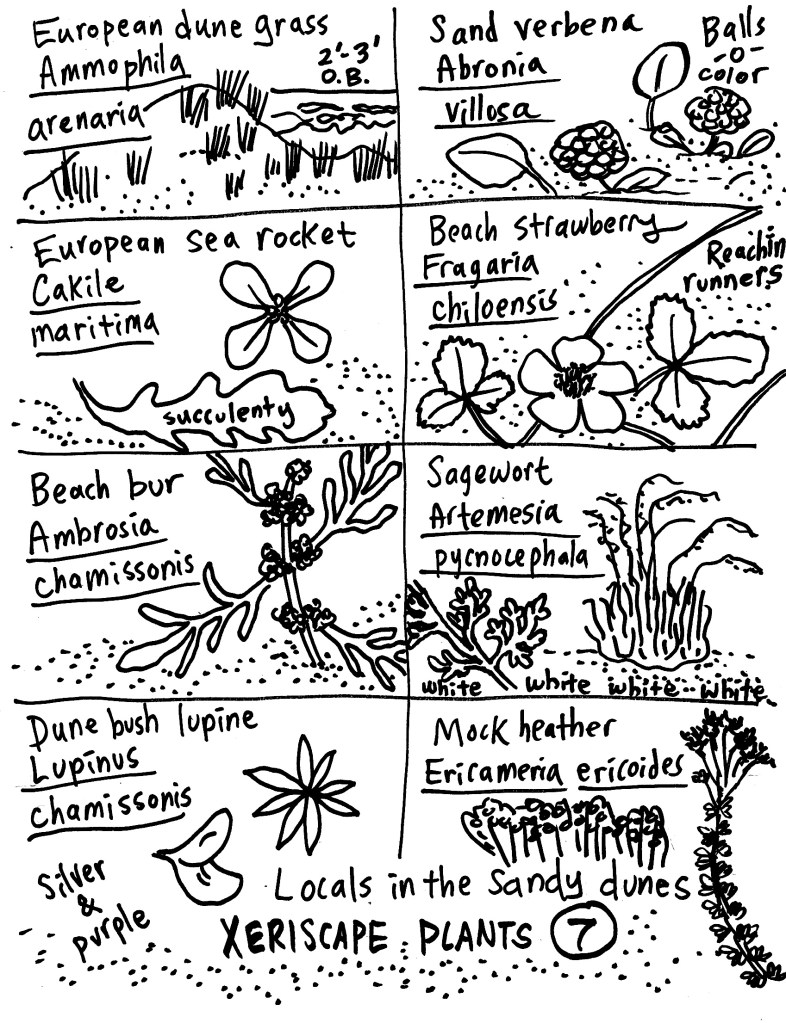
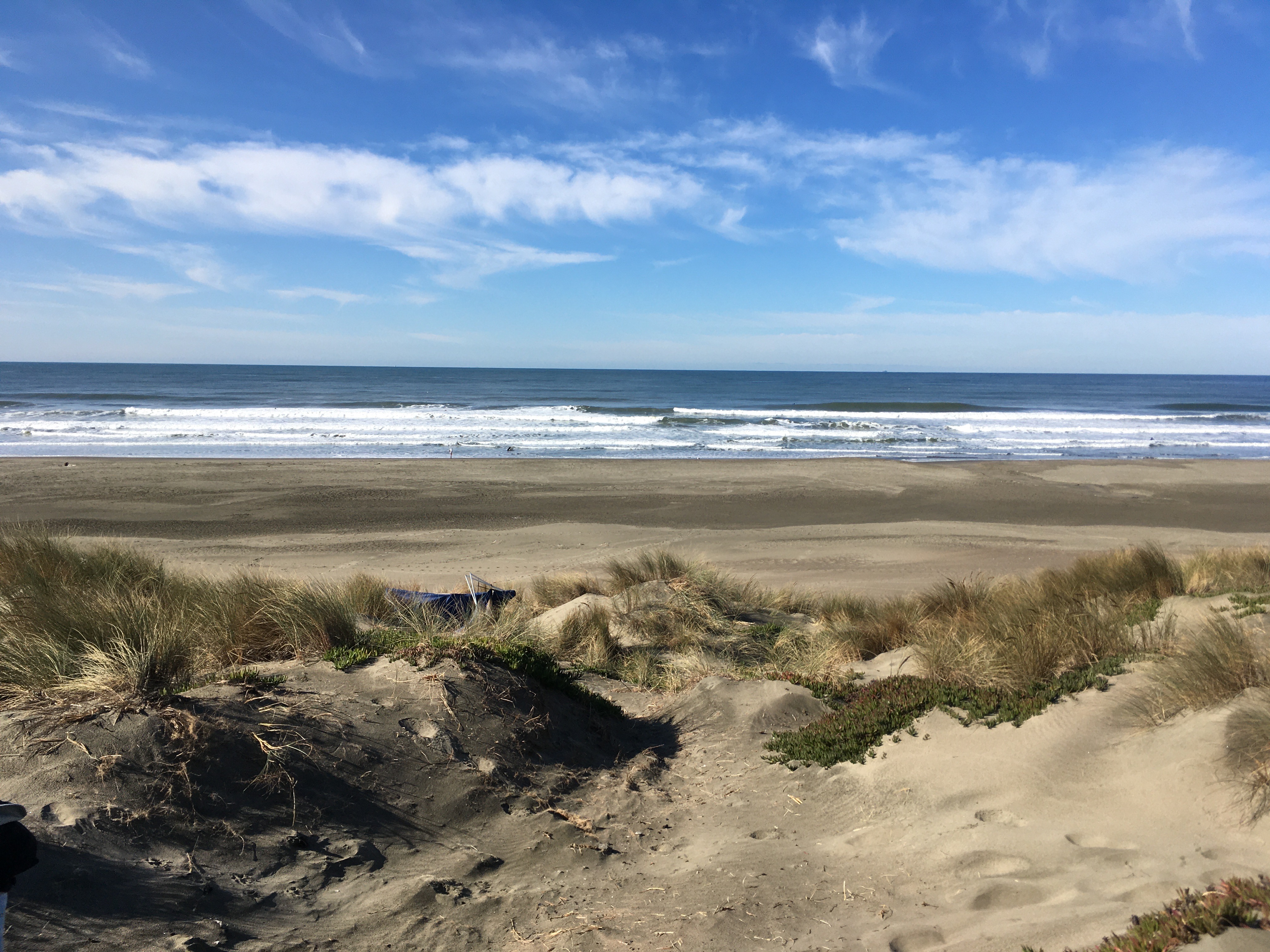
Many of the native populations have suffered. Again, we are talking about plants, not people. Plants. Some of them evolved in the clay riverine drainage flats of the central valley. As the soils were plowed and converted to large tracts of farm land, the plants either disappeared or shrunk and shrunk their range. In some hilly grasslands, cattle were let loose. If the cows were to munch a munch and move on, the plants could recover. But if the cows were fenced and walked back and forth, back and forth, then the carpets of annual flowers eventually caputted and faded away. Here in San Francisco, as the western dunes were developed to make way for people, the flora of the sands got bulldozed into oblivion. And with the flora went the insects that depended on them for food. Hence, the first couple of butterflies to go extinct in North America happened right here – a couple of dinky little blue butterflies by the names of Xerces and Pheres. Right here along Ocean Beach and the Sunset Richmond and Marina green neighborhoods.
Then what do we do? Cant go backwards, only forwards. For people distraught about all that has been lost and destroyed, the goal is restoration. Restoring native habitats. This is happening in the grassland prairies of the midwest, the wet soggy woods of the northwest, and the wetlands of the bay area. Restoring some of that diversity that once existed, re energizing some of that connection ancient peoples had with their land. This is a neat challenge that utilizes many of the same principles as xeriscaping – planting with the rains; fitting plants to the specific site according to water, light, soil; planting for desirable wildlife. Most important though, as far as restoration is concerned, this is about restoring the love that native peoples have for the earth. And by native I do not mean measurements of blood lineage or your ability to make a sinew bow string or your agility to ride a horse, I am talking about being part of a place and a community, of being grounded.
You know, native, in the best sense of the word. Not native like in native versus cosmopolitan, like you never left the street you were born on. Not native like in native versus educated and cultured. Like you are ignorant and without manners and don’t know anything about hygiene. Native meaning proud, protective, working with, and on behalf of, all the creatures big and small, young and old, healthy and infirmed.
I dont know about how and when you grew up, but it seems to me that much of this generation of children may be the first to grow up with absolutely no clue as to their relatives and kin in the natural world. The wild kin. Not the kind you have to pay to see, not the pestiferous ones always following us around, not the pets in the house. Wild kin that are independent, going about doing their own thing: goofing around, talking to their friends, raising their families. By no clue I mean that kids don’t know them alive, in person, hands on. These days, all those kin are either sitting dead in a glass case, jailed in an outdoor museum, verbally dissected on a screen, or so far away as to become mythic creatures. Yes there a few kids that gut fish, or shoot 22’s, or harvest tomatoes with their mom, or go picking apples in trees, or paddle a canoe, or make a fort in pine woods. It would be nice to see more. More kids actively engaged with the natural world.
If you are a kid who grows up without ever having damselflies land on your fingers, or butterflies flitting around your head, or hummingbirds zapping back and forth in your vision, what does that do to your imagination? Or your psyche? What kind of a sterile lonely place would a mind retreat to, when it is devoid of fellow sentiment majestic forms? If you had to count the monetary cost of such a transaction, would your calculator be able to hold all the zeros? Well, easy to get overwhelmed by the world’s drama, best to open the door out back. To the ranch and the farm and garden and the plants – to work. With a shovel a pick and a handful of seeds, and wait for the rains to come.
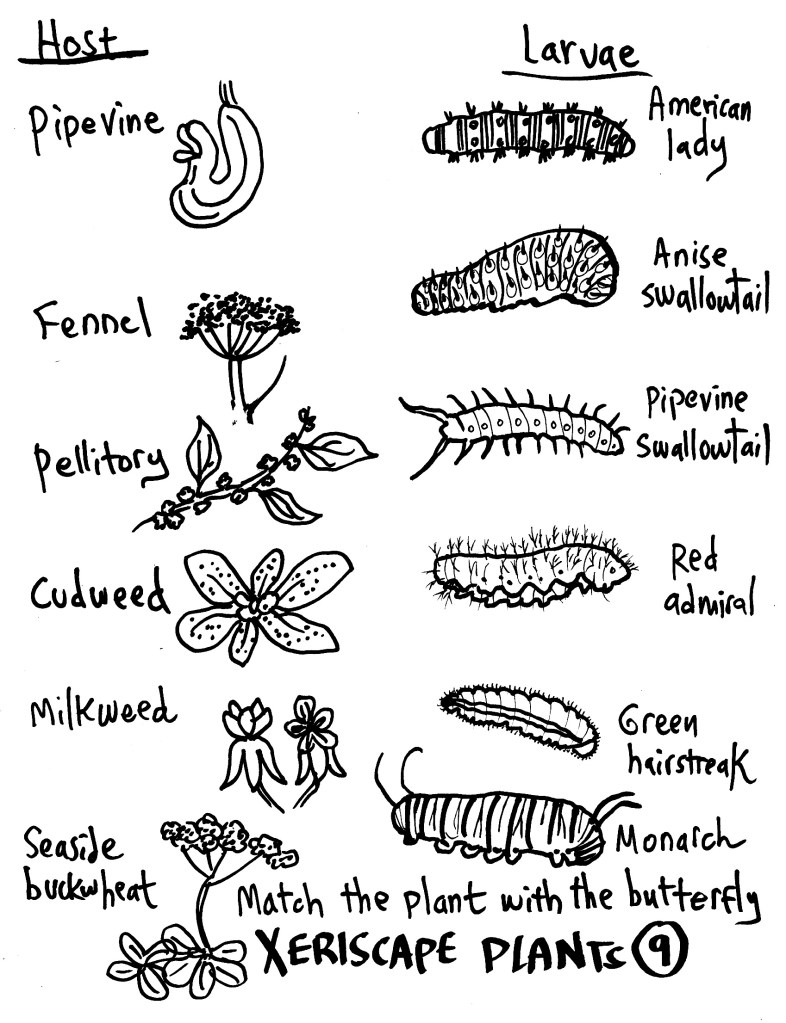
Alright, where’s the action? Well in the past years gardeners and academic entomologists have been working together towards the conservation of insects. You can help by planting native plants, planting forage and nectar plants, and planting caterpillar host plants. You can make trendy solitary bee homes or leave patches of open sands for them too. A UCB professor who specializes in bees, Gordon Frankie, has been hard at work alongside nurseries like Annies Annuals and curators like Dr Don Mahoney of the San Francisco Botanical Garden. These folks have been advocating for these beneficial creatures that help pollination and pest control. Dr Don gave us a tour of his garden, and discussed how he maintains his fantastic collection of plants. It is not xeriscaping per se, but it is close to gardening in a way that the natives would appreciate. Please watch his two part video here for specific tips and advice about habitat gardening:
As a gardener, you do have to come to terms with life and death. It is a part of all the interactions in the field. If you want to grow and protect the plants, you will have to help them against their foes. Doing nothing or letting nature takes its course just means that you are neglecting your duties. For example, with regards to gophers, you could use cultural measures to stop them, like the use of gopher baskets. But, time to time, you may have to trap them and kill them. Same thing with the weeds. Take care of them, you’re the gardener.
You are an active manager of the wildlife in the garden; one who is tasked with the balance and health of all the species. I will tell you right now that it is not an easy job, and real messy too, but necessary. There is a discomfort that comes with death. In the amazonian universe the hunters go into the rivers or under the earth in dream state to negotiate with the master of animals. Its a back and forth as a caretaker of the jungle and a taker of life. You realize that it is a reciprocal relationship to maintain the fecundity and abundance of all creatures. It must be approached with respect and gratitude, otherwise it will all go to poop. Whoops I think I strayed off topic again to mythology and anthropology or rainforest conservation or some other unrelated topic. Xeriscaping – it is about water, plants, the land, and life. Water is the ultimate connector and universal solvent and most and least common denominator. That is how it is all tied together.





 Mission Azul