Archives for category: Uncategorized

Introduction to xeriscaping

Dry land gardening

When you talk about the average rainfall per year, San Francisco and Oakland get around 25”, Los Angles around 15”, San Diego less than 12”, Cabo San Lucas in Baja Mexico gets around 9”. Then you start going inland to Death Valley and the desert and you come in at around 2” per year. In drought years it is less everywhere. During those times water starts getting rationed, folks paint their lawns green rather than water them, and all the feral pigs start dying off along with other wildlife. Even three hundred year old oaks and two hundred foot tall eucalyptus go brown.

As you go north in California, the average rainfall comes closer to the USA average of 38” per year. That is about what Santa Rosa and Sebastopol get. By the time you get up to Fort Bragg on the coast or Willits a little inland we are at about 50”, Humboldt about 55”. All that rain falls on the western parts up north. When you go inland towards the high obsidian peaks of Modoc County then we are back down to 14” or less, and 6 8 10 12” in the Great Basin deserts of Nevada.

So that’s nature, we can’t really control where the rain falls, and how many inches of rain and snow fall a year. But once it falls, culture takes over. Dams stop up rivers, make reservoirs, and control flooding. Water works, pipes and pumps can convey that water to farm land and cities. We can move water from water rich areas to water poor areas. Wells can bring the water deep down below the ground back up again for irrigation or consumption. We can treat that water, recycle that water, contaminate that water, waste that water. Use it as we please.

We do recognize that water is a precious resource, and that water is life. Plus, these days, it costs money. It is money. So we try not to be careless with the substance, and hope that everybody gets a share. People and wildlife alike. However, like any limited resource that varies from year to year, theres fightin’ and arguin’ that goes along with the territory.

When we discuss water issues, it gets messy and tied up with politics and morals and country lines and farmers and fishermen and plenty of emotions. Science, which is supposed to be factual and objective and fair, tends to sway and dance, or just throw up its hands and give up. Theres a reason why river riviere riparia rivus rival forms a continuous stream of words. We’ve been fighting about water and life for as long as people have been people.

You’d think that planting flowers and growing trees would somehow be harmonious and be above the fray. But it too is a culturally bound activity with trends, standards, and tight perspectives. So theres a few topics to explore as we ponder xeriscaping – the plants themselves, our attitudes towards them, and how to make our garden a happy place that works according to plan.

Plants evolved from, and are adapted to, the climates and soils of the world, whether that be the sticky humid southern heat of the bayou or the chilly limestone rock outcrop on a north facing slope. They grow best within a given comfort range. Therefore, in your garden, you try to grow the plants that are suitable for the given area. Some plants like more heat, some less. Some plants dont mind the salty coastal winds, while others prefer the calm protected valleys. So on and so forth; plants are like people, they got preferences. Yes you could grow a plant out of its natural zone, but usually you would have to supplement it with artificial means (extra lights, heat, protection). Or, you would have to accept the fact that the plant will not go about its natural life cycle; it will not give fruit, or it might not flower well. Its not happy, not gonna do its thing.

Every culture has got its own look and aesthetic. Of what is desirable and looked up to. And then within that culture, you’ve got a whole lot of variation too. Of course culture being culture, this standard is not fixed, but changes over time. Sometimes that change is enforced externally, whether by violent means or by mandates of the law. Other times it is something that happens within individuals or tribes because the mind opens up to something new and it is a good feeling. You get that why not grin and give it a shot. So this is true for culture as a whole but also for horticulture. Theres a mold, the mold breaks, another form emerges. Like the insects molting, shedding skins, and undergoing metamorphosis.

Fashion is like this too. Sometimes it is rarity that drives desire and demand. Other times it is some charismatic persons who everybody wants to follow. Could be an ad campaign, could be a viral image. Could be some weird kinda ancestral dream you keep wanting to be a part of. Back in the day, after World War II, prosperity was all around. Given the settlers European lineage, what you wanted was a nice big green lawn. Even in the hot deserts of Texas and Arizona and Cali, a nice green lawn. Its not like people were thinking hahaha I’m gonna waste a whole lot of water and enslave myself to this little piece of earth every weekend. Mow it, fertilize it, aerate it, pest control it, water it, dethatch it, and so on. The lawn was a symbol. It was a remnant memory of a green pasture and lovely expanse of hills filled with sheep and milk and cheese and grains. It was an homage to ancient kings and queens and a fighting spirit with knights and armor and axes and yew longbows and the whole thing. It was worth the investment so to speak. Nowadays the lawn as landscaping has spread worldwide. It is a great place to sit and have a picnic, to play on, to take a nap and look up at the sky and clouds. It serves a function, and embodies a story. Everywhere the lawn goes, it takes on another personae. In Guatemala you got the human machete mowing method. Down in the amazon they like – we always cut our grasses short anyways cause we don’t like snakes hiding in the tall grass near the houses. In Asia’s cheap abundant labor pool you got thirty grandmas and grandmas on their knees wearing bamboo hats with asparagus knives picking at every tiniest dinkiest weed in the lawn, all the while mowing with pairs of scissors like they was a haircutter at the salon.

If you have the neat & tidy, everything-in-a-nice-weed-free-row mentality of farm and garden, then some of the native gardens were totally unrecognizable and probably ugly to you. The accounts that come to us from Spanish chronicles of the 1500’s or the 19th century botanists and writers articulates this view. What seemed a messy incongruent jumble of chaos was perfectly orderly to the west coast locals. Diversity was not some flim flam concept for fundraising, it was about survival. The garden included a myriad of plants for food and medicine and fiber and construction. Why would you go weeding something that would provide edible seeds? Why would you throw away the root that would relieve the painful toothache? Just leave it! Granted that they had limited access to metal tools and irrigation. It just wasnt priority or within their capability or part of the cultural mindset to make it just so… controlled. Relaxed is probably the correct word to describe their relationship with nature. They focussed their cultural efforts, organization, and formal structures on the baskets, the sinew bows, the fishing nets, and the coyote stories.

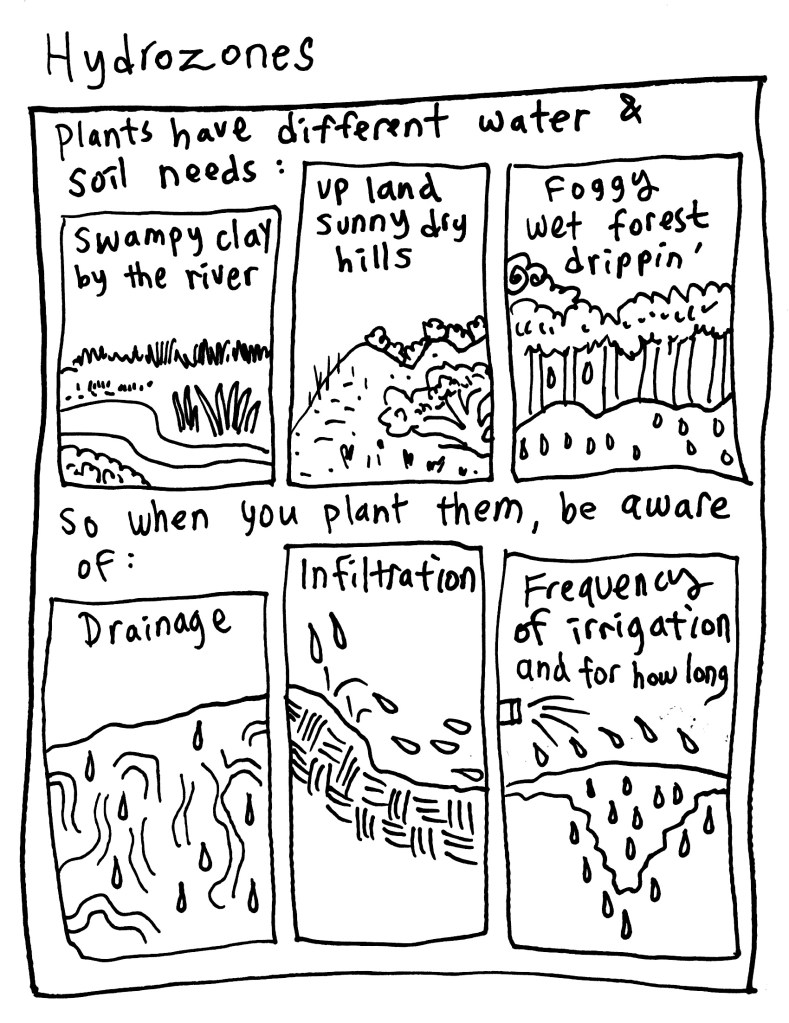
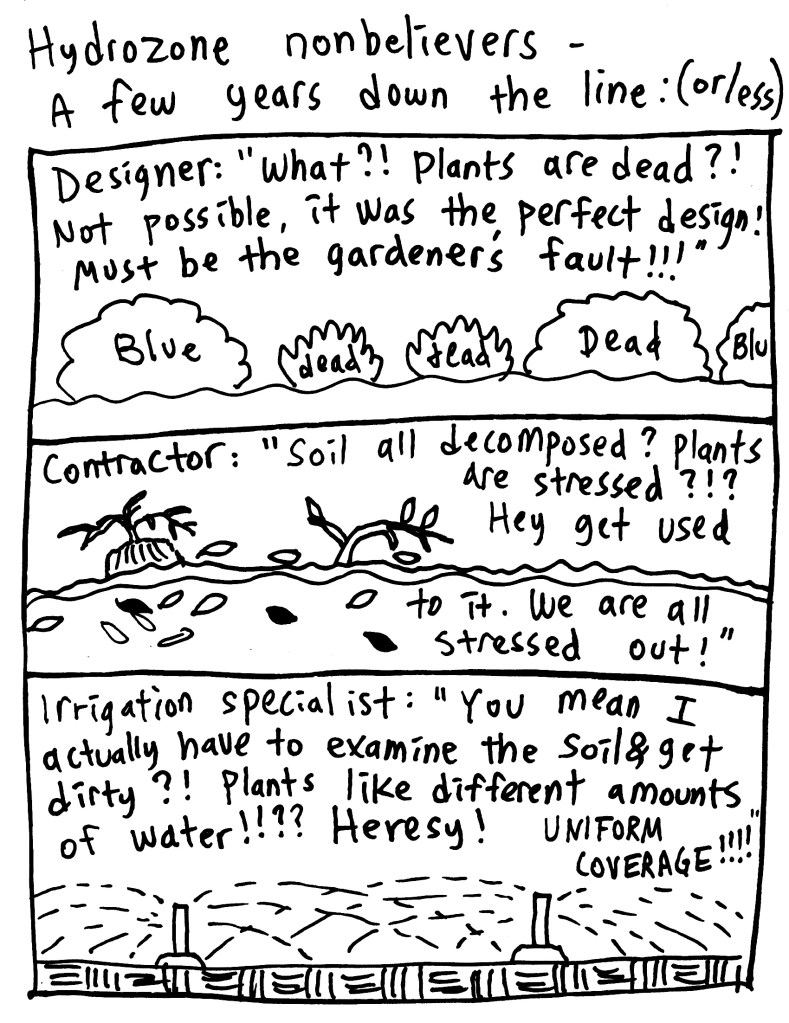
We are at a junction in the garden. The old ideas are still valid, but need to be tempered and balanced with novel solutions for a crowded and conscientious world. That is where xeriscaping comes in. In a sense, the way it is utilized these days, it goes beyond water conservation in the landscape. It dovetails with native plant restoration, designing with hydrozone principles, and the awareness of the importance of water to all life and habitats. It does challenge the old school green estate aesthetic with other ways to appreciate plants and nature. It does so with methods that are slightly less intense and a little easier on the body. Mostly with intelligent and wise plantings. Given that folks do not keep slaves anymore, and not everyone likes the constant din of motorized blowers and hedgers and chainsaws, this is a normal progression. If you could work less, pay less, have more fun, and still look good, why not?! Okay then here we go…
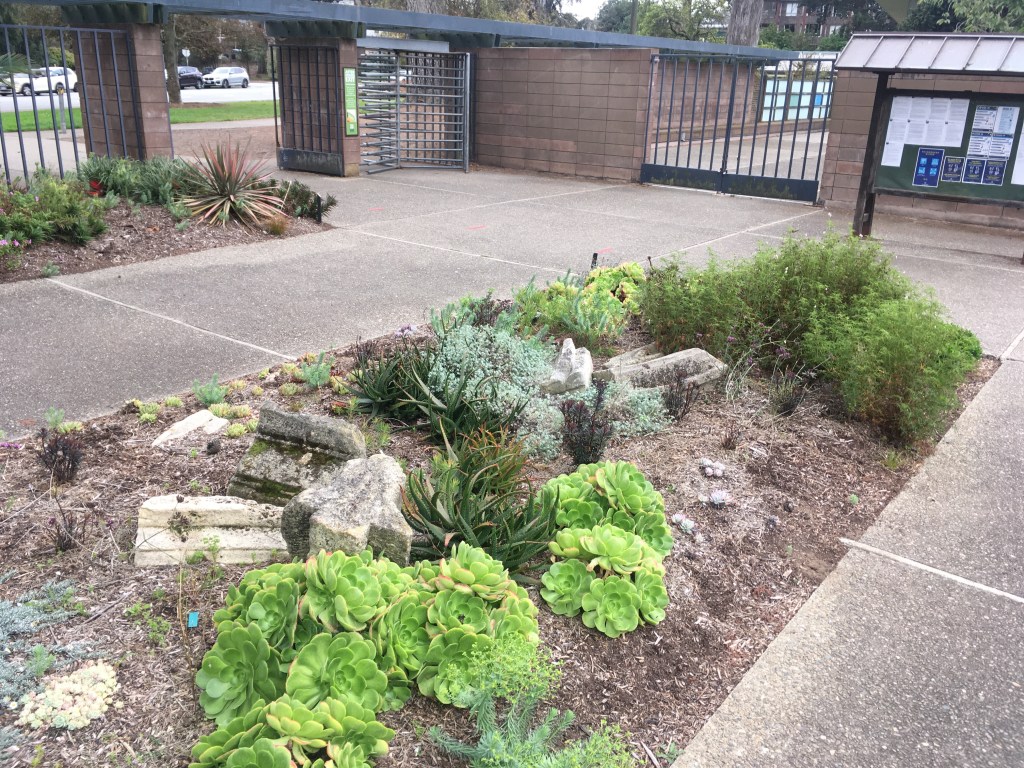
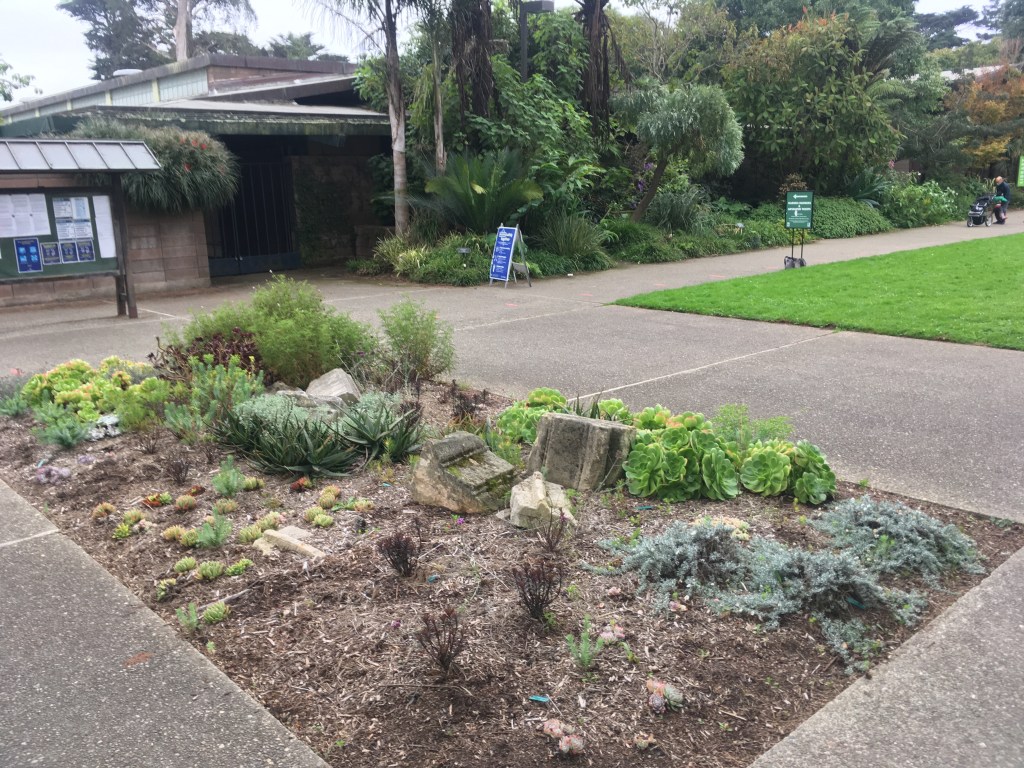
As part of the landscape design class, we visited the San Francisco Botanical Garden to examine the role that water, stone, and plants play as part of the overall design. The gardens feature a diversity of plants from the Mediterranean climates of the world, cloud forests of Central America and Southeast Asia, and temperate zones of mostly Asia, Europe, and North America.

The design of the gardens is a cooperative effort between many different peoples over time. This includes supervisors and managers that stretch back to superintendent John McLaren and more recently folks like Walter Whalen and Matthew Stephens. Notable designers and architects such as Thomas Church, Ron Lutsko, Bernard Trainor, and Roger Raiche have all left their footprints here. Past curators and collectors who have develop the plant palette include Don Mahoney, Bian Tan, Tony Morosco, David Kruse Pickler, and on up to the present day curator Ryan Guillou. Contractors of course play a part in actually placing stones, moving soil, and installing boardwalks. Of late, that has included Rock and Rose and Goodscapes. Lastly, and most importantly, it is the gardeners day to day activities that help to shape the true design of a garden over time.

We will take a counter clockwise tour of the botanical gardens, and check out individual vignettes and specific gardens. Put your critical thinking cap on, and be ready to apply the basic principles we have discussed in class – balance, rhythm, scale, and unity. We may touch upon issues of public and private space, native versus non natives, function and aesthetics, people and wildlife, safety and maintenance. In short, you are called upon to use your skills as a designer to bring it all together.

At the entrance, this is a piece by Guillou. While most of the plants have grown in, and its become a bit harder to discern the pattern, the number of objects is always in odd numbers. Threes, fives, and more. So there is that tension or asymmetry we discussed with regards to repetition of plants and the counter balancing of softscape with hardscape. Count em.

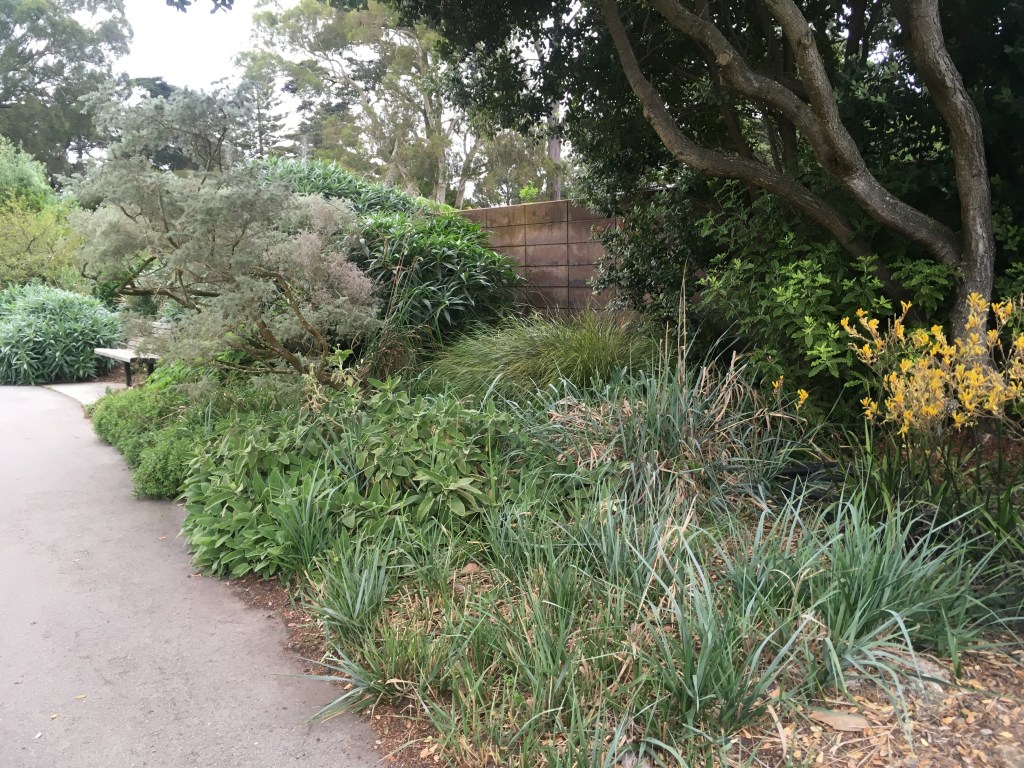
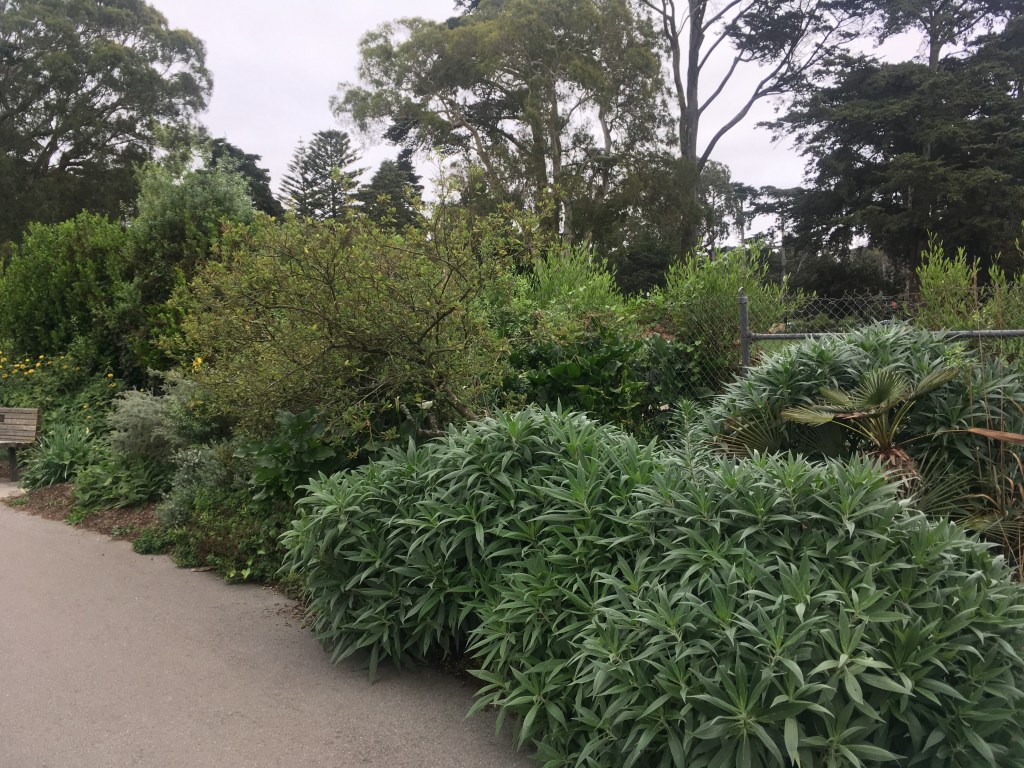
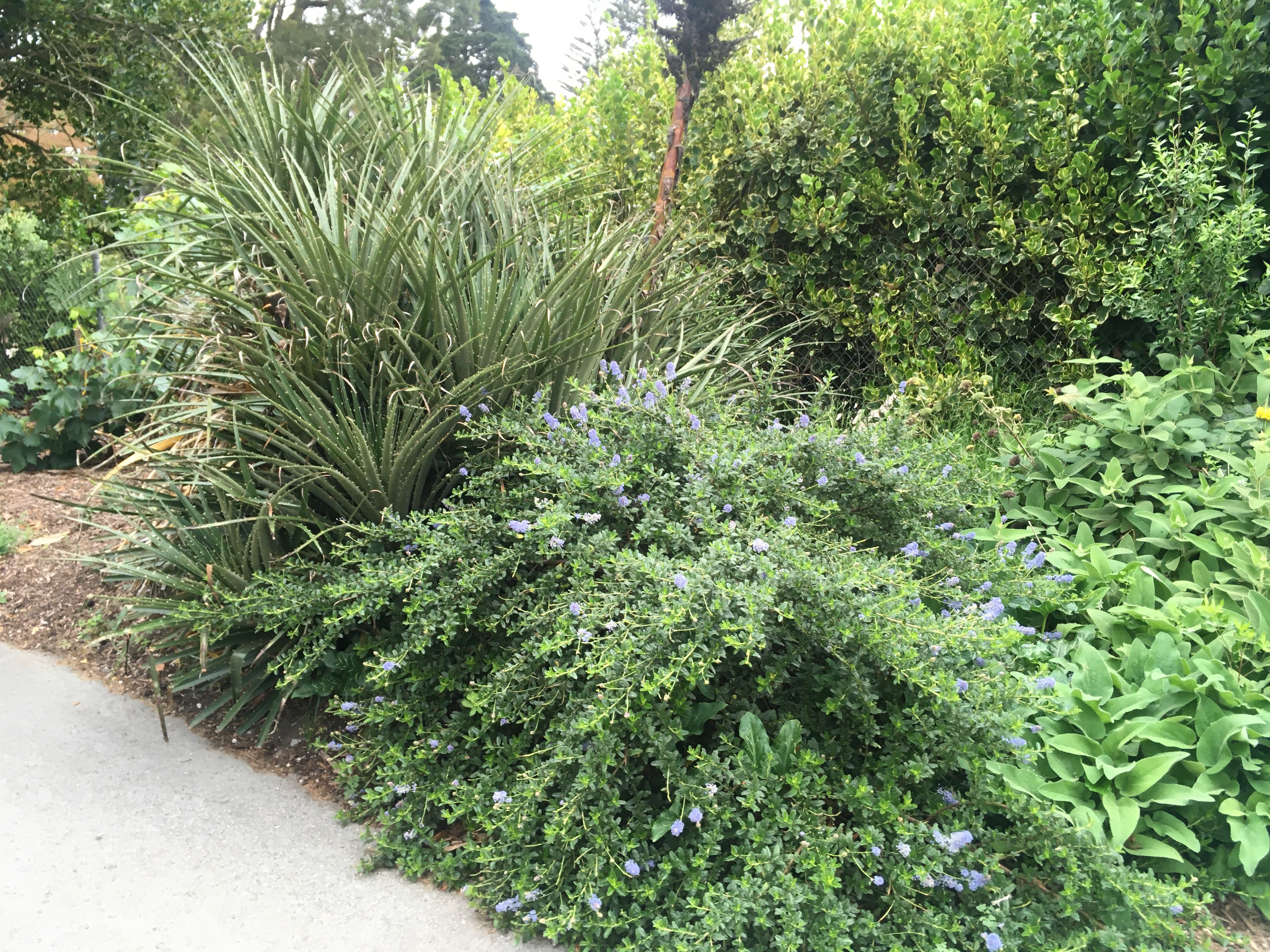
As we traverse the northern edge of the great meadow of lawn, take a look at the planting beds on the right side. The plants are grouped not by geography or rarity or ecology, but by color. All the plants are of the cool blue yellow and white wavelength. In the first picture there is the rhizomatous running grass Leymus condensatus, the yellow feet of kangaroo paws Anigozanthus, yellow flowered Phlomis fruiticosa, and the shrub sticking up is Melaleuca incana the grey honey myrtle. Further on there is blue Ceanothus, gray greenish Echium, and a Griselinia hedge with the variegated yellow borders. All super cooooool.

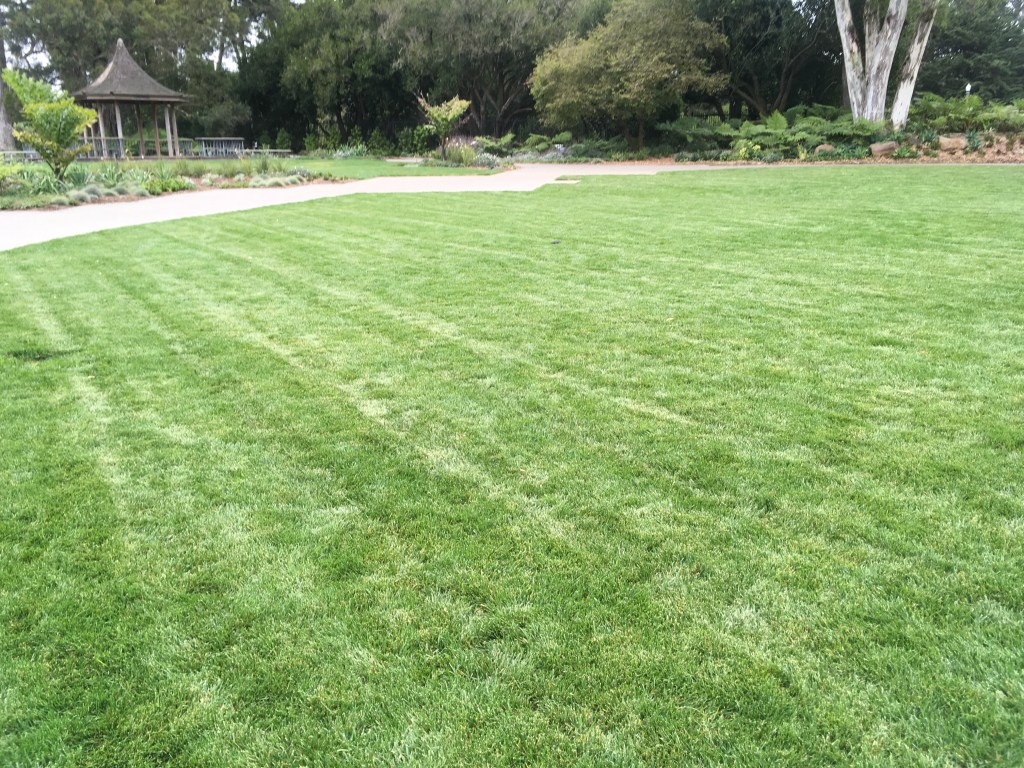
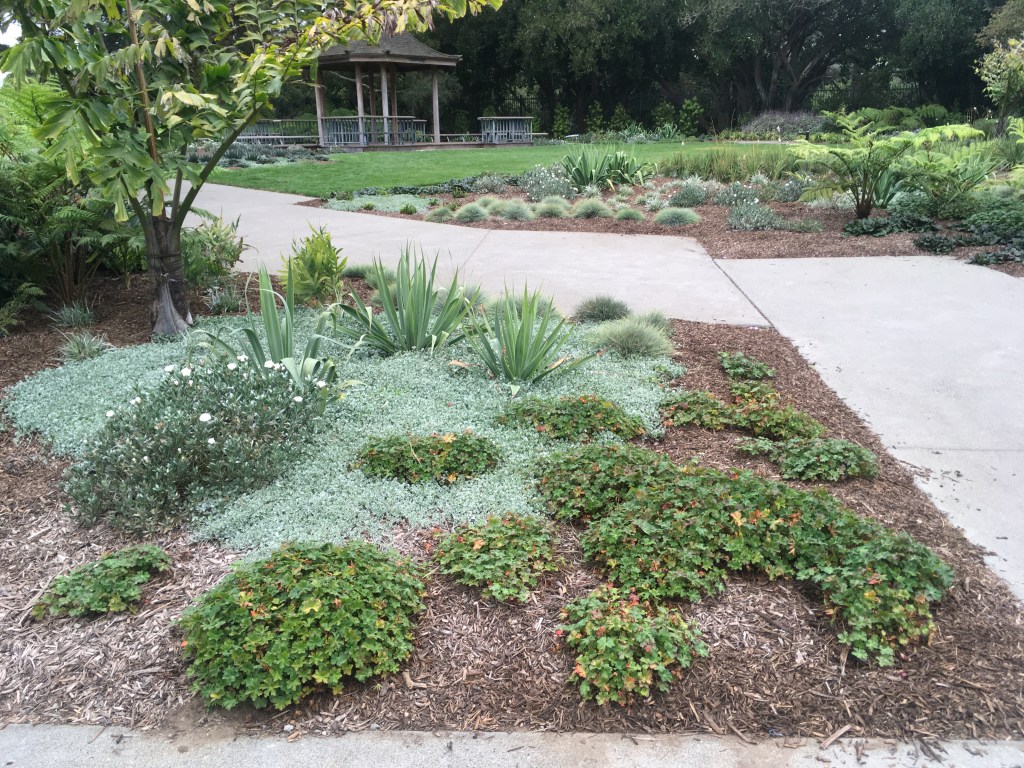
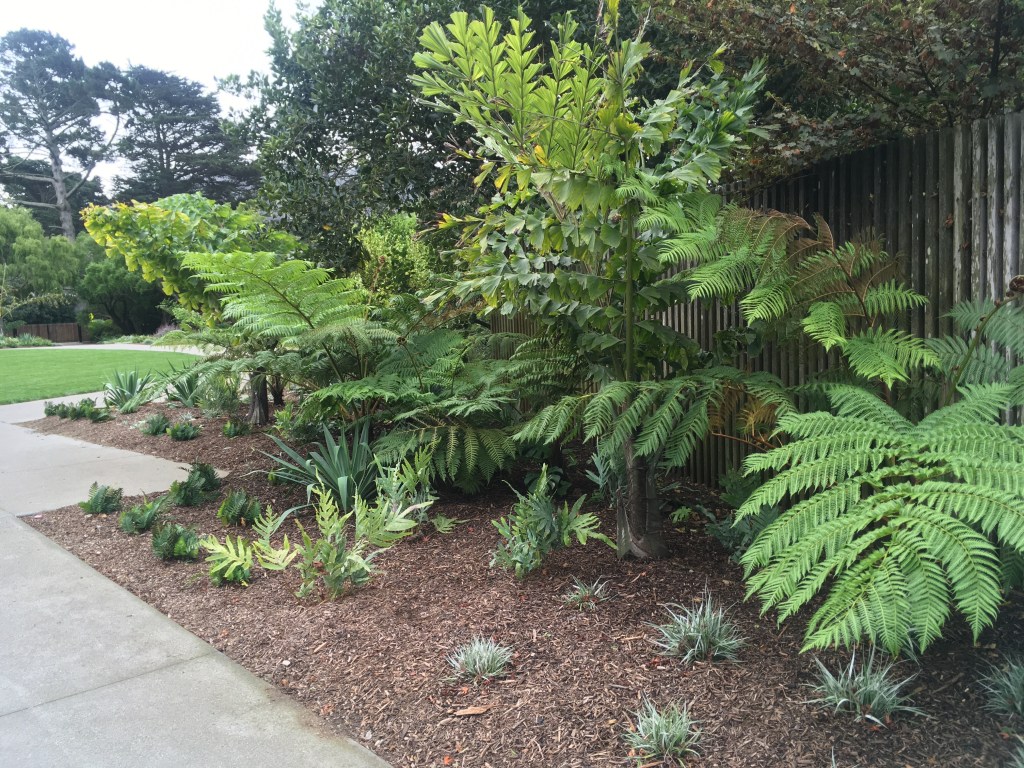
Go in to the new garden that has been designed by Lutsko and Guillou, it is called the Celebration Garden, a garden meant to be used as an outdoor venue for events. It replaced the demonstration garden; the only remnant of the past here is the pavilion designed by Thomas Church. This garden is also planted primarily based on color – whites, silvers, blues, greens. Elevation wise it is mostly flat and low. The tallest plants planted here are the large fishtail palms Caryota. In time, they are to be overtaken deliberately by the wax palms Ceroxylon. In maybe 40 or 50 years according to the staff.

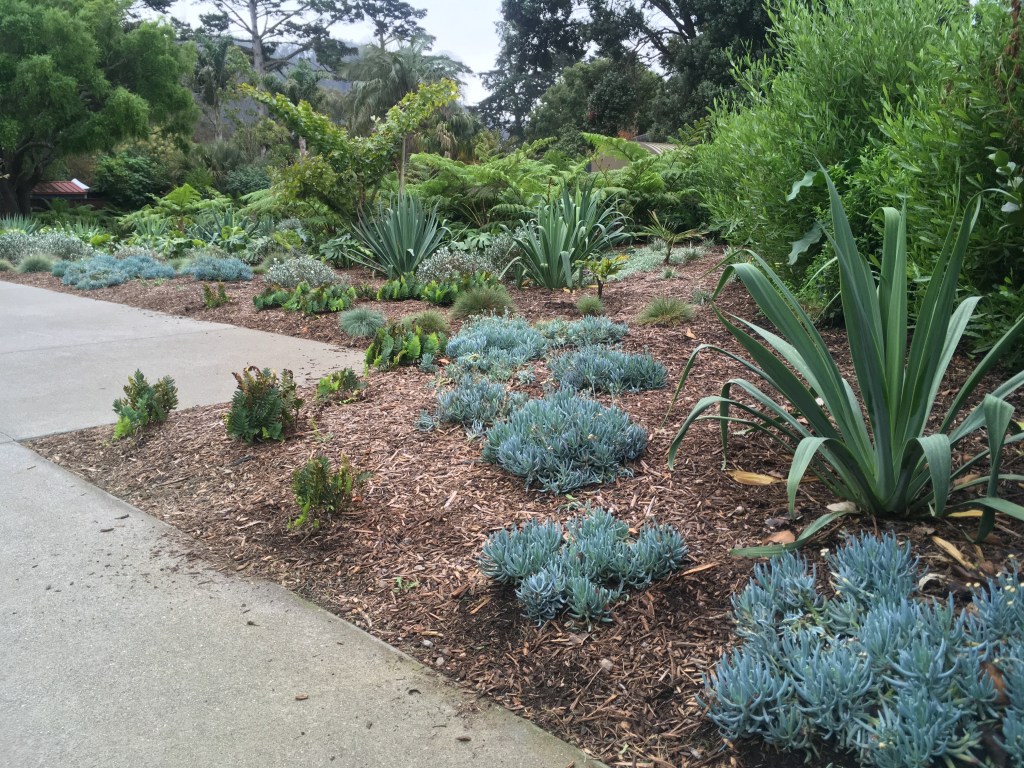
This garden is defined by wide expanses of turf, followed by silvery Convovulus and low spreading silver Dichondra; tree ferns, silver spear Astelia; blue succulent Senecio madraliscae; blue fescue. You get the idea – color is cool, and the plants range from full sun to shade. The most challenging aspect is likely the litter under the tall Eucalyptus trees, the open and windy exposure, the meticulous nature that is crucial to a rental space, and the safety of 2-4 year olds playing near sharp agaves.

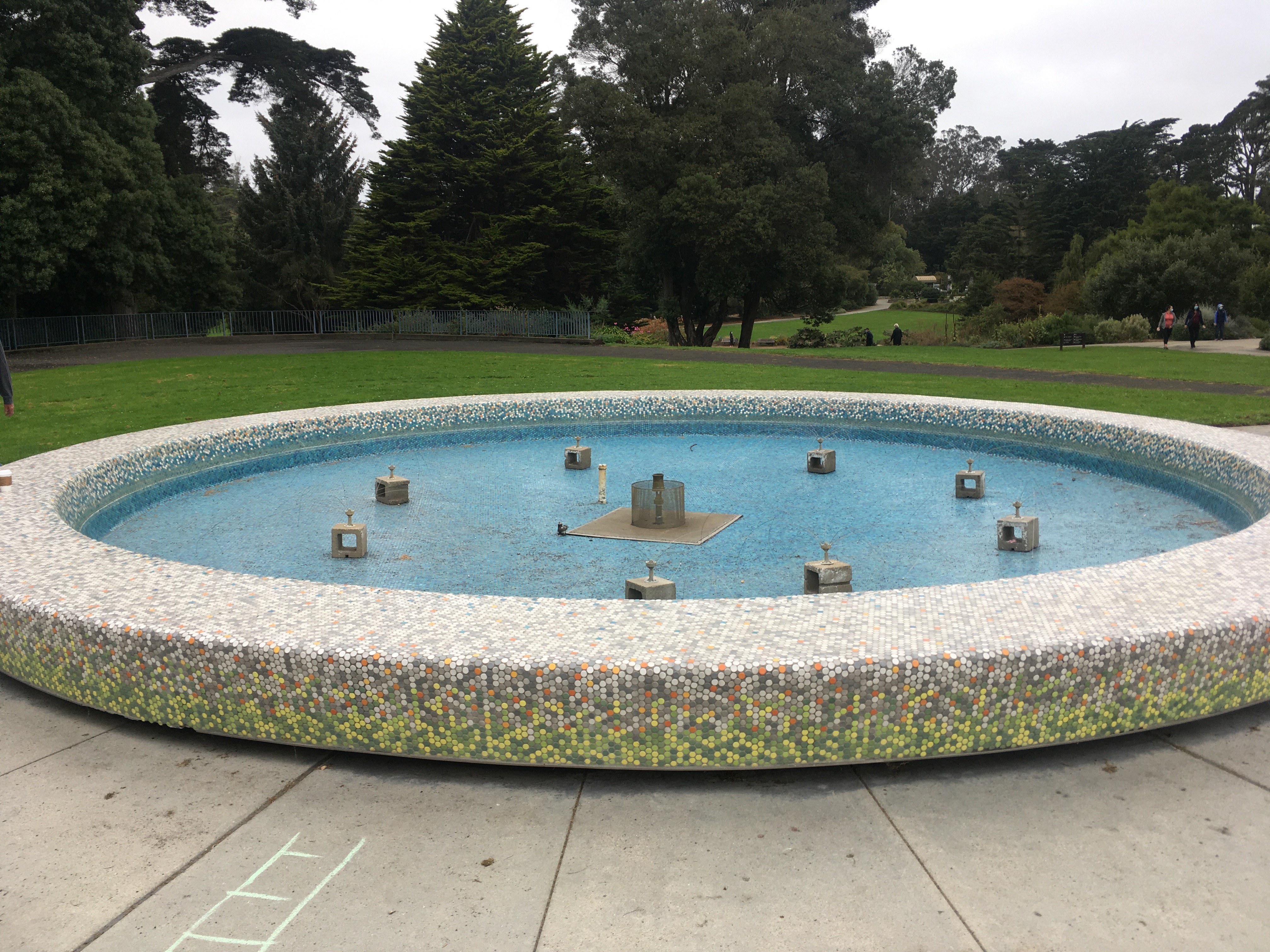
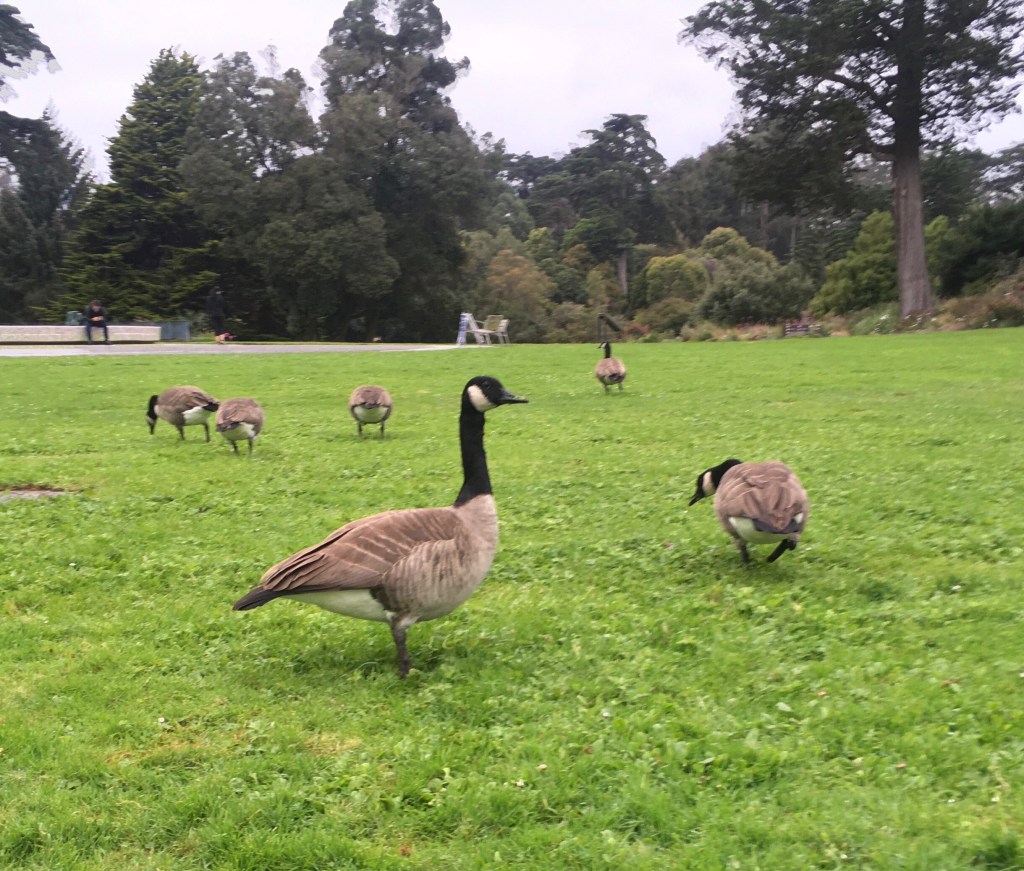
Water is central to a garden. In the old European style it is commonly a fountain in the middle, or in the Moorish style it might run along a trough through the center. San Francisco Botanical Garden is no exception. At the end of the great meadow is this beauty. It is temporarily not running due to construction or repairs. The cinder blocks with the wires on top is a bird deterrent that resembles a daddy long legs spider. It is meant to keep geese and other critters from going in the fountain and pooping there.

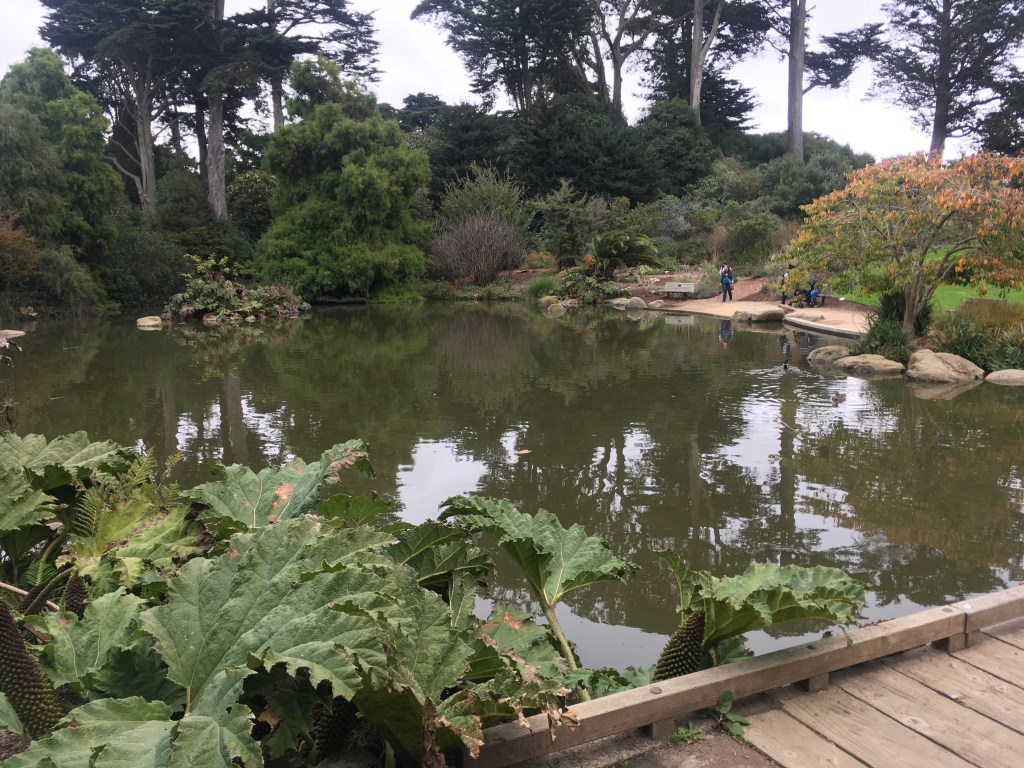
Walking over towards the Primitive Garden and you will notice the water trough that conveys water from the Japanese Tea Garden across the street to the large pond known as McBean waterfowl pond. The trough is made recycled materials – specifically it is concrete, aka urbanite. It is lined with a white clay that is called bentonite. A nice thick layer of bentonite will make it water tight and minimize leaks. It is a commonly used material for pond building, an alternative to the thick EPDM rubber liner.

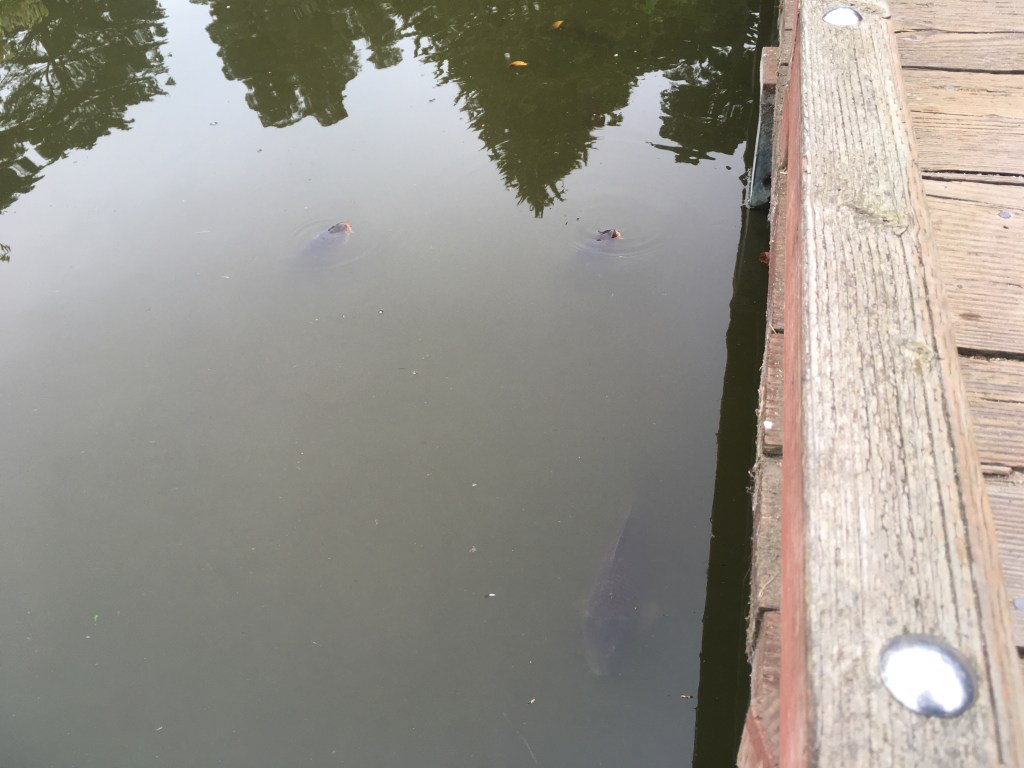
Big ol carp always come by for a hand out at the pond. They are not the fancy pretty koi, they are all gray brown colored. But they are the same fish – a chunky scaly fish with barbels around the mouth that thrives in freshwater that has low oxygen content. It likes a similar habitat as catfish. In many parts of the country the carp is considered an invasive species.

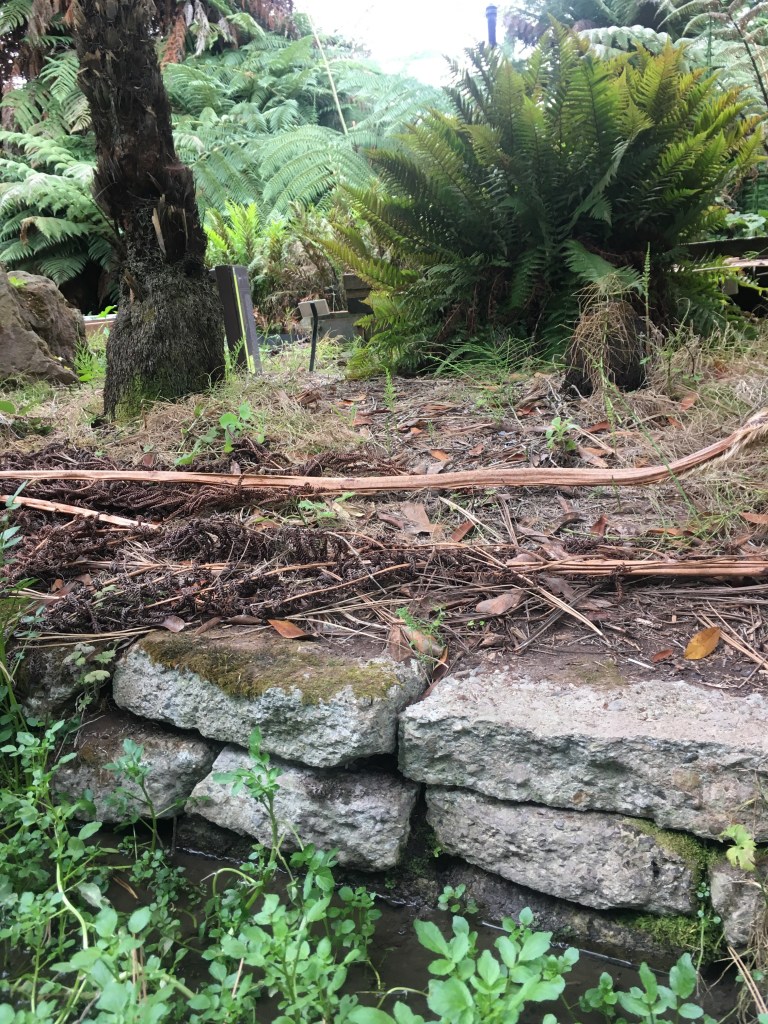
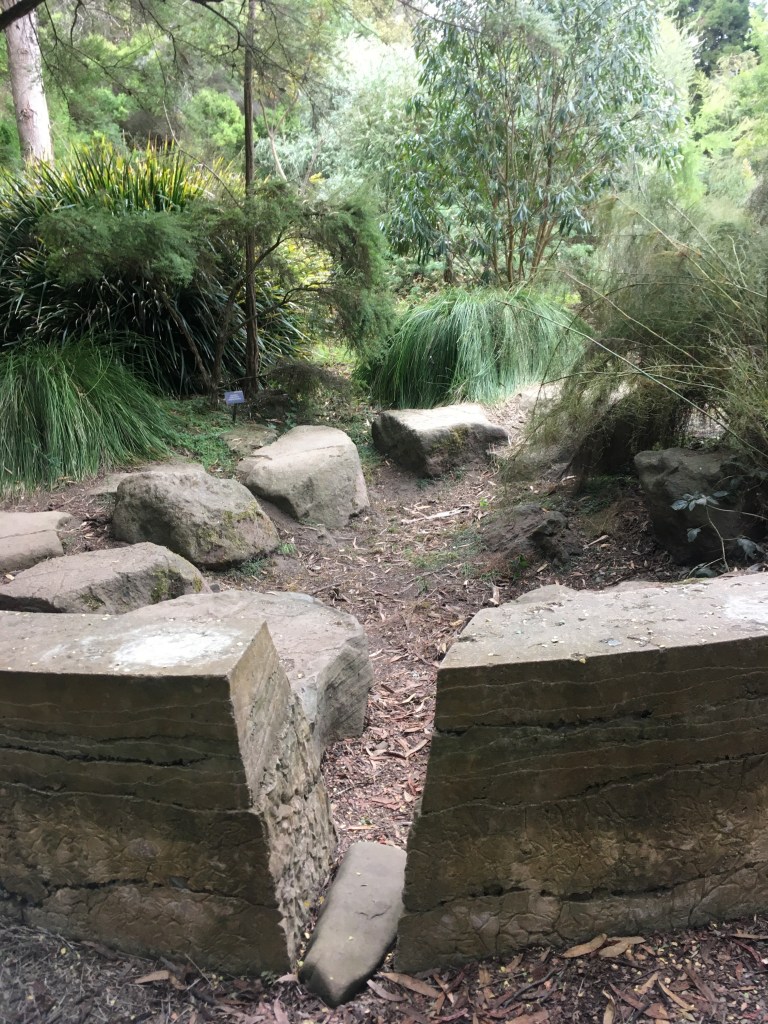
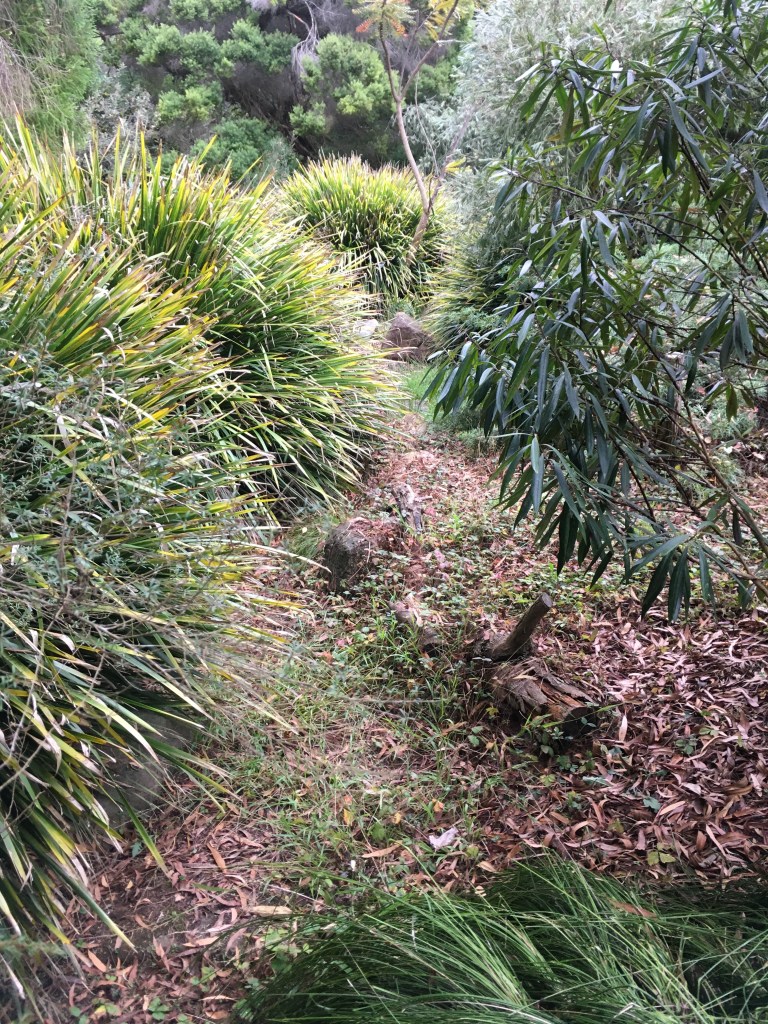
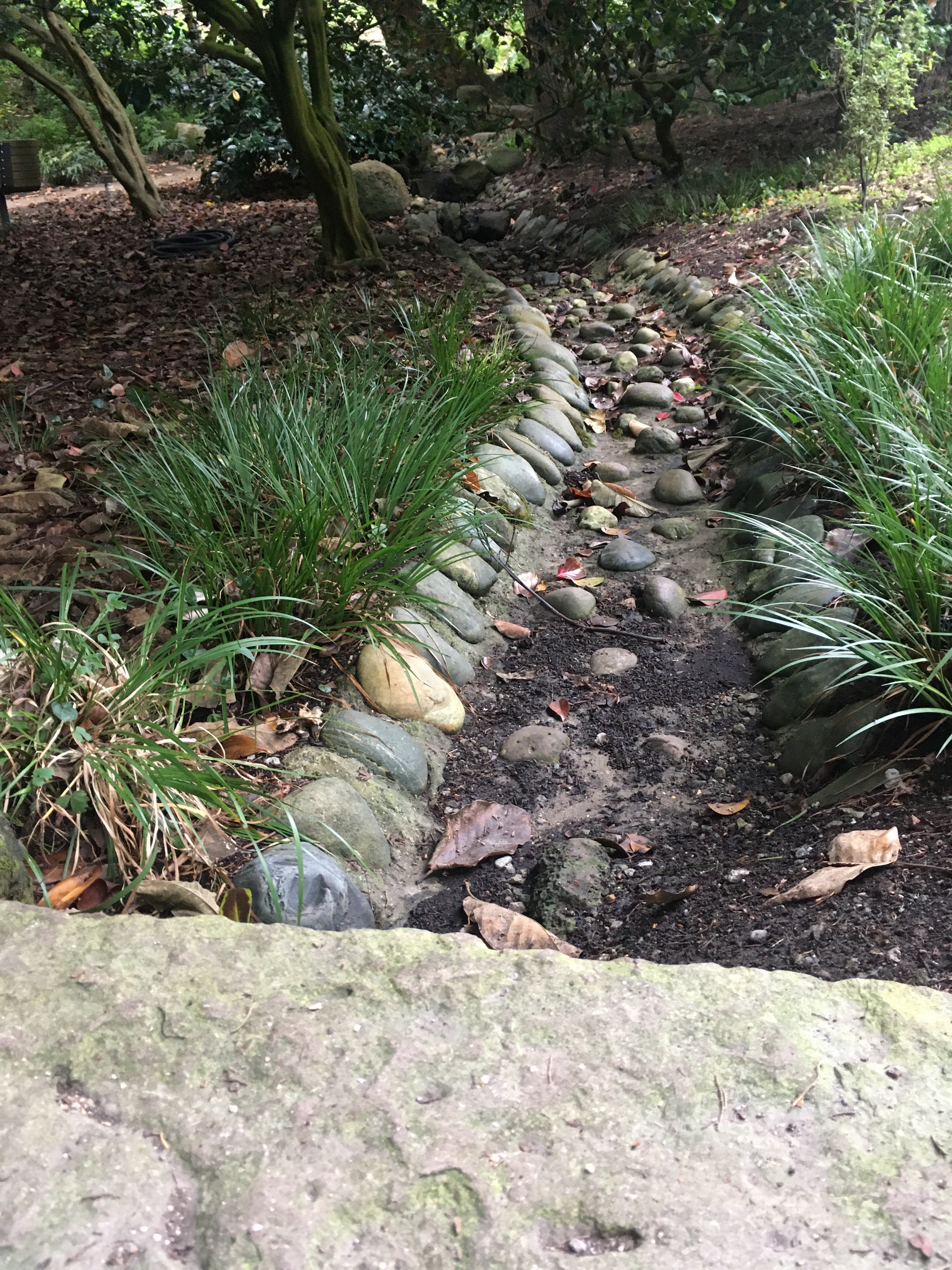
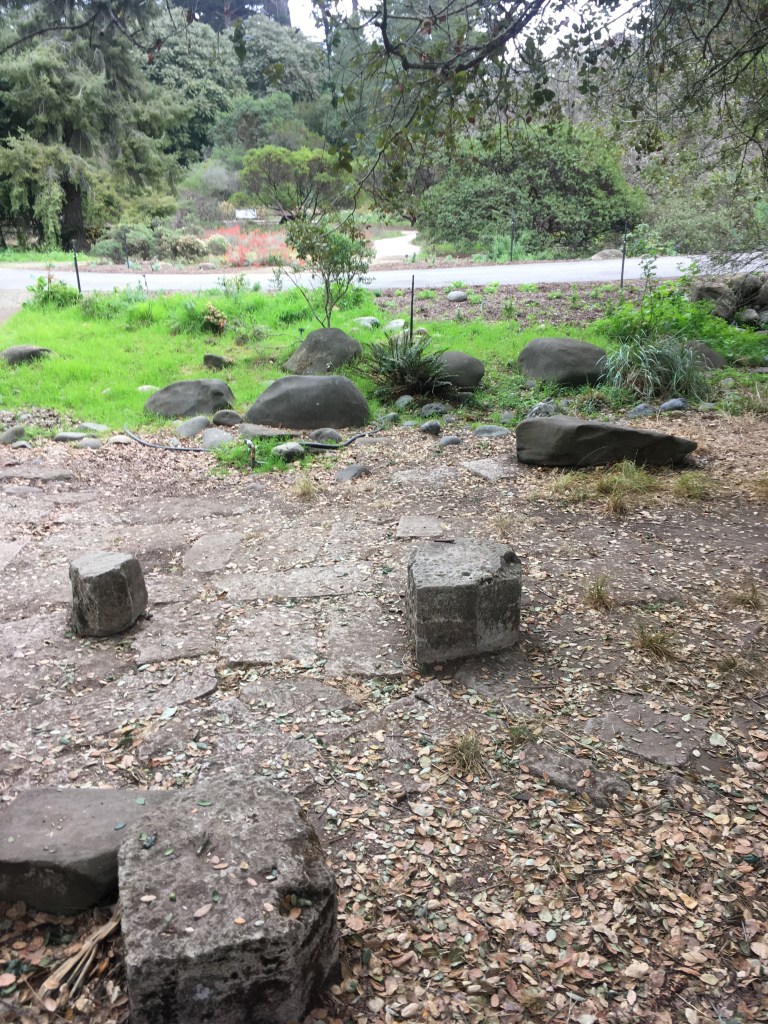
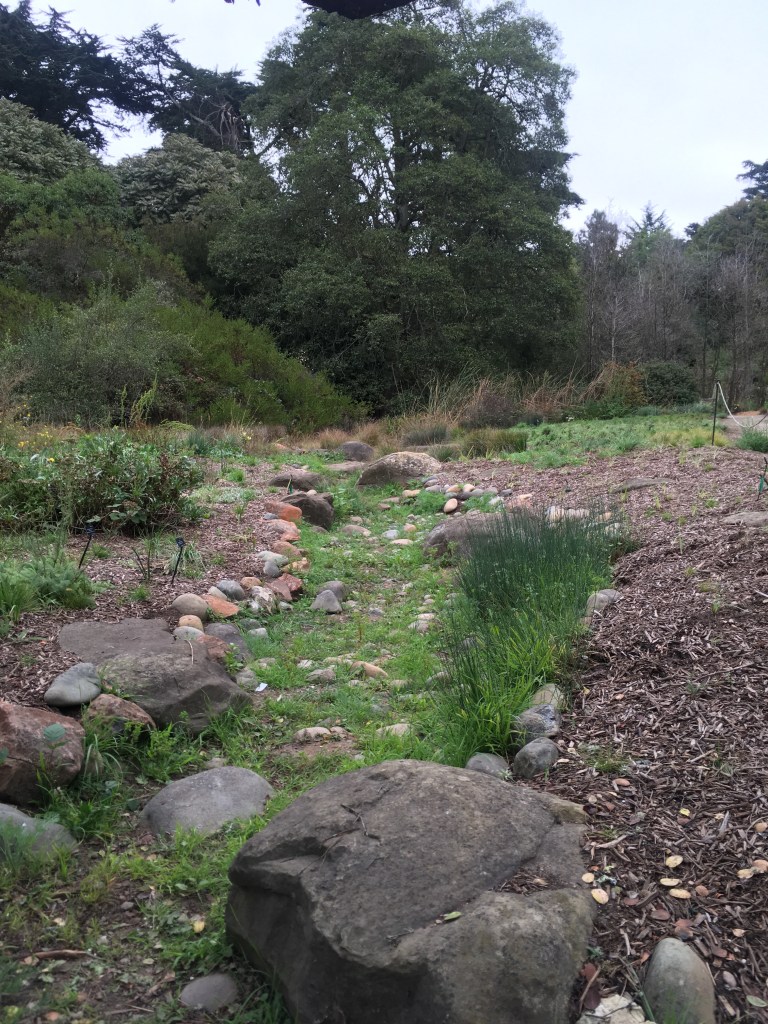
The Australia garden next to the Primitive Garden has a water feature that runs down the middle of it. It is a dry creek bed. This first picture is the end of the dry creek. Over the past ten or fifteen years, all the plants have grown up around this design feature, to the point that it is almost completely obscured by erosion and leafy debris and tall shrubs. But it is still there, the defining cohesive element of the whole design.

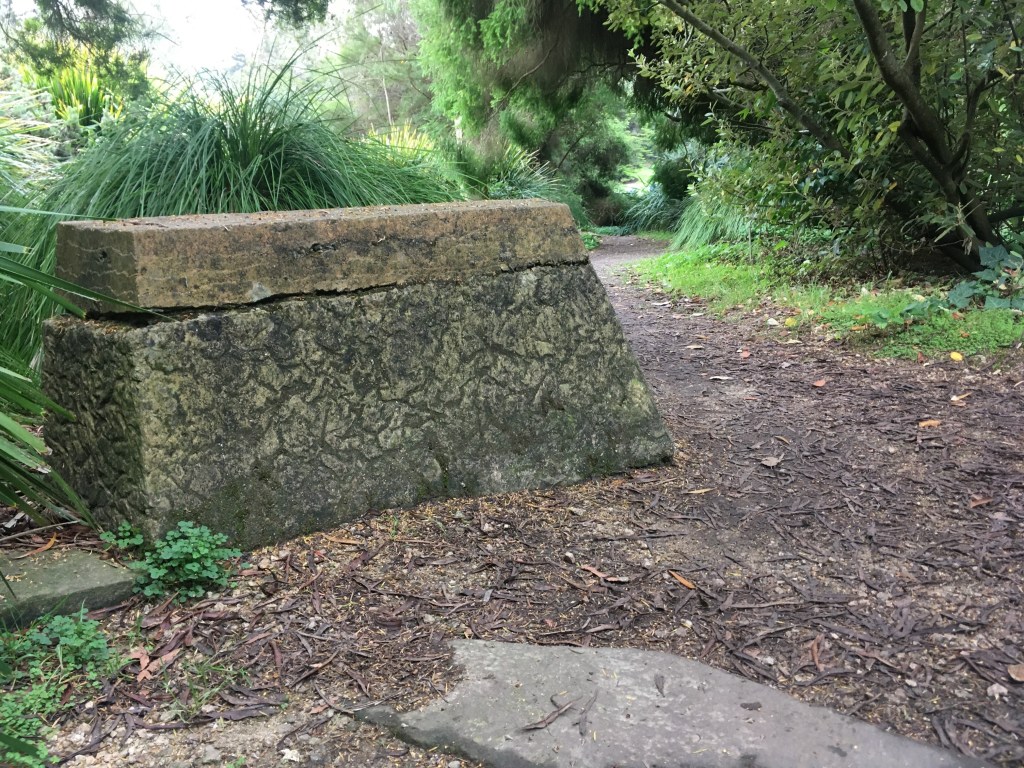
Besides water, stone and rock bring character to a garden. Mr Trainor had a neat idea here while making the retaining wall benches and seating. Rather than a smooth level gray concrete of a form, he utilized crumpled up aluminum foil and concrete colorants to create texture and geological age. Yup Australia is a really old continent and so the hardscape seeks to reflect this. I like how as it ages, the grooves and cracks and unevenness picks up the moss and stains of time.

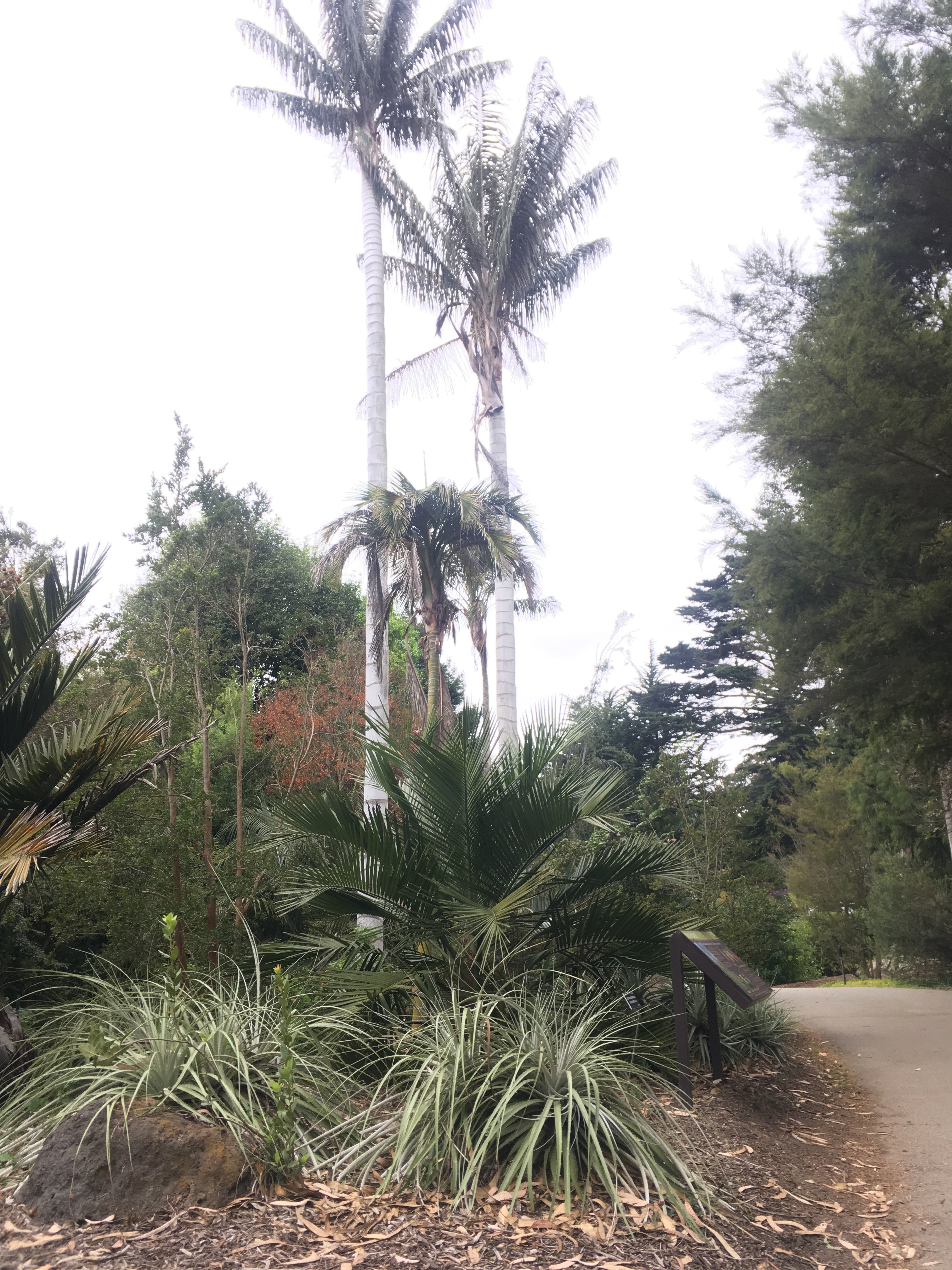
We cruised through the Chilean garden and saw these Andean Wax palms, the tallest palms in the world. Imagine the Celebration Garden when the palms grow up tall! Well I’ll probably be dead by then but it is worth dreaming about…
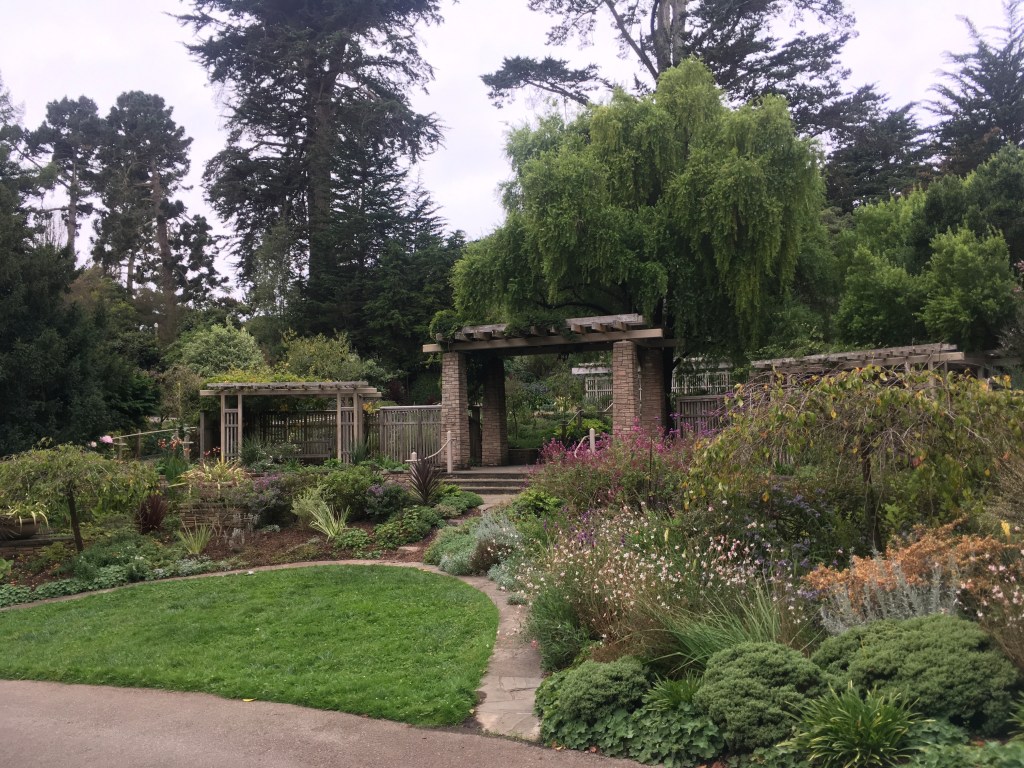
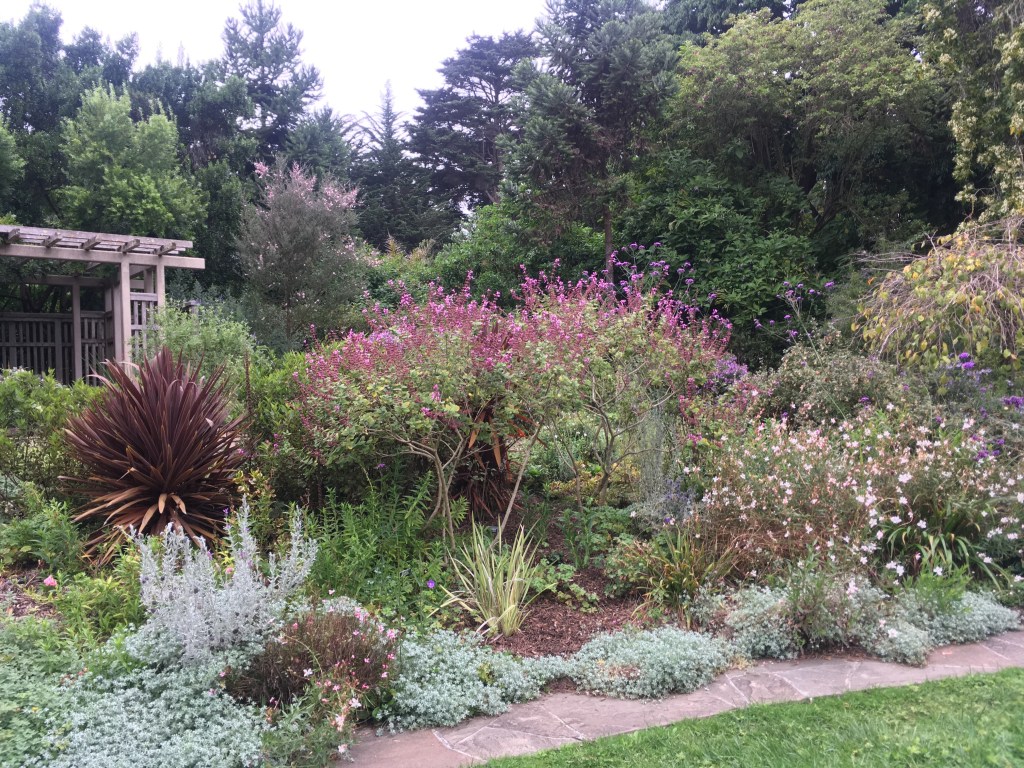
The Zellerbach Garden is a formal garden that is high maintenance. To look good the perennials need a lot of attention. Luckily it has some help from a group of volunteers who have been coming for over thirty years weekly. Deadheading, pruning, weeding, and so on. It is another garden that is not focused on diversity and ecology, its palette is based around the pinks and purples, with a smattering of red white and blue. So it is warmer in temperature and wavelength. There is a little bit of symmetry – the matching structures and trees – but it also has that English perennial border feel of happy exuberance and abundance. Notice how the perennials are for the most part herbaceous, not woody. Hence over time you get nice clumps of blooms, and not huge shrubs trying to take over and shade out everybody else.

When you line yourself up under the gazebo, and look back at the expanse of the botanical garden, you will see the axis of view that defines the formal gardens inspired by European royalty. Ideally, you would be able to see clear across to the other side of the garden, with the water feature in the middle. Can you see the white rim of the fountain?

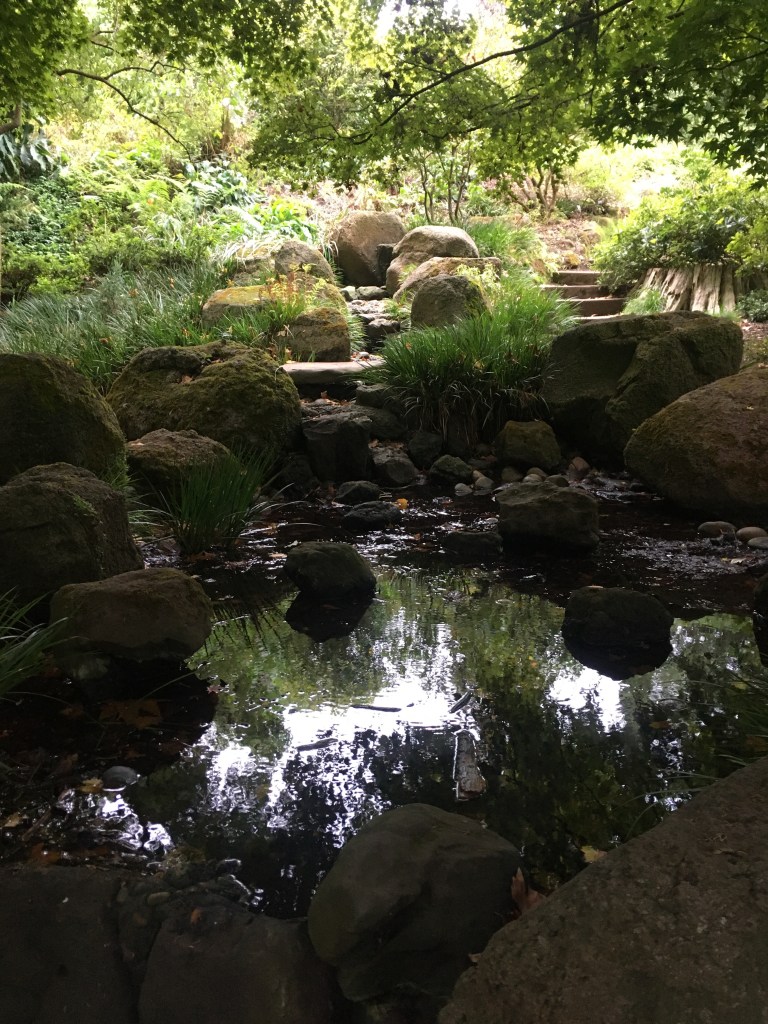
Back to water – the water trickling down the stones of the Moon viewing Garden. This water feature is constructed in an old fashioned manner – lined with concrete, with round river rocks pressed into it. It is the same method of construction as the ponds in the Japanese Tea Garden. On this day, the upper waterfall had water, but the lower troughs leading to the moon viewing pond was dry.

The deck and view of the pond was closed for a wedding. So sorry – could not get in to show you the sights. The pond there is shallow, and there are no fish in it. It is a raccoon hunting ground. What is a neat feature there is a small island in the pond that is in the shape of a turtle. And the overhanging Coriaria tree is quite a specimen too.

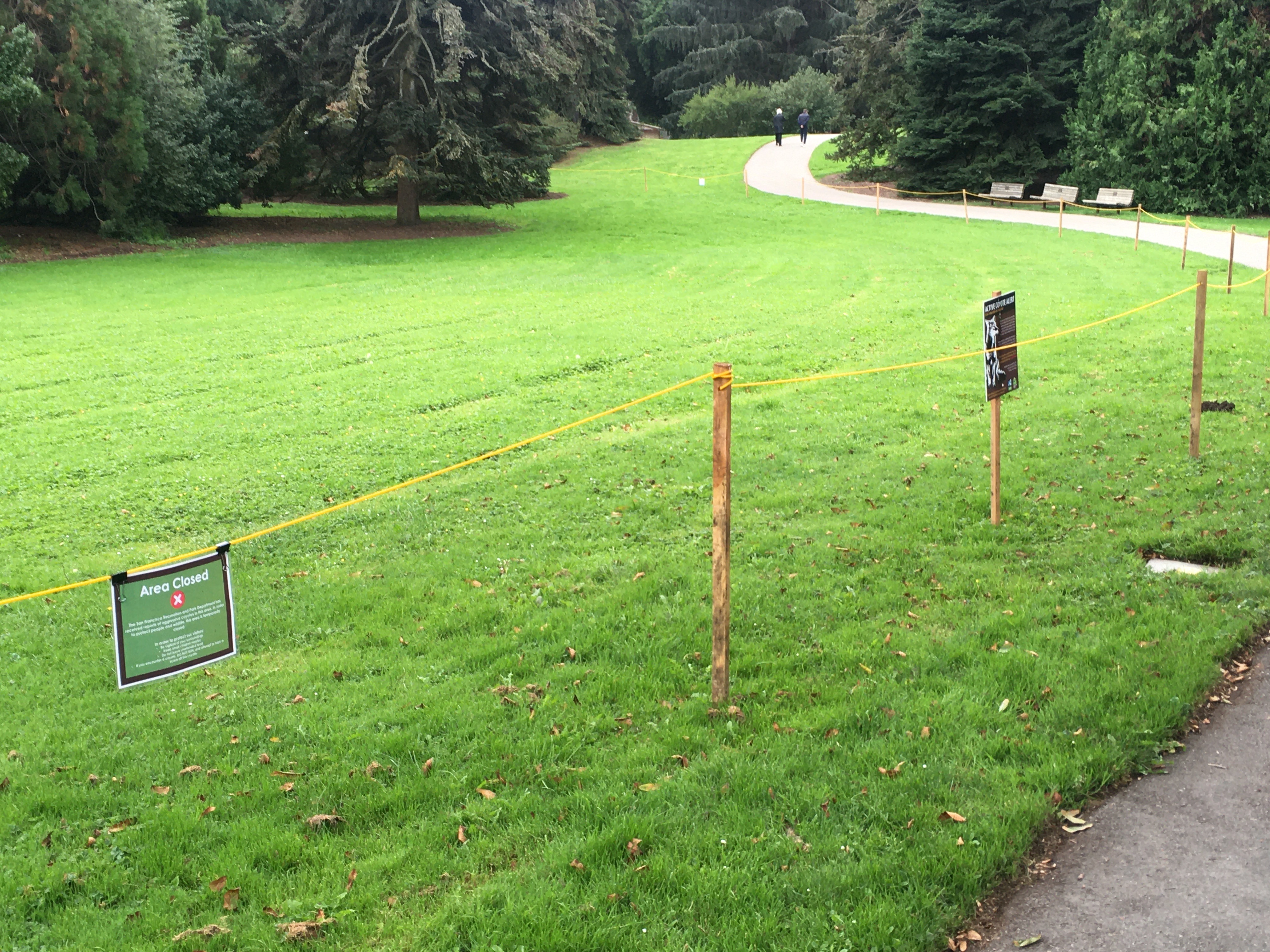
There was more closed area by the Conifer Lawn. Signs explain that a coyote had been sighted and perhaps threatening a garden visitor. This was the area that it was last seen in. What a drag. Between Covid and now the coyote.

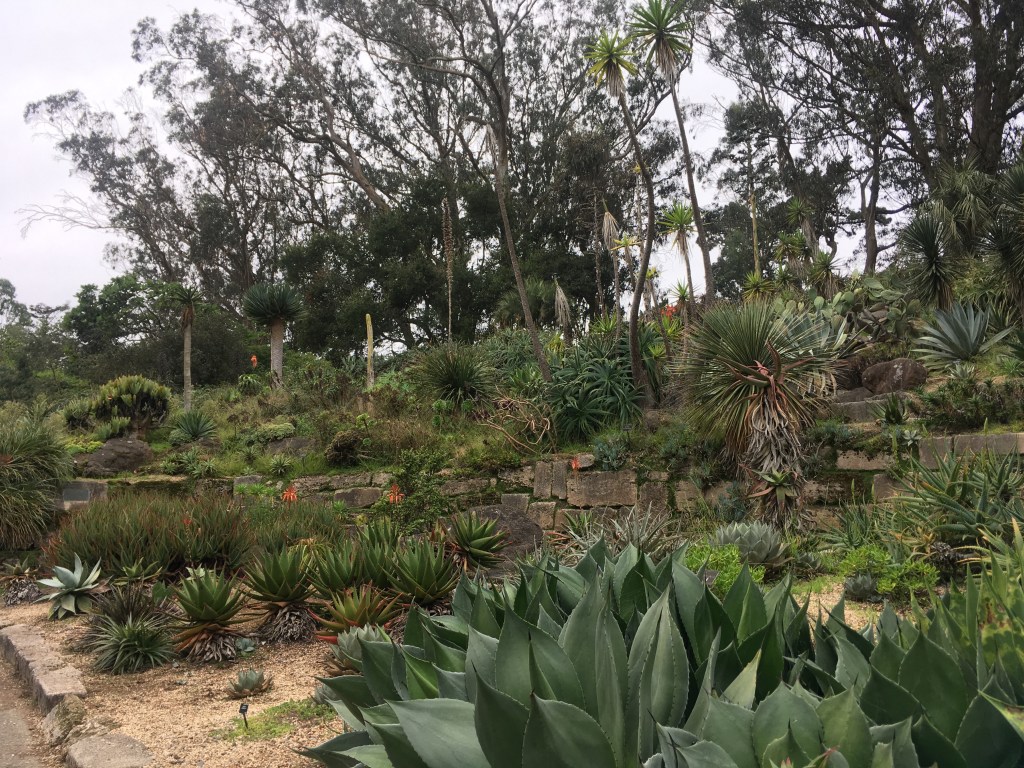
Finally at the top of the hill is the succulent and cactus garden. The placement of this garden took into account the ecological needs of this group of plants. They like it hot, with good drainage. The monastery stones used for the retaining walls have great thermal mass, and radiate the heat they have stored during the day, at night. There is a diversity of forms and colors here, they are united by the predominantly dry and desert like conditions of their native habitats – whether that be Africa or the Americas.

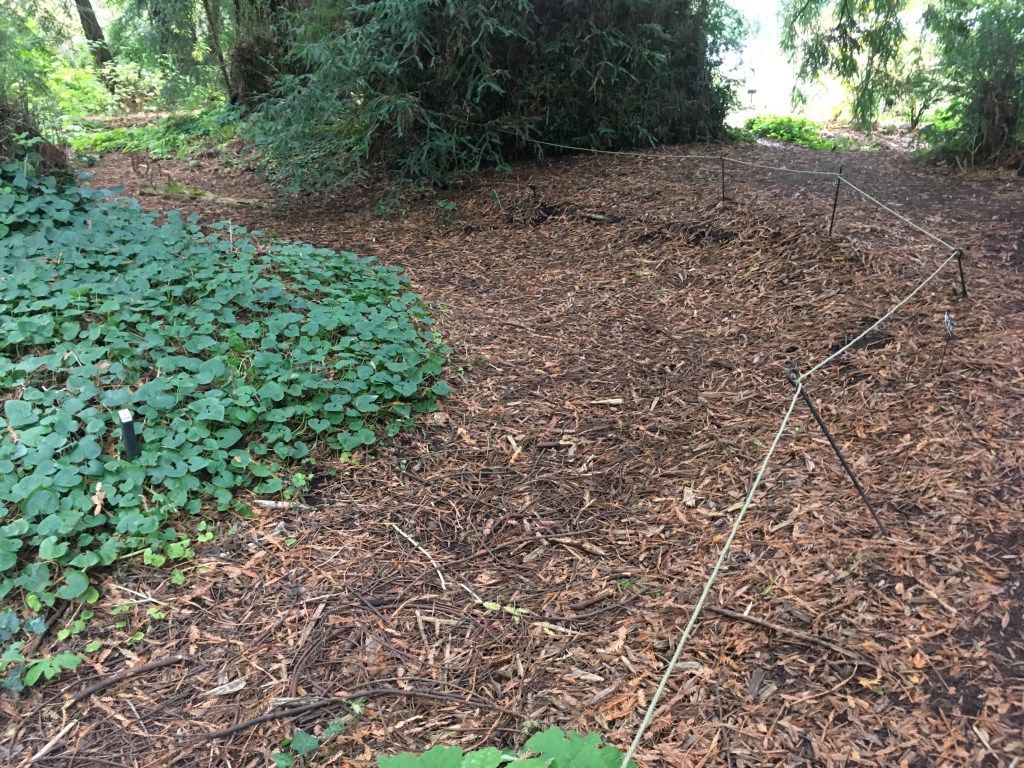
Back to water again as we go down the hill through the grove of coastal redwoods. It is running dry here as well, whereas in the recent past stands of skunk cabbage wet their roots here under the Sequoia canopies alongside ground covers of redwood ginger and redwood sorrel.

Water always descends to a low point. The lowest point in the botanical garden is by the Arthur Menzies Native plant garden and the old greenhouse. The water ends up in a big reservoir where a pump in a pump house, staffed by a stationary engineer, pushes the water back up the hill.

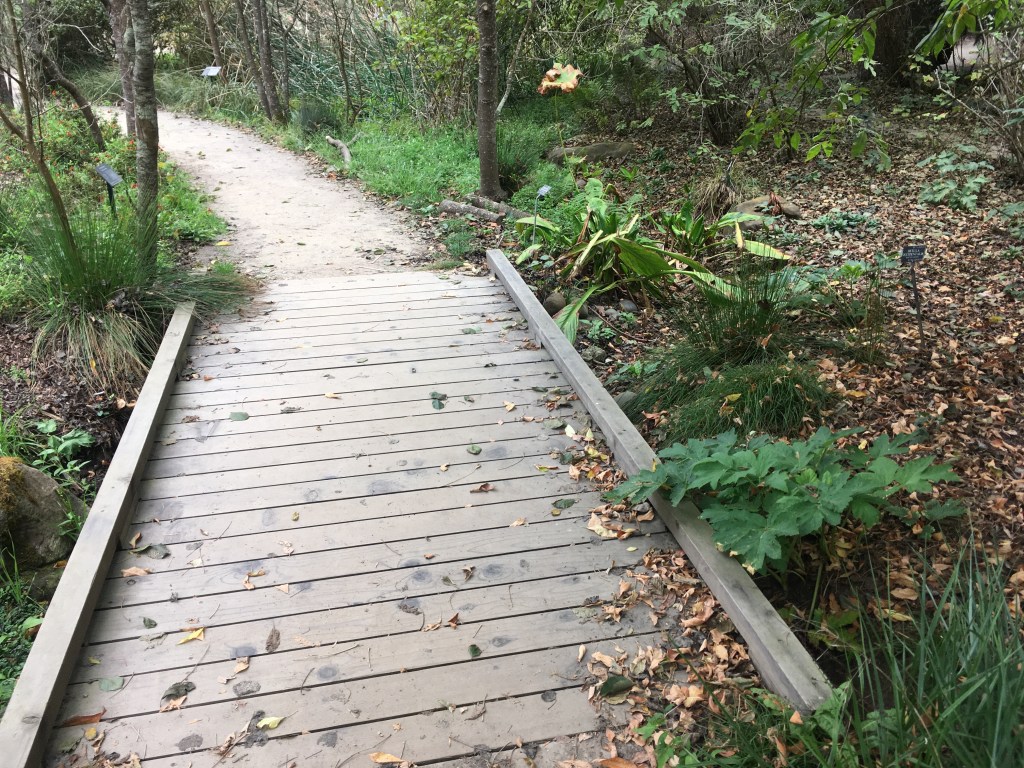
The main body of the California native plant garden is in the shape of a large oval, with a small pond and a bridge at the head of it, and a dry creek that runs through the garden. (This is a common motif, no?). Here we are looking from the end, or the base of the garden, up at the head. The asphalt road that cuts across it is a new addition – meant for easier access for supplies to the to-be-built new nursery. At the end of the dry creek is a tiny tule and cattail lined pond and an Alder tree, which is commonly found close to water in nature.

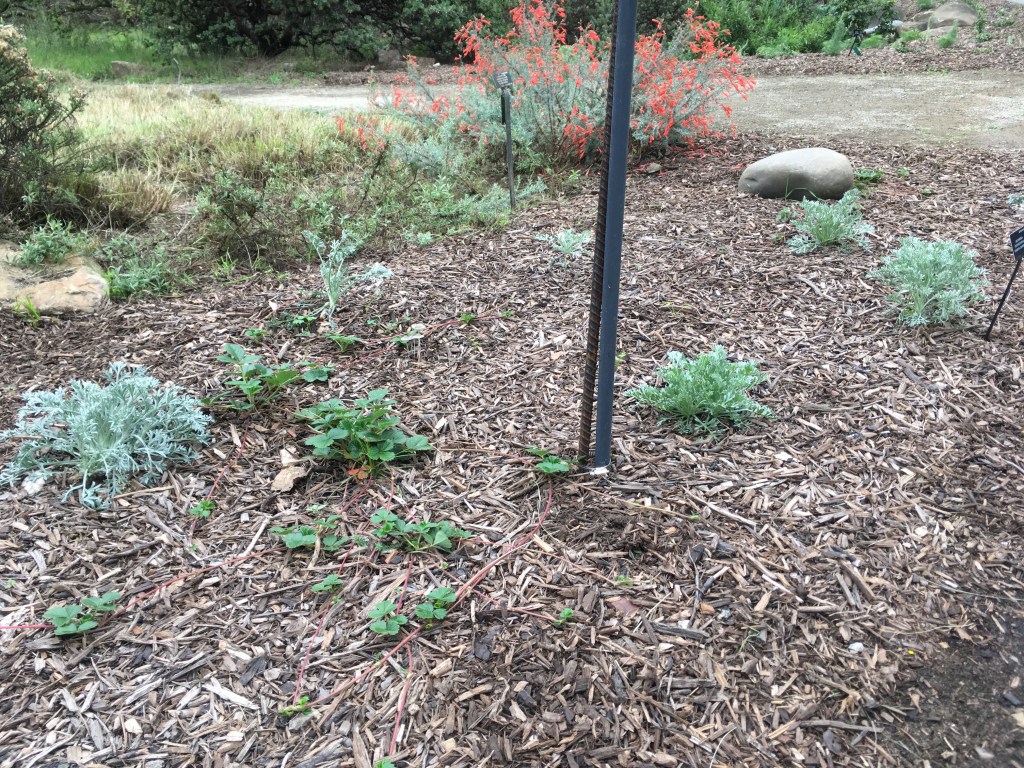
Alongside the new road are new plantings. On the far side are woody shrubs – sticky monkey flower, toyon, coyote bush, coffee berry. The dominant shrubs of the coastal sage scrub. On the side closer to the rest of the garden are low plants more commonly found on the beaches and sand dunes – beach sage and beach strawberry, plus some coyote mint of the clay rocky uplands too.

The original design plan of the native plant garden was to showcase the vegetation communities of California. The palette is an ecological one. There was the native bunch grass meadow that was common in central valley. There was the coastal scrub and chaparral of woody shrubs all knit together. There was the oak studded foothills and woodlands full of acorns. There was the serpentine outcrops of rocks and gravel and strange endemics. And there was the riparian riverine plants alongside small drainages and lakes. There was no desert biome represented, neither the low Anza Borrego desert flora nor the high Mojave desert flora.

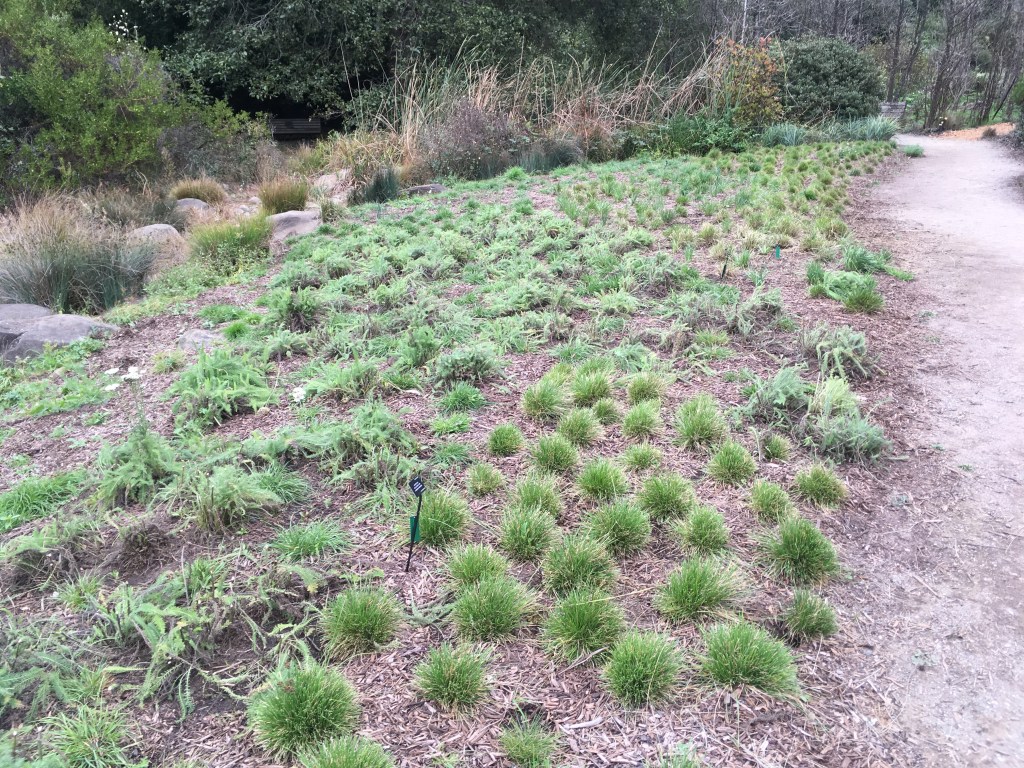
The bunchgrass meadow has been painstakingly planted. Heres Purple needle grass Nasella pulchra, tufted hairgrass Deschampsia cespitosa, and California oat grass Danthonia californica. You can still find these plants occurring naturally in San Francisco. Nasella and Danthonia form small stands at McLaren Park in the grasslands by Gleneagles Golf Course. They are periodically burned around the Fourth of July. The only place you will find wild tufted hairgrass in San Francisco is on Bayview Hill by Candlestick. It is in a few patches where it is wet and close to the groundwater seeps near the top of the hill. It is scattered and does not form dense masses.

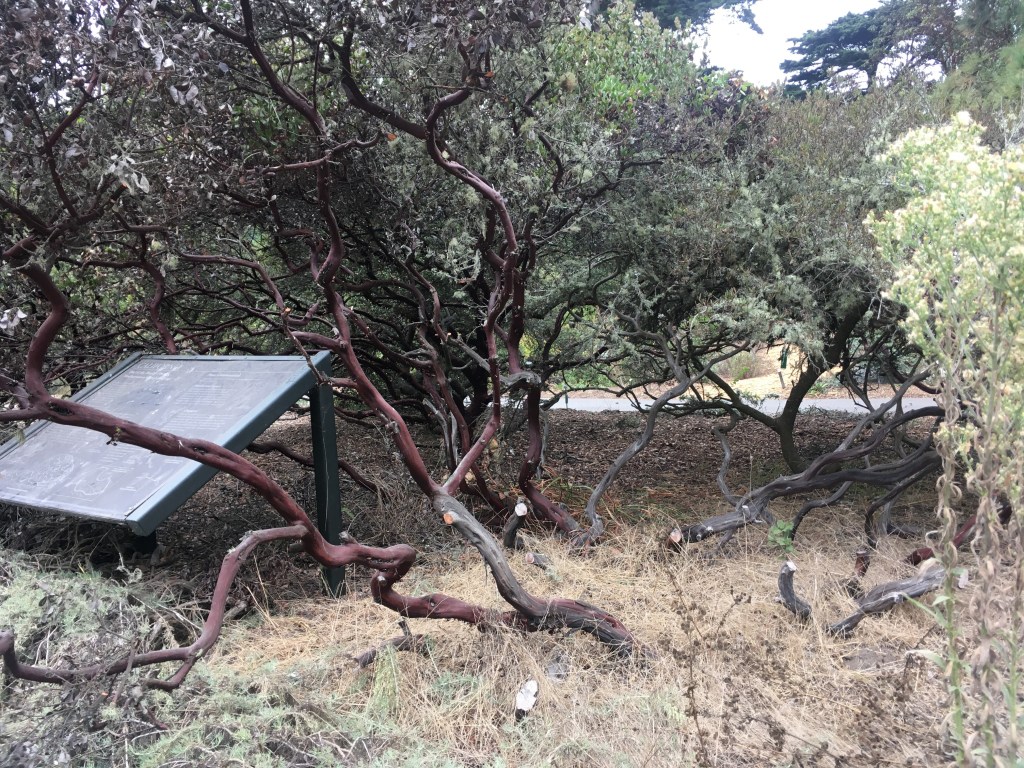
The chaparral is often dominated by manzanitas, yerba santas, chamise, and sagebrush. In the native plant garden the manzanitas have been heavily pruned to accentuate their branches and open up the views.

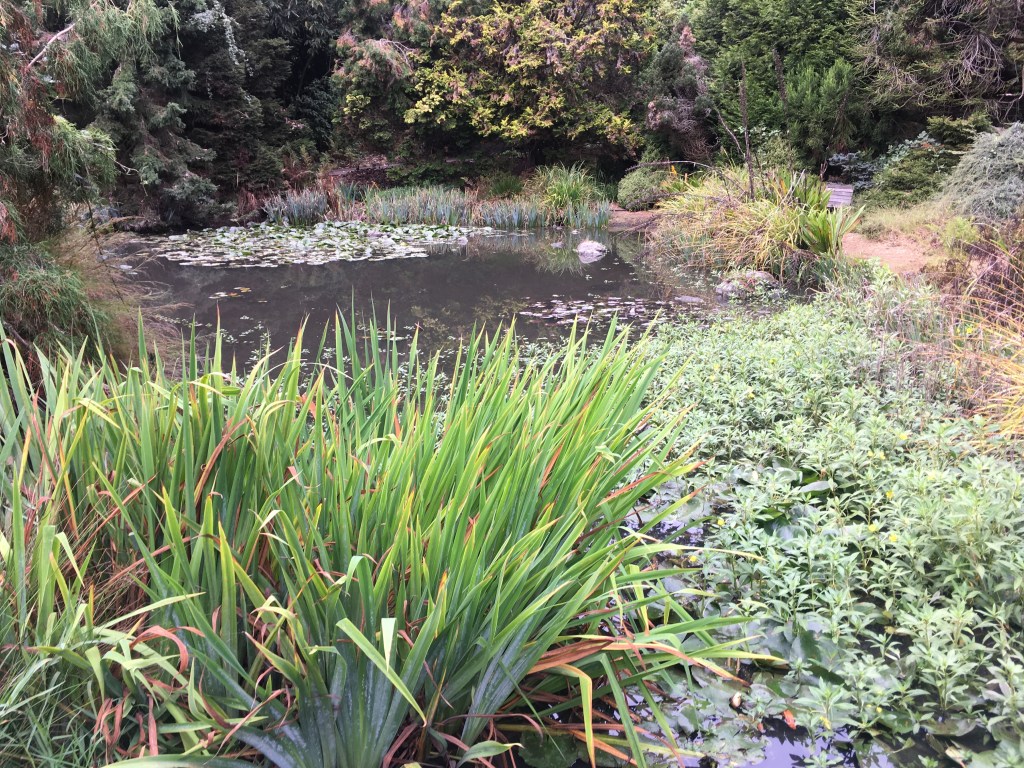
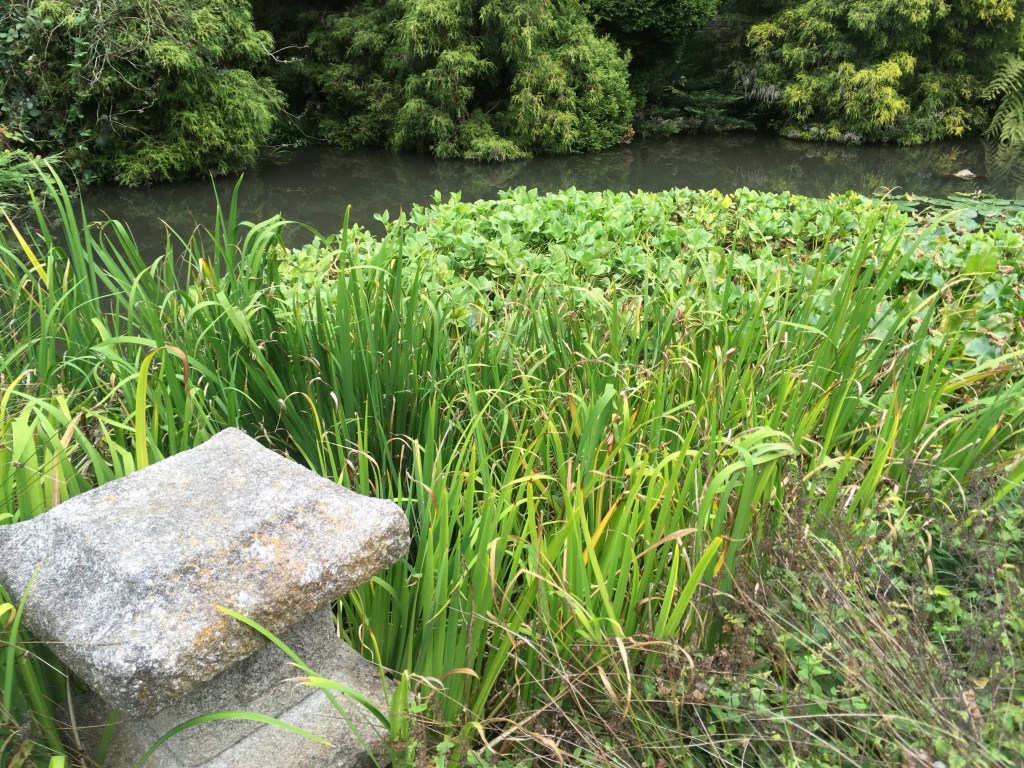
Okay. We are still following water, up the hill, past the California natives, up into the temperate Asia section of magnolias and dwarf conifers. There are four distinct ponds, all connected to one another by pipes and gravity. Simple and elegant design. The bottommost pond was dry, a pond that originally housed carnivorous plants. The rest had water. These ponds are also lined with bentonite clay. Occasionally leaks will occur at the edges where raccoon and coyote and skunk hunt for crayfish. Then the gardener has to fix the leaks… The ponds have names like bamboo pond, dwarf conifer pond, and Annelli Pond.

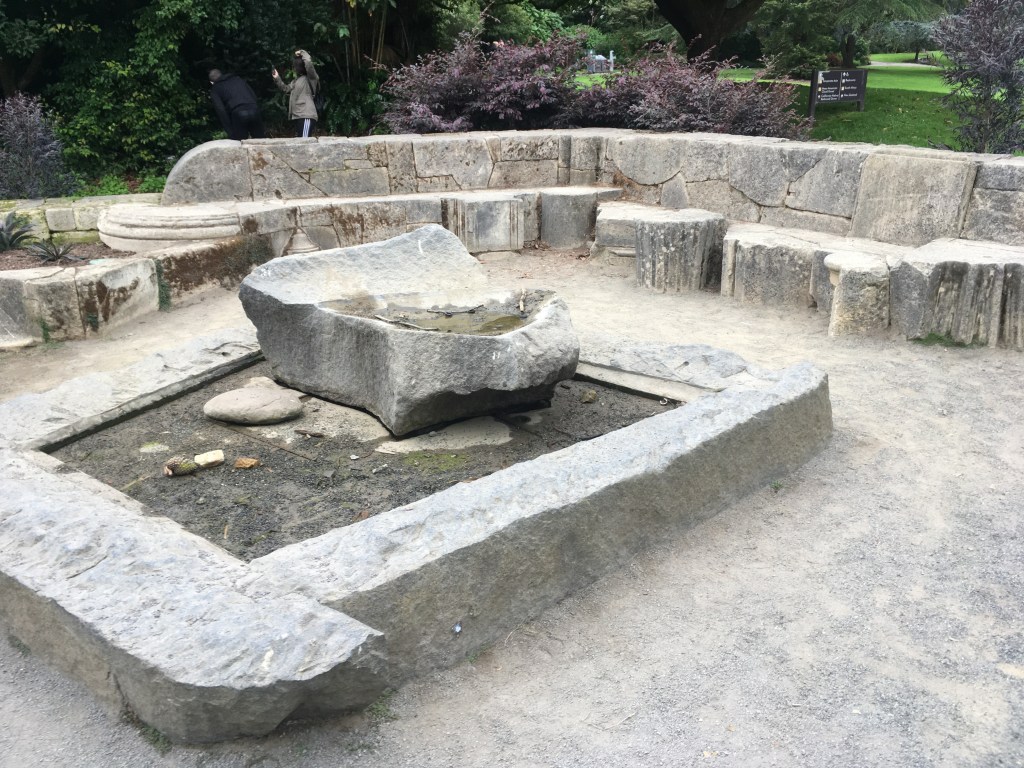
At the end of the tour we ended up back at the entrance, by the library courtyard garden, a garden enclosed by the Spanish monastery stones. With, you guessed it, a small fountain in the middle. There is a good history of the stones here: https://www.outsidelands.org/monastery-stones.php

Unlike a regular building material you go and buy at the store, the stones came in irregular sizes and shapes. So as a designer, there really is no way you can draw a plan and say make it look exactly like this. You can come up with a preliminary idea/structure, and then just let the stone workers run with it. It is in a sense off the books, improvised, and built in an organic manner. This is the same approach we use when building with recycled materials like granite curbstones or granite scraps from the cemetery dumpster.

Not sure about who did the work on this wall, but for a similar structure by the rhododendrons, they had to bring in four or five old time stone cutters from Oaxaca Mexico to put it together. This is not a common trade around these parts anymore, more like traditional artesanal craft. Pretty neat results.

The fountain was dry. And the plantings? They are new. Another design by the current curator all in purple with a touch of orange from the Alstroemerias. A plant palette based around, for the most part, one color.

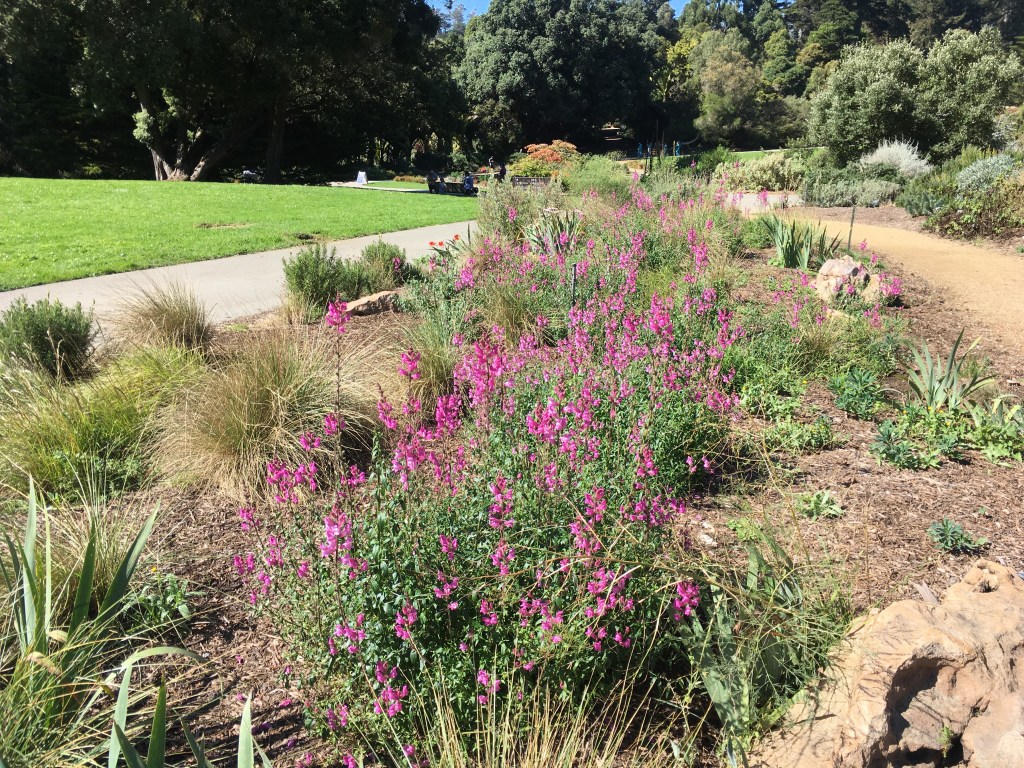
Well we will end the tour with a picture of plants wild collected from southern Spain – snapdragons, red poppies, yellow rockrose, esparto grass, and asparagus. A plant palette that come from a place, a community, an ecological niche, and a climate similar to our own. Well, enjoy, and see you in the gardens!

Water management addendum:

Salts

As gardeners and horticulturists, we talk about salts the way the chemists do
we are talking about a crystalline solid formed by a positive and a negative ion

table salt is sodium chloride, nice clear white crystals sitting in a shaker jar
pour that salt into water and the bonds split
the salt dissolves into solution
sodium and chloride become ions swishing and swashing around,
tucked within the H2O
sodium ion is charge positive +
chloride ion is charge negative –

an ion, by the way, is an electrically charged particle
the particle can consist of just one atom,
or it can consist of a group of atoms – polyatomic, a molecule
for example, sodium chloride is one atom of sodium to one atom of chloride
if the salt was ammonium nitrate, that would be one ion of ammonium and one ion of nitrate
ammonium is NH4 (one nitrogen and four hydrogens)
while nitrate is NO3 (one nitrogen and 3 oxygens)

we can now call that water solution full of ions an electrolyte,
meaning it conducts electricity
kinda the same concept as a car battery
or the special vitamin water or sports drink that says it replenishes your electrolytes
or the cells in your body with sodium and potassium coming in and out all the time
we are all skin bags of water, filled with bits of charged ions

now go look on any fertilizer or potting mix label


ammonium nitrate salt
ammonium ion is positive, nitrate is negative, easy

potassium sulfate salt
Potassium is positive, sulfate is negative, easy

calcium phosphate salt
calcium is positive, phosphate is negative, easy

all those -ATES: sulfate nitrate phosphate
theres gotta be a pattern
yeah it just means theres some oxygen in there cause oxygen loves to bind with others
sulfur and oxygen – sulfate
nitrogen and oxygen – nitrate
phosphorus and oxygen – phosphate

if you are ground water running through limestone channels or quarries
for sure you will pick up some of that calcium and magnesium in the limestone
then that water is called ‘hard’, and it forms deposits on the kettles and things called ‘scale’

if you are ground water running through sodium rich soils
then you will pick that up too
and become sodic or saline or salty
maybe somebody will put you in a pond, and evaporate the water
then bag that salt and sell it to passerbys and traveling caravans

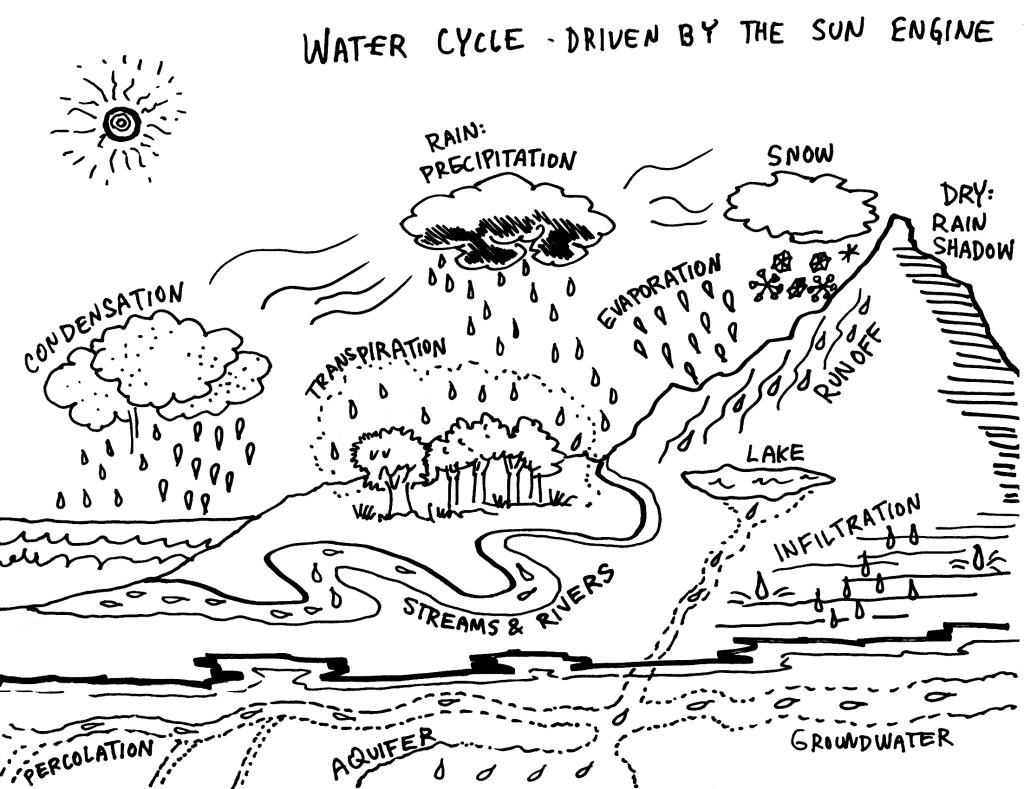
if you are rain water, that is pretty pure stuff for the most part
unless you picked up some burnt stuff particles on the way down from the clouds
some bits of sulfur or nitrogen from the volcano or the power plant…

in general
as a gardener and nursery person, you want minimize the salt buildup in the soil
a little bit of salts (fertilizers) is good right?
yes, but you want a balance, you want just enough, not too much of a good thing
which becomes a bad thing

imagine you have the soil chock full of sodium ions
and the plant stops absorbing the other ions altogether
no more magnesium and calcium and iron and copper and potassium and zinc
all it gets is sodium
not good, gonna get sick
plant goes caput, and your career as a grower goes down down down

time to time you may have to leach the soil, or add other things to compensate & balance for
the distribution and quantity of ions
the amount of salts

last thing
just to be technical and make the high school chemistry teachers happy
a negative ion is called an anion
and a positive ion is called a cation, a ca+ion

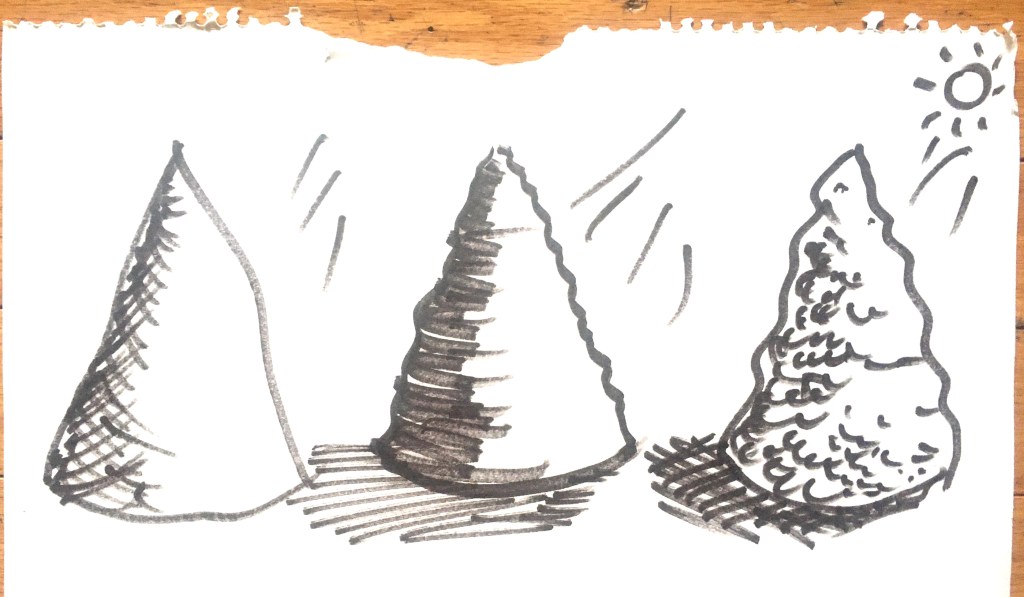
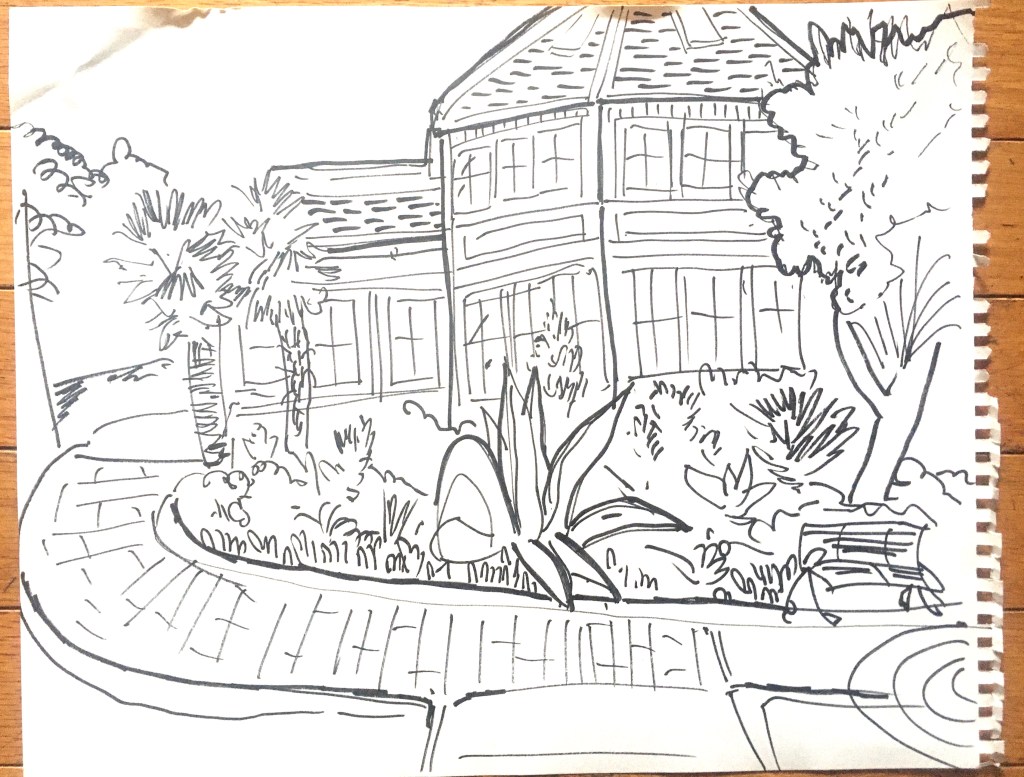
We had a nice draw freehand style draw at the Sunnyside Conservatory

talked about different ways to shade a tree

and how freehand requires a loose throw it all out there approach

in contrast to the more accurate but rigid to-scale type drawings

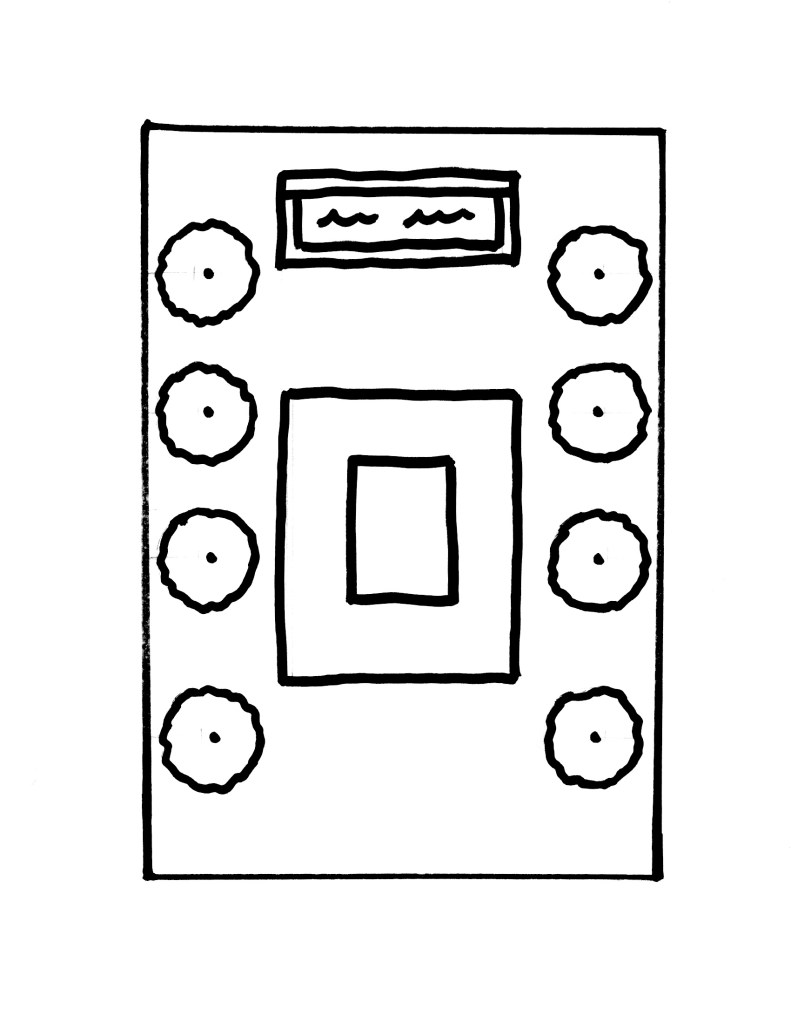
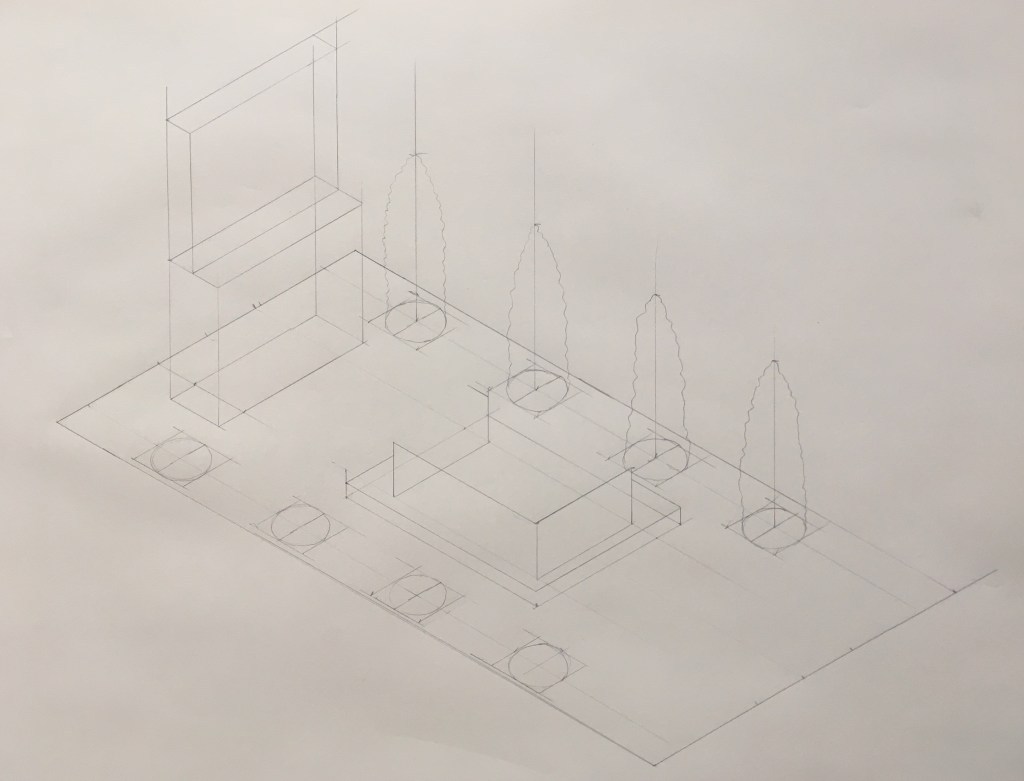
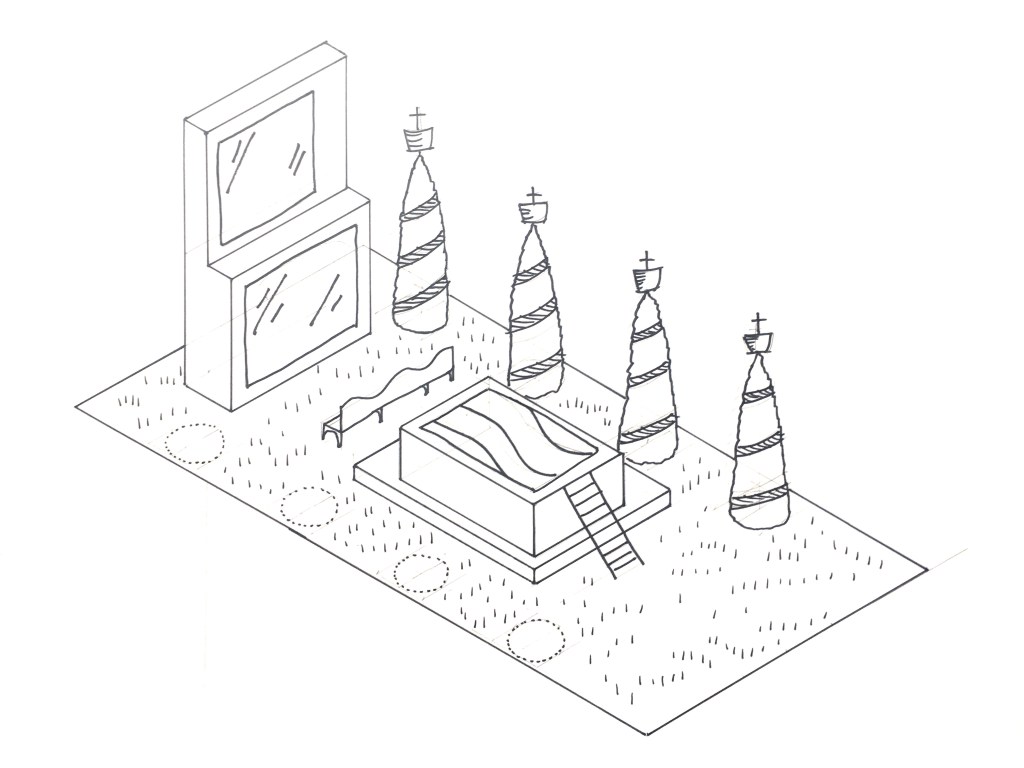
Lets take the basic plan we had from our one point perspective

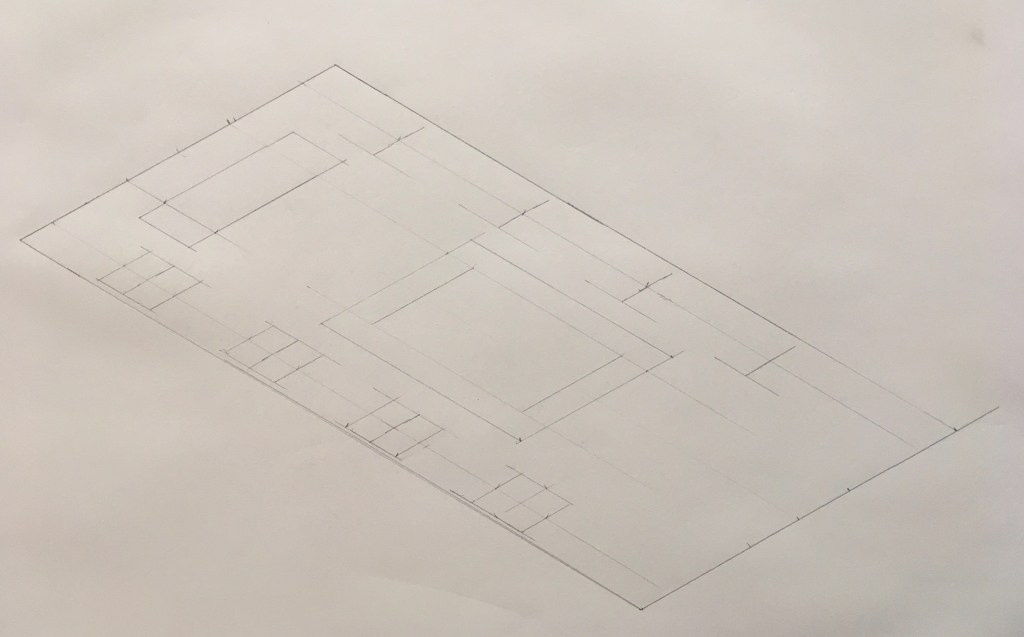
and develop it into an isometric drawing

where that nice 90 degree angle is now 120 degrees

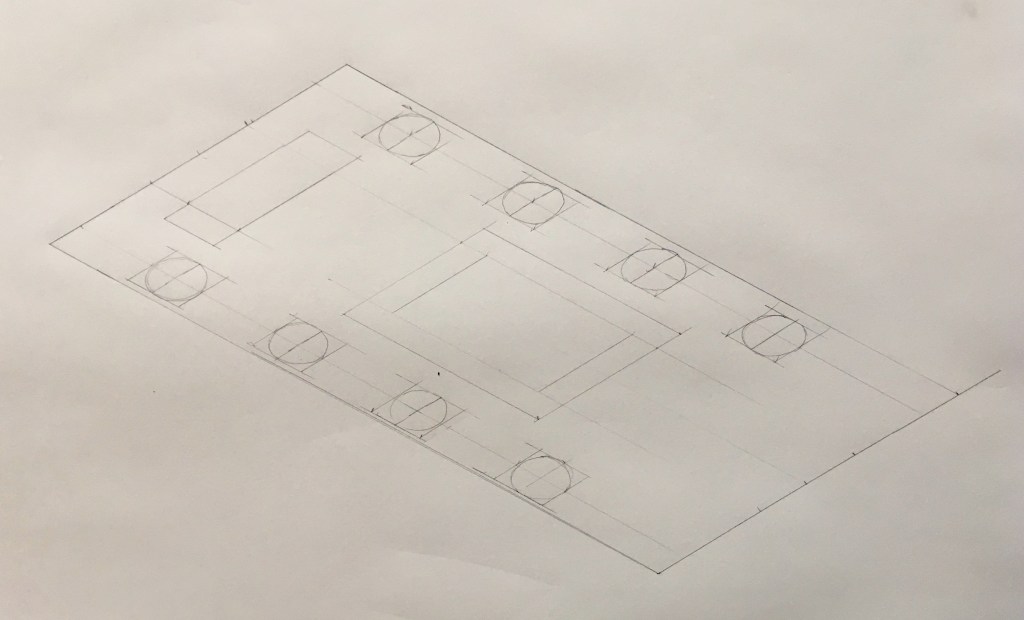
and much of the drawing is done with the help of the 30-60-90 triangle

it is all to scale – so that is pretty easy

but to be fair – it is not really a perspective

in the sense that things far away are small, and things close up are big

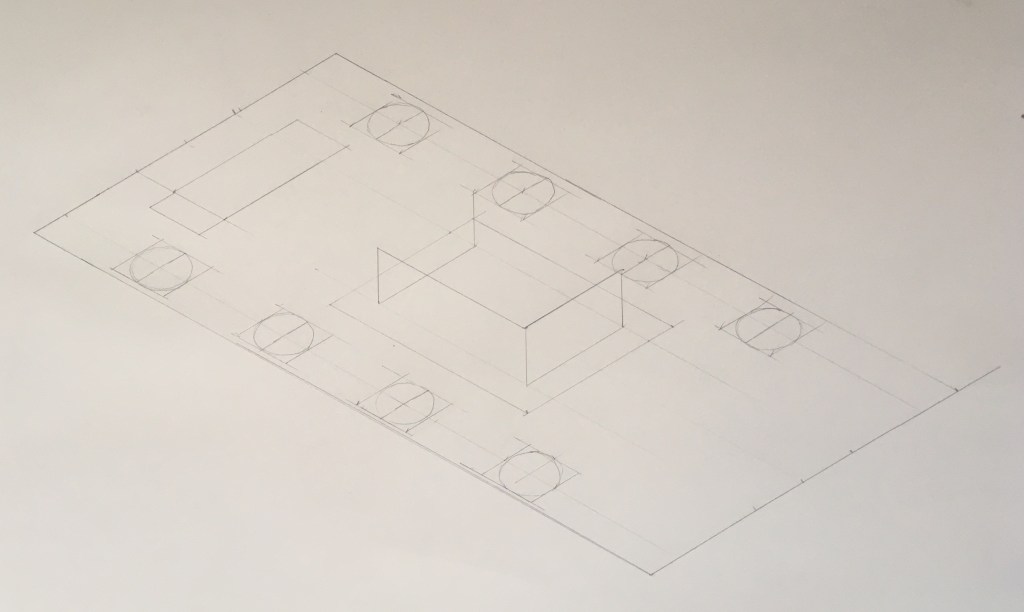
still, it does convey the three dimensional imagery,

and helps the viewer to understand what you are visualizing

for the outdoor space

Remember to use the 30 degree angles!!!

And measure correctly! Start with pencil…

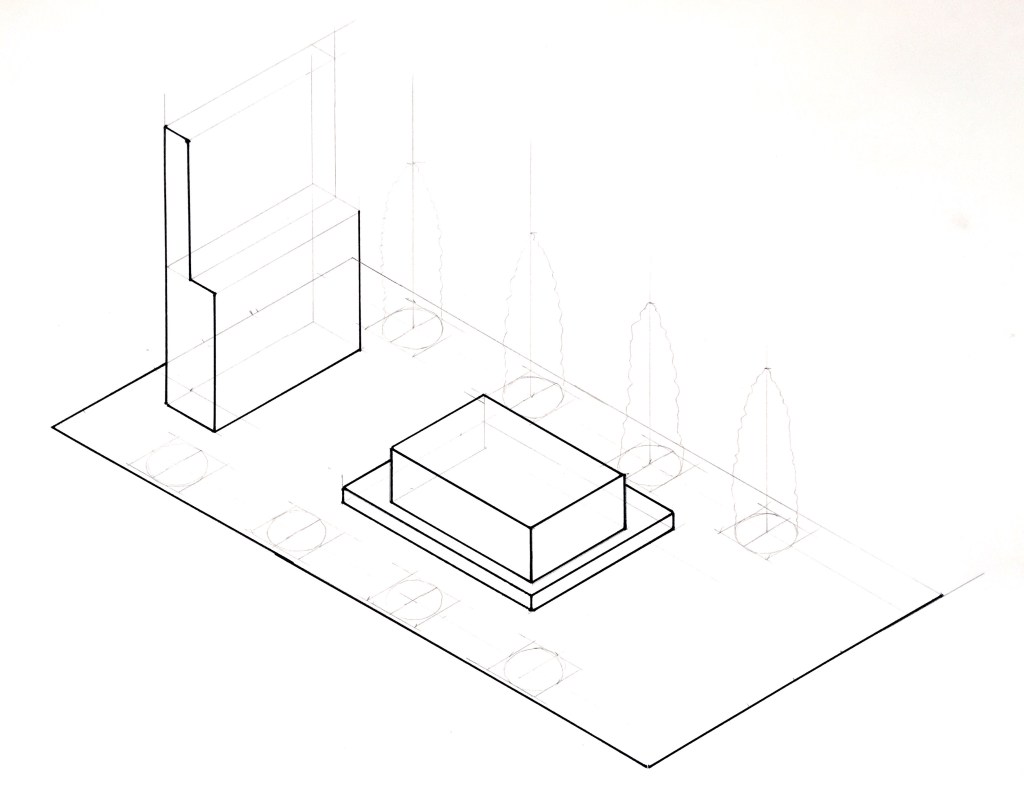
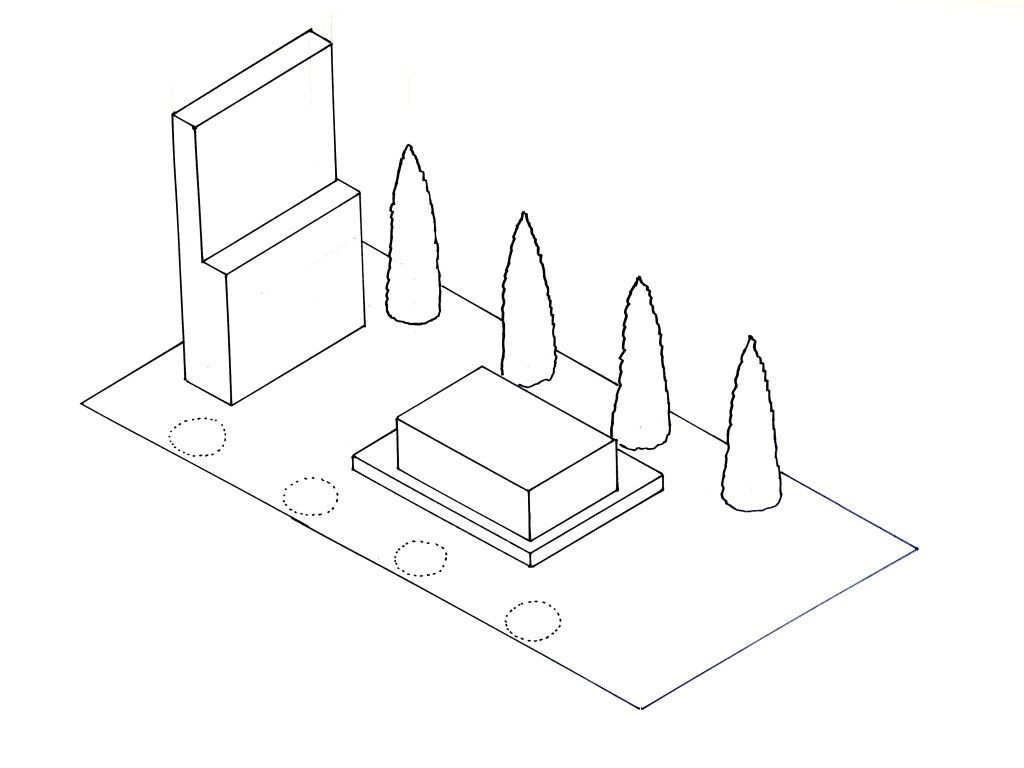
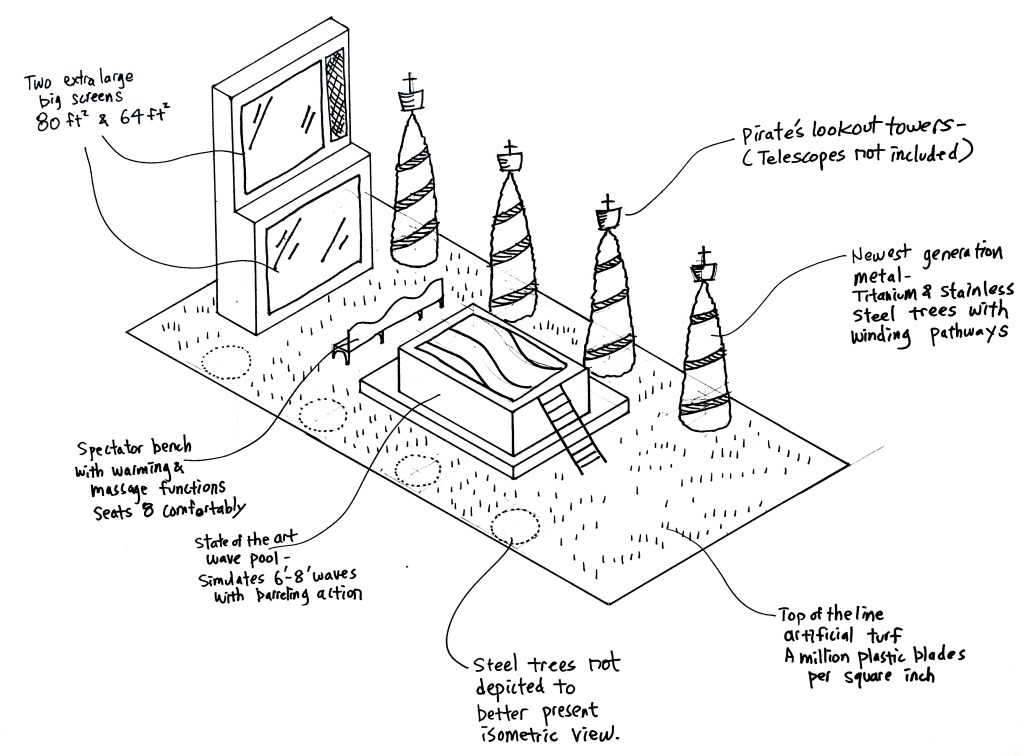
Okay that about does it! So instead of a rectangular patio in the middle, thought it would fun to pop it up into some kinda structure. And the thing in the back of the garden, not sure what that is either?! Practicing the basics of an isometric drawing – YES! Good planning? – Maybe not… But I got my Italian cypress trees ready to screen the neighbors! Lets go to ink.

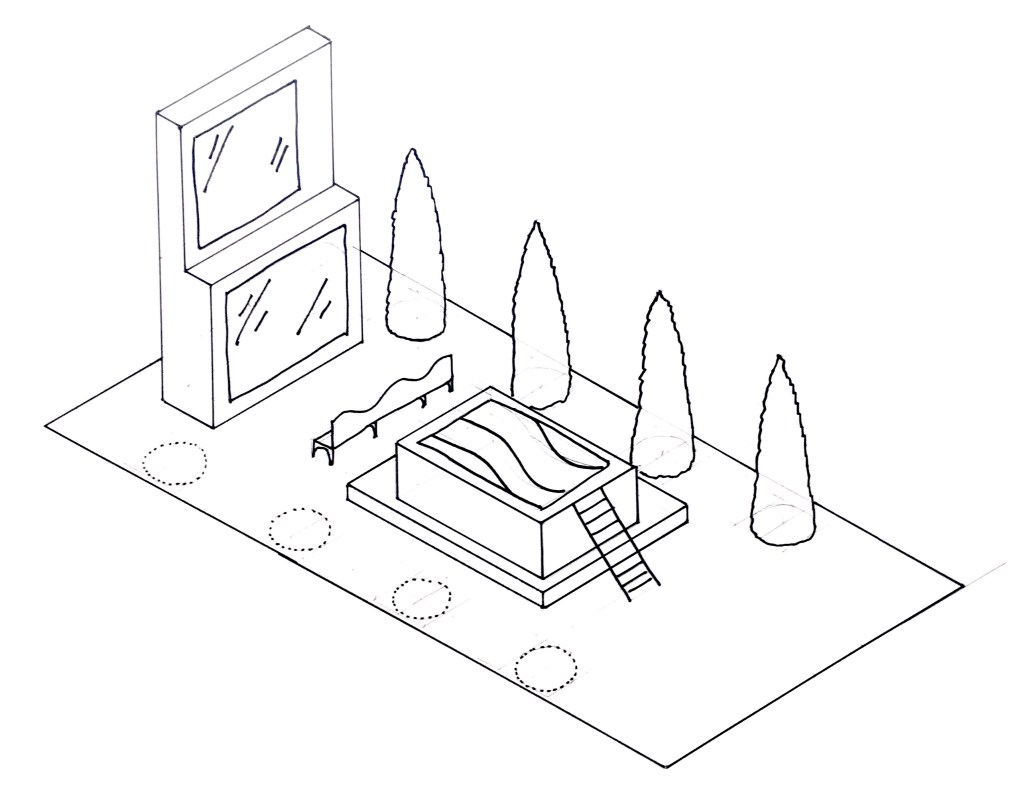
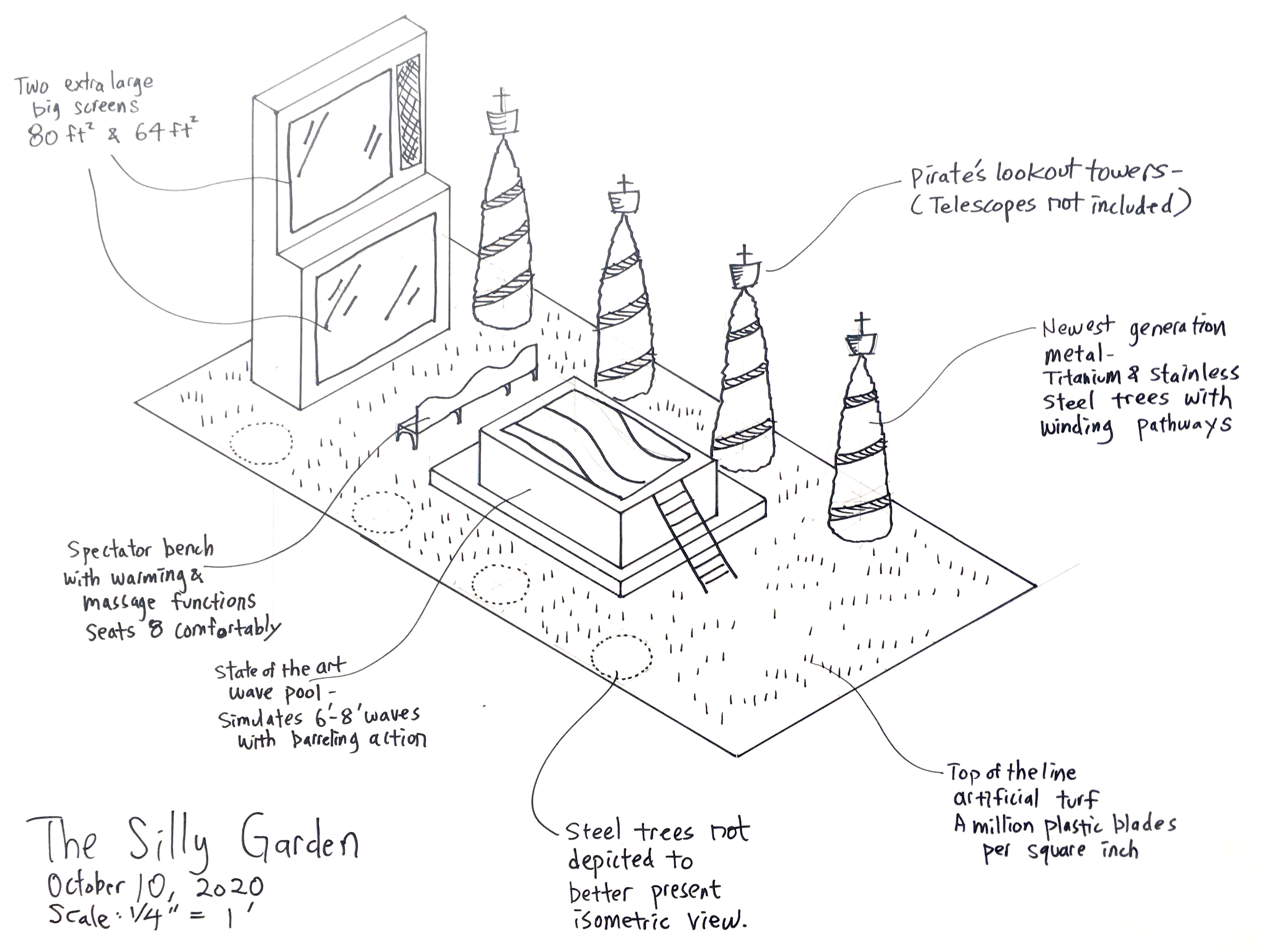
Now wait a second. What are you doing?! What is this strange mess of a garden?!? Stop this nonsense! Go back! Go back!

Are you serious at all!? Who would want to have such a place in their backyard? Well, at least you get the idea – an isometric drawing. Now it is your turn. Let’s go!!!