There is a diagram, in the Ethnobotany of the Seri Indians book by Richard Stephen Felgar and Mary Beck Moser, of the near shore ecosystem at the Infiernillo Channel, between mainland Mexico and Tiburon Island. Figure 2.3, page 23:
What a fantastic world of mangroves, eelgrass, and mullets in the Sea of Cortez! This is my interpretation of the same diagram as above. I am in love with the estero and intertidal sands – tiny biting flies on the beach included:
Aside from the sun depicted in the sky, the lunar months of November and December are represented by the two stars of jack rabbit and turkey vulture. And that is a pack rat playing a violin at the bow of the balsa reed boat.
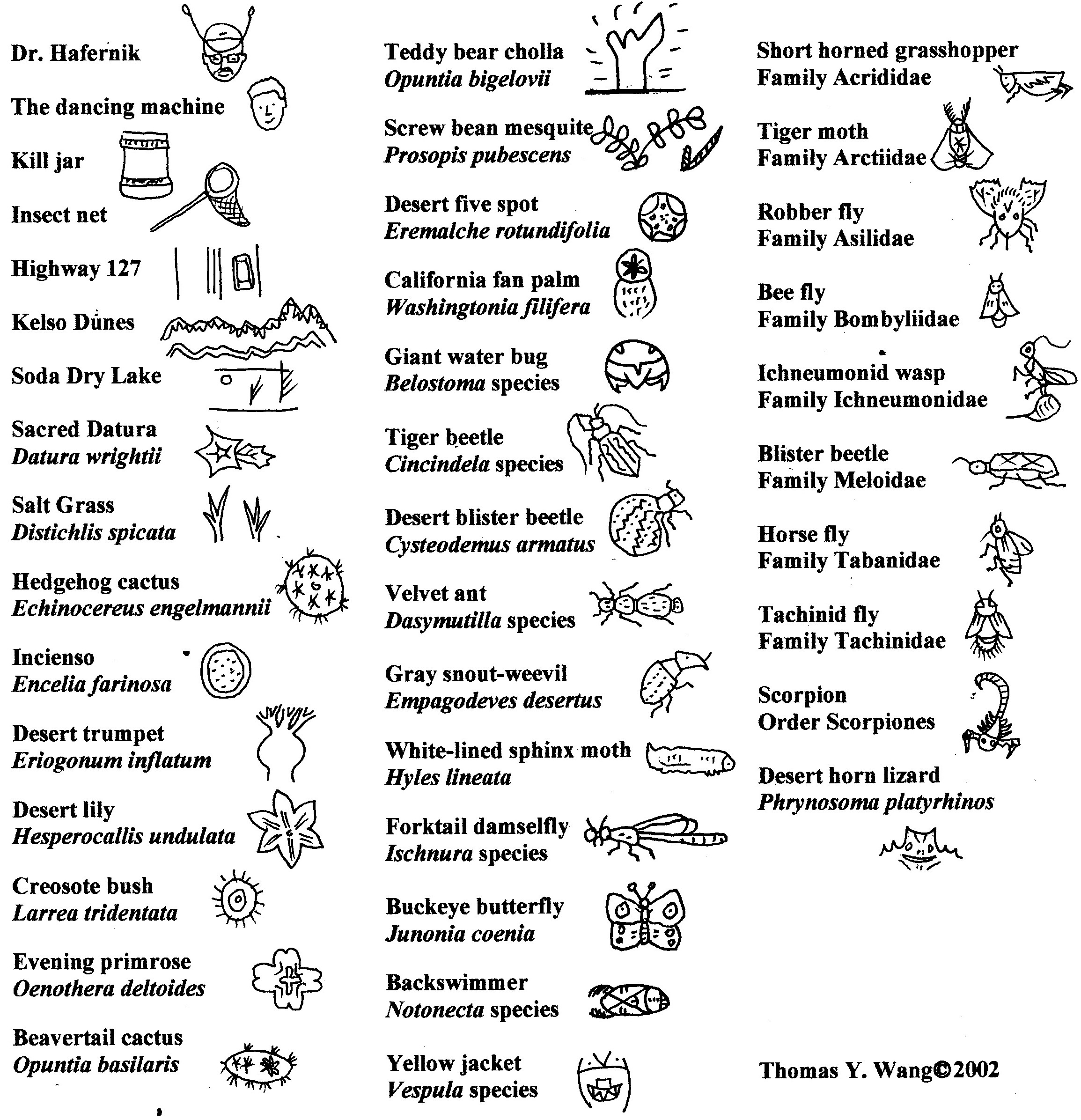
This painting was inspired by our entomology class field trip to a desert research station located in the Mojave desert at Zzyzx, about a hundred miles south of Las Vegas. It is dedicated to my teacher and advisor Dr John Hafernik of San Francisco State University. He is depicted as a buckeye butterfly wearing a baseball cap, surrounded by screw bean mesquite. My fellow graduate student is at the lower left, Dr Gene Hannon (aka Gene the dancing machine) who studied damselflies.
The overall image is that of a glass collecting jar we use to gas the insects that we captured. The jar has a plaster and cyanide base that kills/asphyxiates our prey after a bit. Then, we identify and pin them for our studies. You can see a tiger moth, a short horned grasshopper, a backswimmer, a velvet ant and others all laid up, upside down at the bottom of the jar.
There is also the landscape that we traversed. There was Kelso dunes with primroses and stink beetles walking casually across scorching sands. Plus spiny flat horned lizards who specialized in eating ants. There was clustered spreading mounds of pungent creosote bush, and white tissue paper like fragrant datura on the sides of the road. We drove on a highway crossed by thousands of sphinx moths on their ancient migration paths; some larvae were smeared, others made it out alive. We paused at a dried up, white, alkaline soda lake, where tiger moths were at the edge, emerging from holes with buzzing speed. At the research station itself, there were California fan palms with full voluminous skirts of dried up leaves, and sandy washes with blazing stars.
Last but not least in the picture, there is an odd bug looking dude staring back at you. Its got a pair of cactus eyes – comprised of a round hedgehog cactus and an opuntia flat pad of a nopale. The appendages hanging off the eyes are the handles of insect nets, held on the left by a blister beetle that does not fly, and on the right by an ichneumonid wasp with a long egg laying device coming out of its abdomen called an ovipositor. At the tip top of the bug dude’s head, between the two eyes, near the bipinnate leaves of the mesquite, is a tiny third eye common in insects. It is a simple eye called an ocelli; it is useful in sensing light and dark, and in the function of daily rhythms.
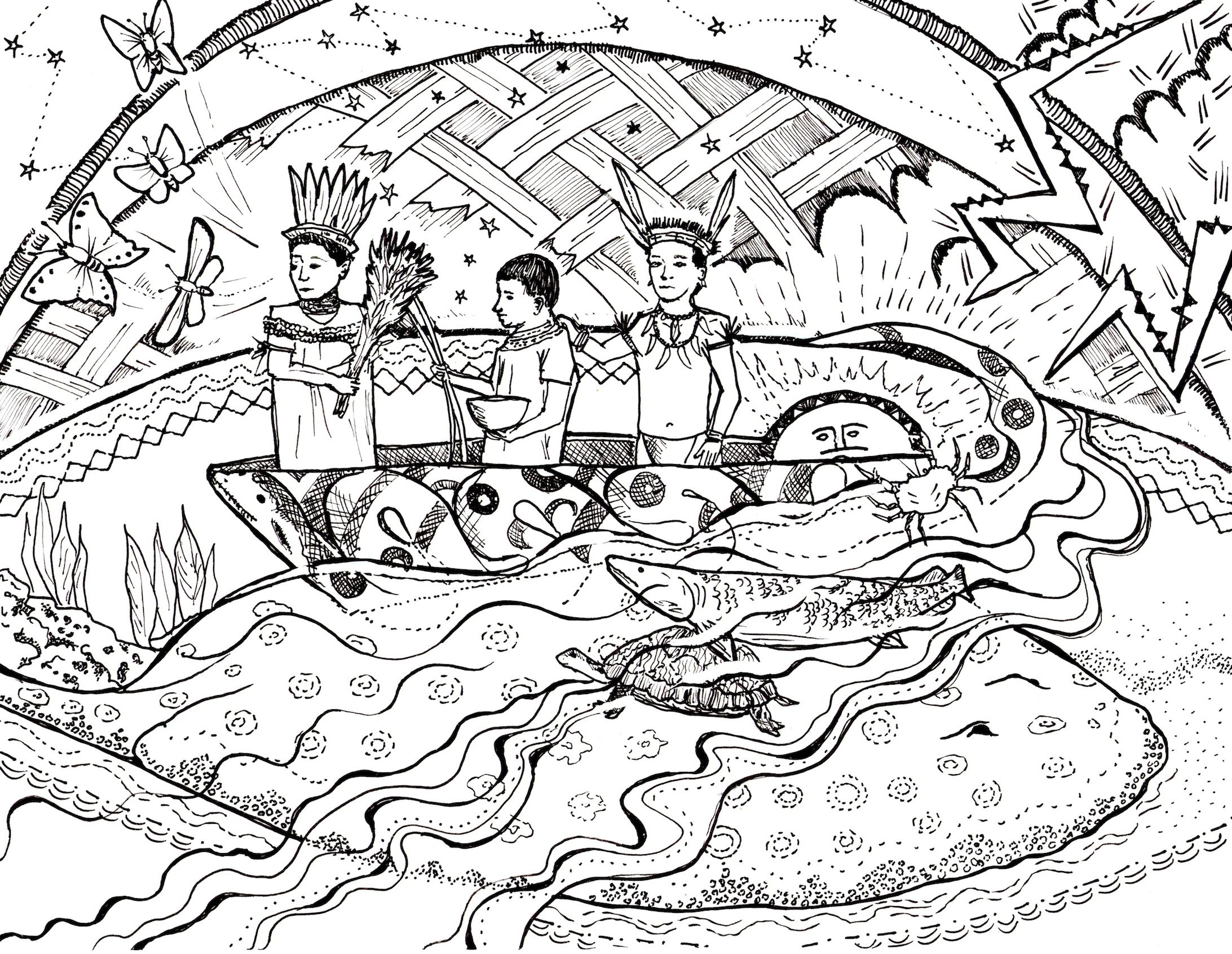

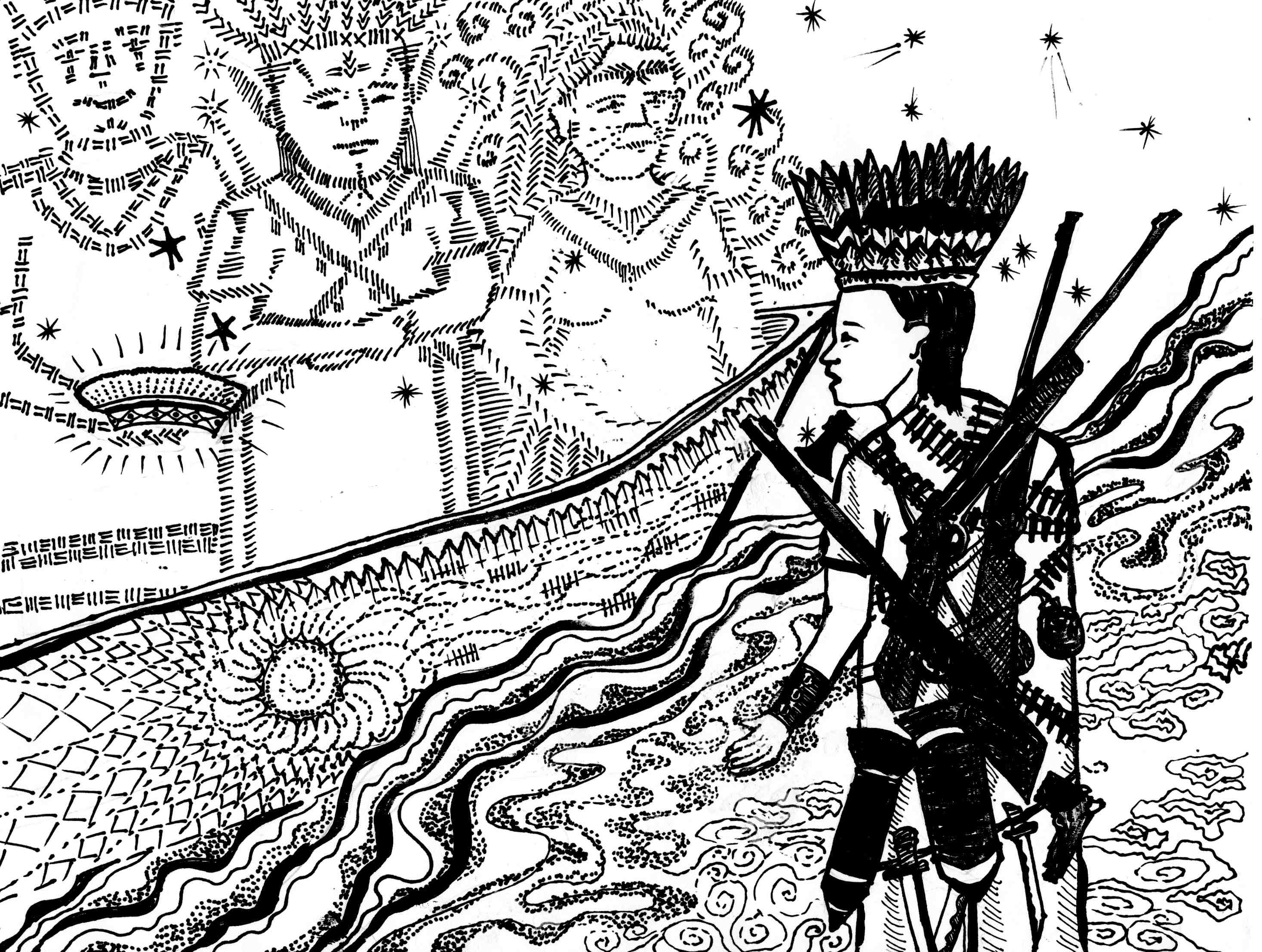
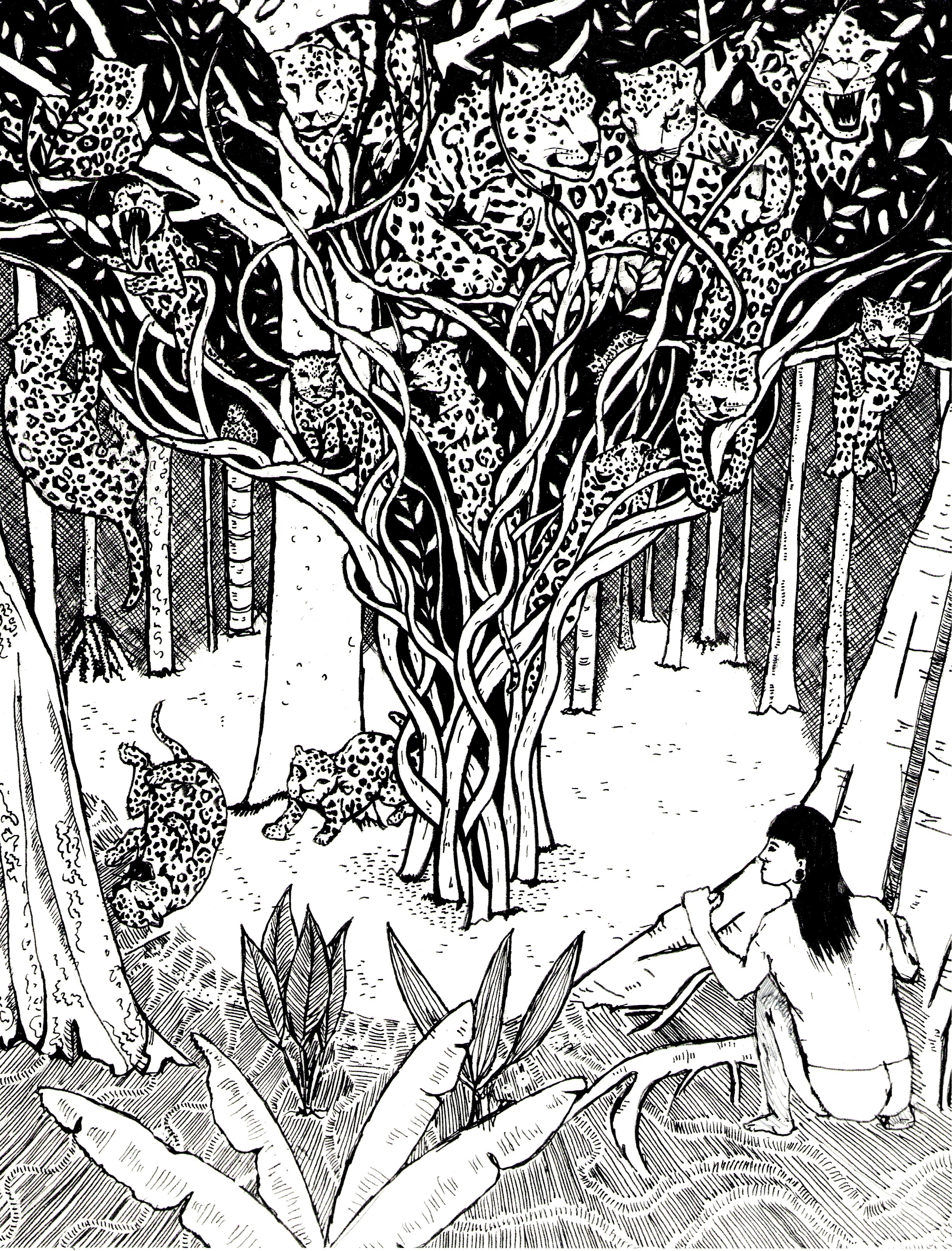
I forget the source of this story. Perhaps it was posted in Amazon Frontlines? The part I do remember is that the squirrel gnaws on the liana that holds the world tree, breaks the vine, then the tree falls down. What happens to the people after that? Where do the birds, butterflies, and cicadas go? And the jaguars running loose everywhere?! There is a huge evil harpy eagle on patrol also…
Sorry folks, I’ll take an incomplete. Better go back to sleep, and dream about this one a little bit more for a followup sometime in the future.
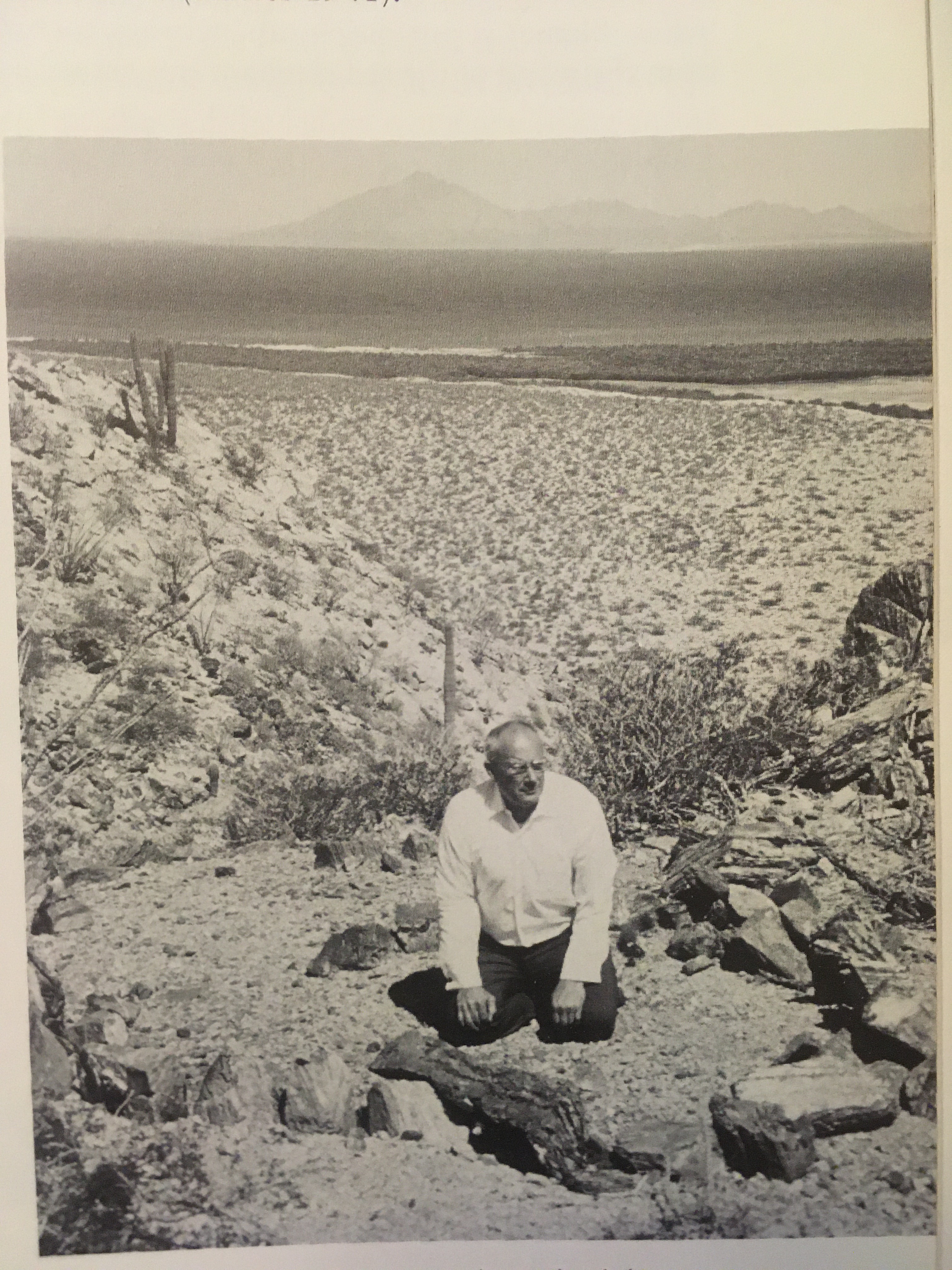
It had a picture of old time hero Dr Schultes crouching in a vision quest circle, lookin’ like he was about to fast for a few days and meditate on the desert.
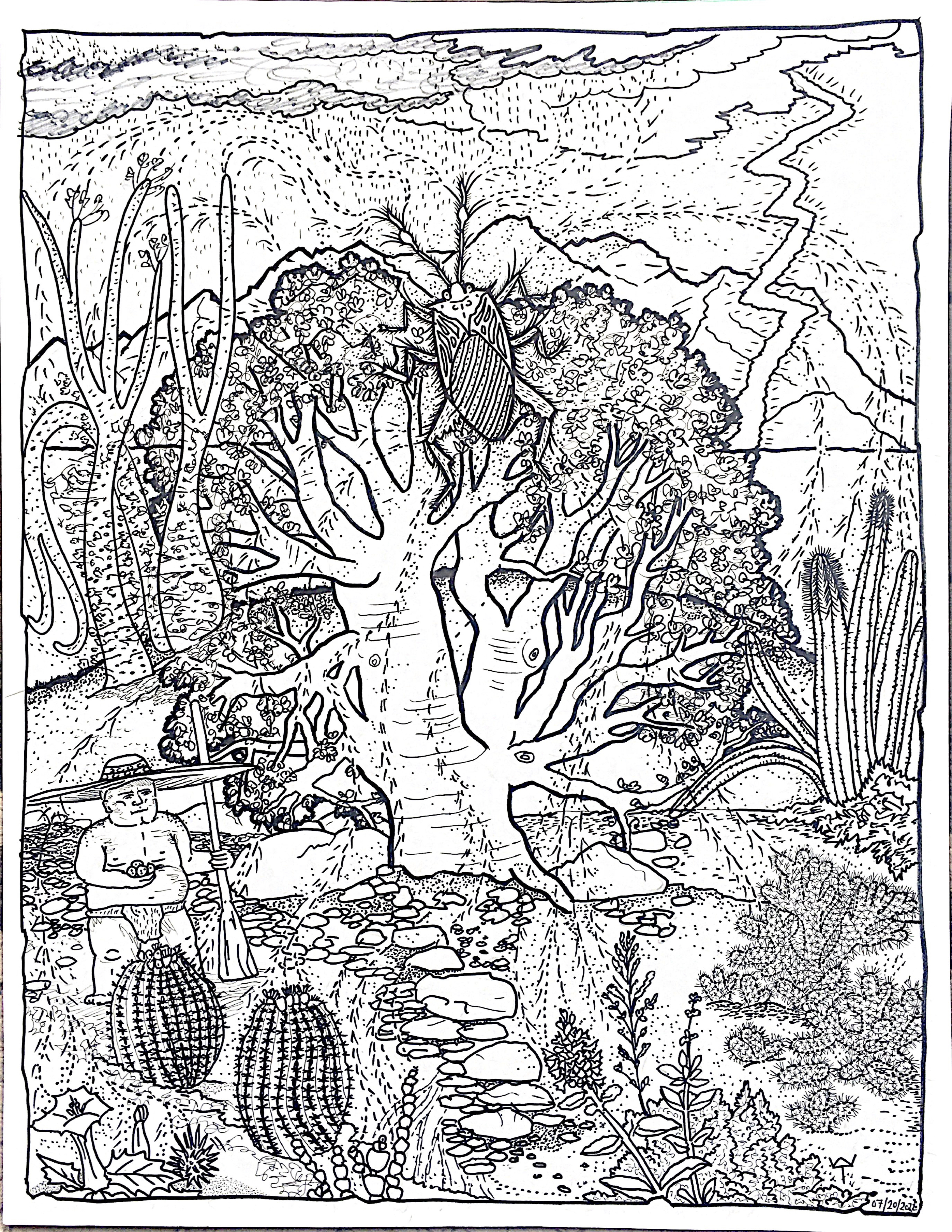
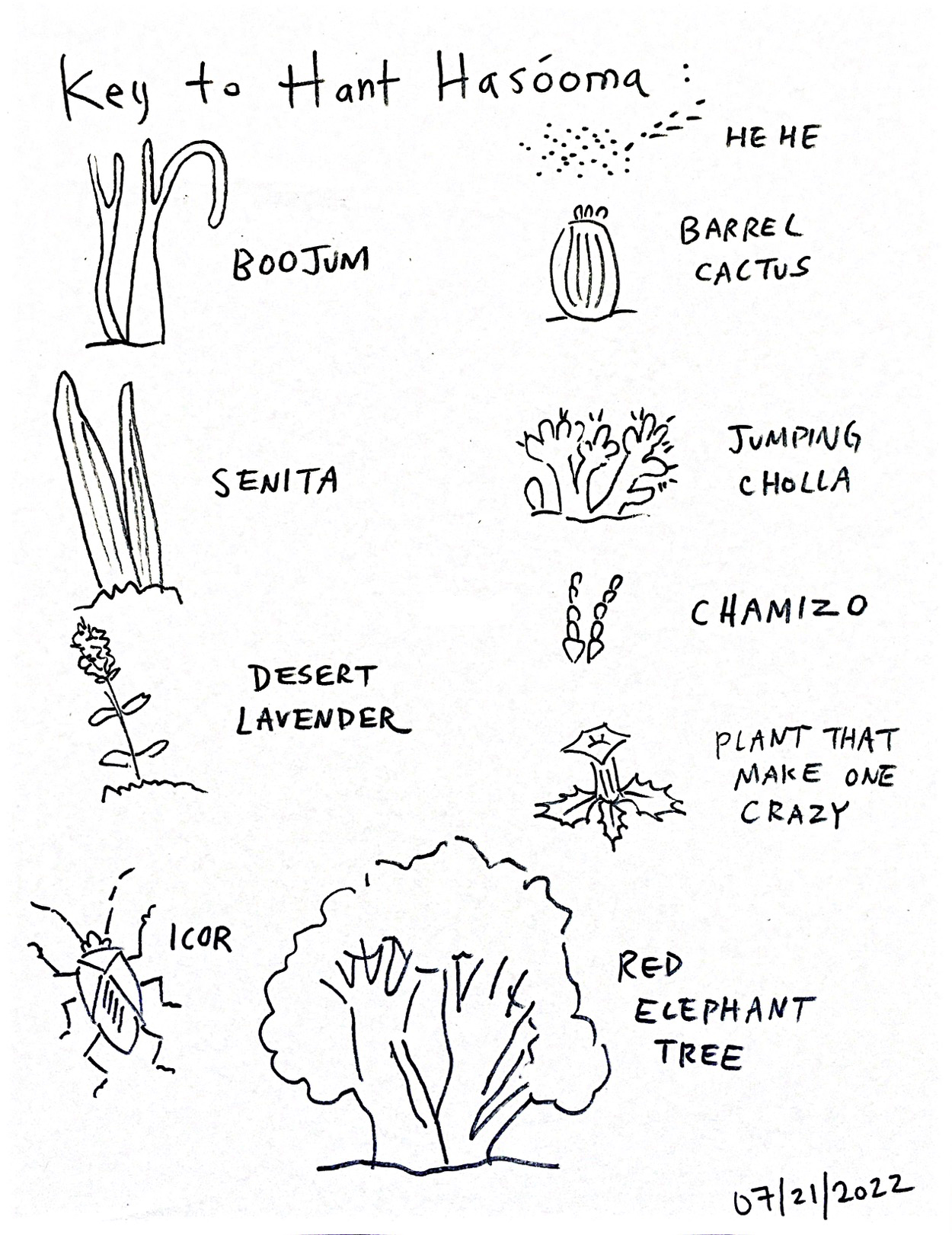
In the section on the supernatural beliefs, origin stories, and culture creators, they talk about the spirit power of plants. There is this idea of an invisible power that looks like a hairy bug named ICOR, and it is in charge of the life and spirit of all the plants. Moreover, the hairs of the ICOR create dust on the plants, dust of various colors. And sometimes this dust drifts into the air and forms clouds, storms, rain, the whole bit.
Well I thought this was pretty wicked cool, and if anything, somewhat resembled our scientific water cycles of transpiration and cloud formation, along with how plant cover can facilitate rainfall in a given region.
Another part of Seri mythology was about the various humanoid mythic beings that made this earth habitable for people. One such creator was a short, fat, dirty, breech cloth wearing dude named HANT HASOOMA. He reminded me of the master of animals, and so I had to draw him too. He is basically the spirit of the desert itself.
And heres the key to some of the Sonora desert plants in the drawing. HEHE is the name given to the life and spirit of a plant:

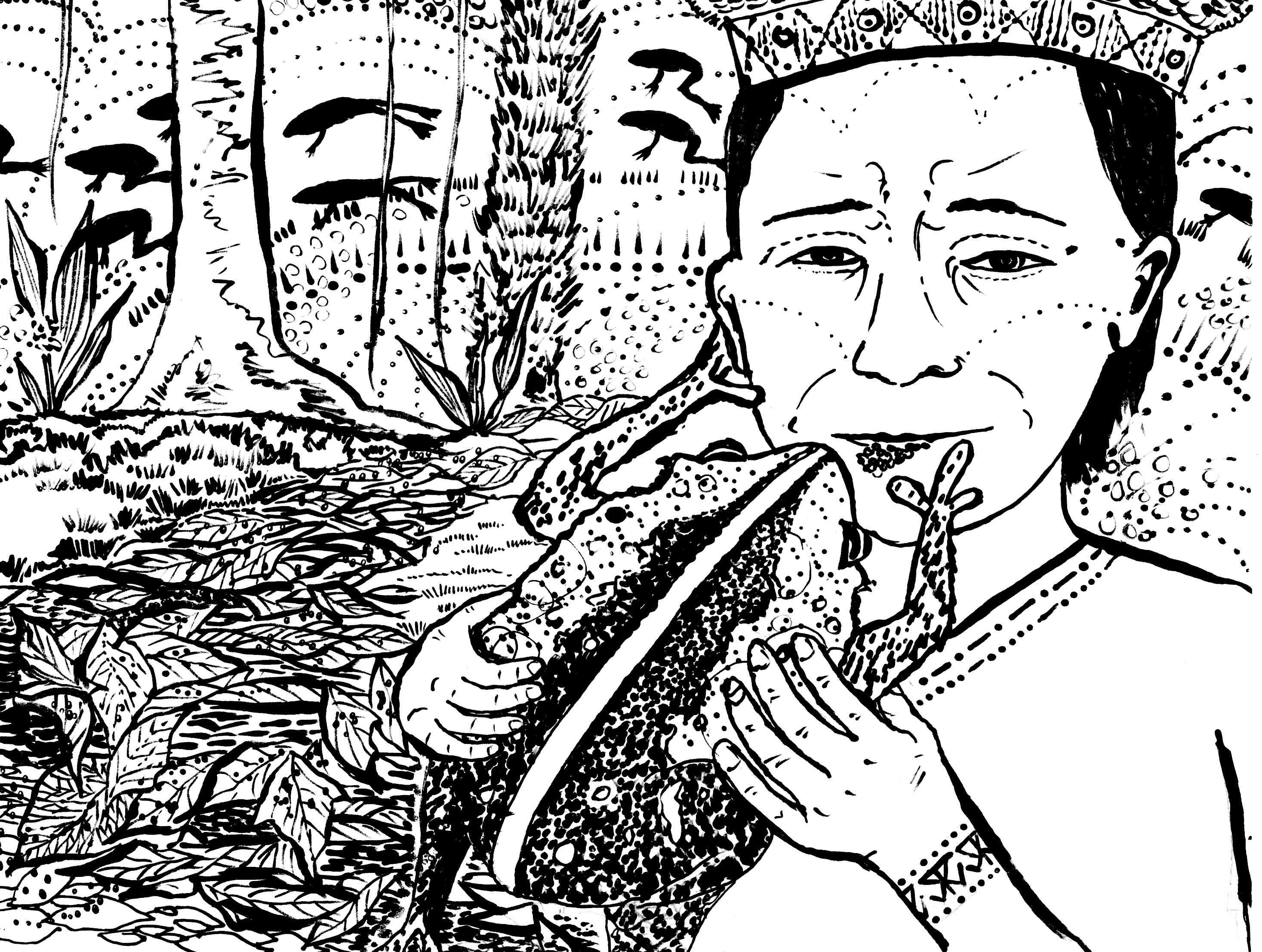

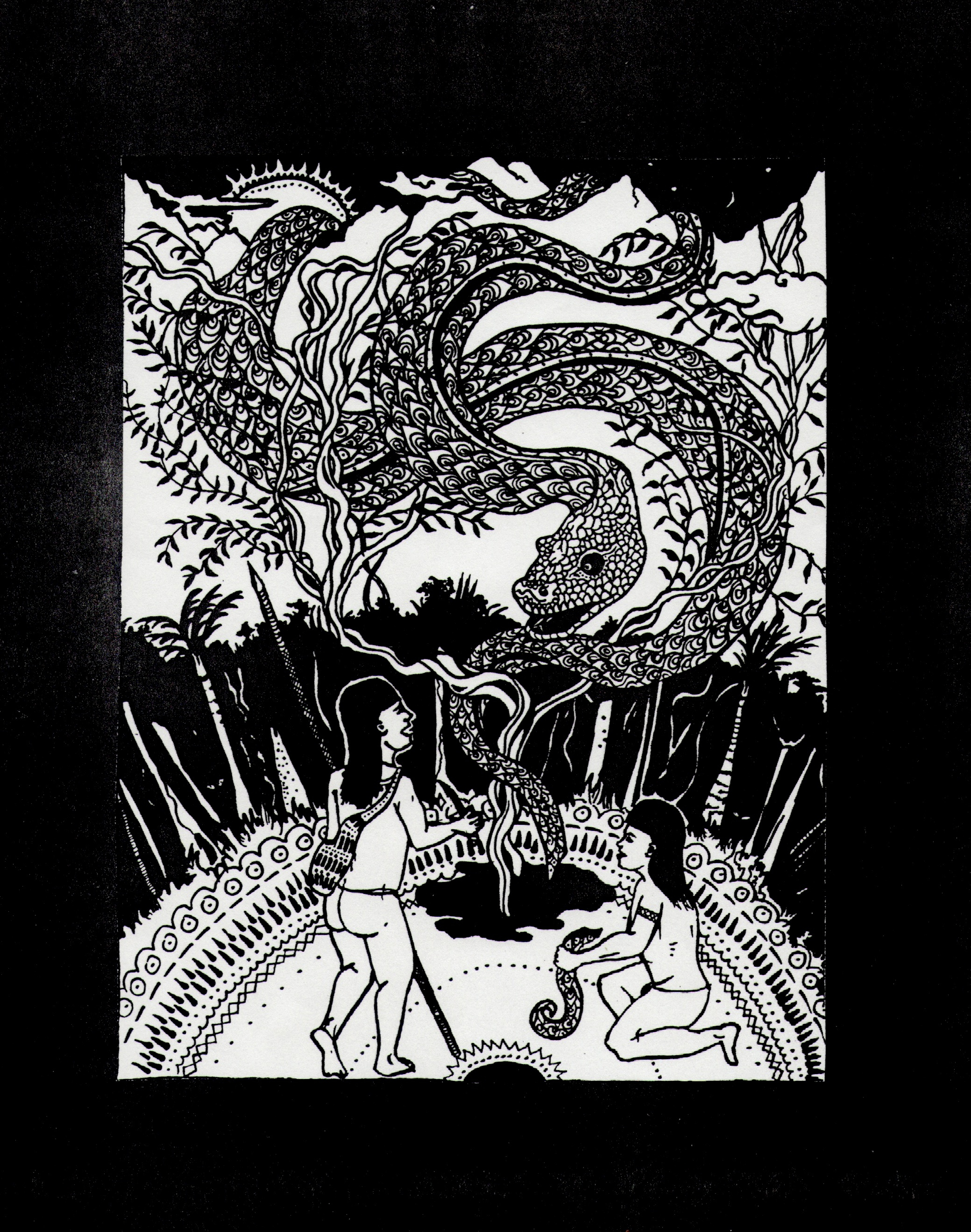
These are some sketches I did for friend Sparrow JSM in his book entitled Rainforest Medicine: Preserving Indigenous Science and Biodiversity in the Upper Amazon. Some of the pictures made it in, some did not. Well, check out the book if you want to learn more about tropical jungle botany and the healing methodology of native peoples.







 Mission Azul