As part of the landscape design class, we visited the San Francisco Botanical Garden to examine the role that water, stone, and plants play as part of the overall design. The gardens feature a diversity of plants from the Mediterranean climates of the world, cloud forests of Central America and Southeast Asia, and temperate zones of mostly Asia, Europe, and North America.
The design of the gardens is a cooperative effort between many different peoples over time. This includes supervisors and managers that stretch back to superintendent John McLaren and more recently folks like Walter Whalen and Matthew Stephens. Notable designers and architects such as Thomas Church, Ron Lutsko, Bernard Trainor, and Roger Raiche have all left their footprints here. Past curators and collectors who have develop the plant palette include Don Mahoney, Bian Tan, Tony Morosco, David Kruse Pickler, and on up to the present day curator Ryan Guillou. Contractors of course play a part in actually placing stones, moving soil, and installing boardwalks. Of late, that has included Rock and Rose and Goodscapes. Lastly, and most importantly, it is the gardeners day to day activities that help to shape the true design of a garden over time.
We will take a counter clockwise tour of the botanical gardens, and check out individual vignettes and specific gardens. Put your critical thinking cap on, and be ready to apply the basic principles we have discussed in class – balance, rhythm, scale, and unity. We may touch upon issues of public and private space, native versus non natives, function and aesthetics, people and wildlife, safety and maintenance. In short, you are called upon to use your skills as a designer to bring it all together.
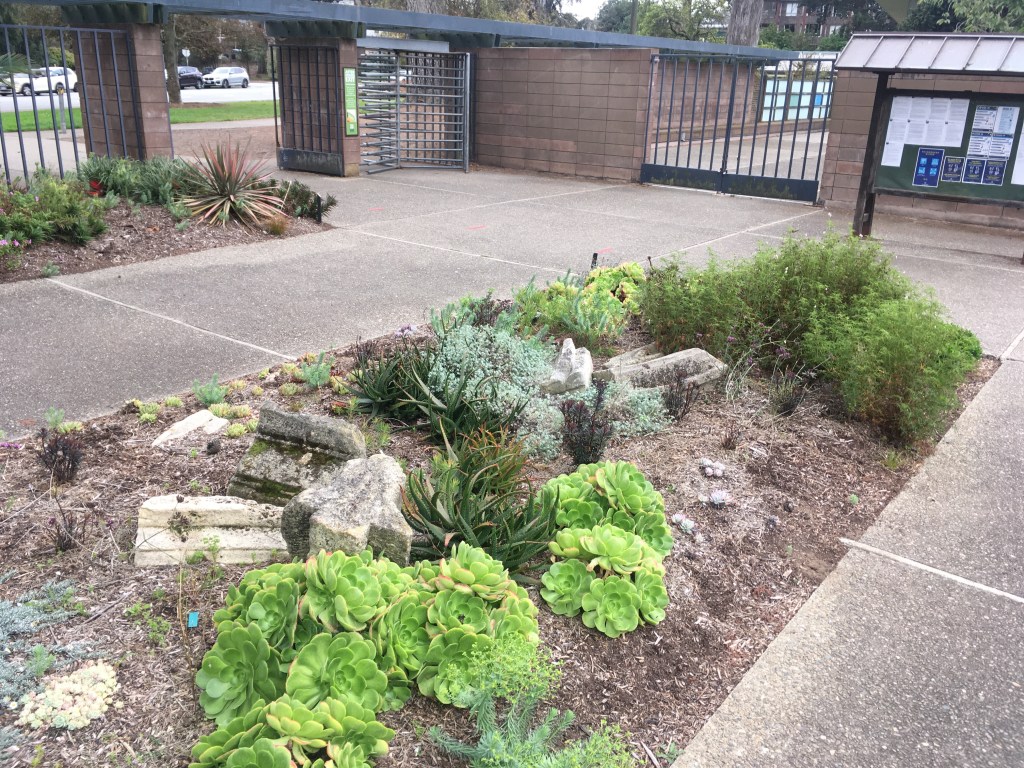
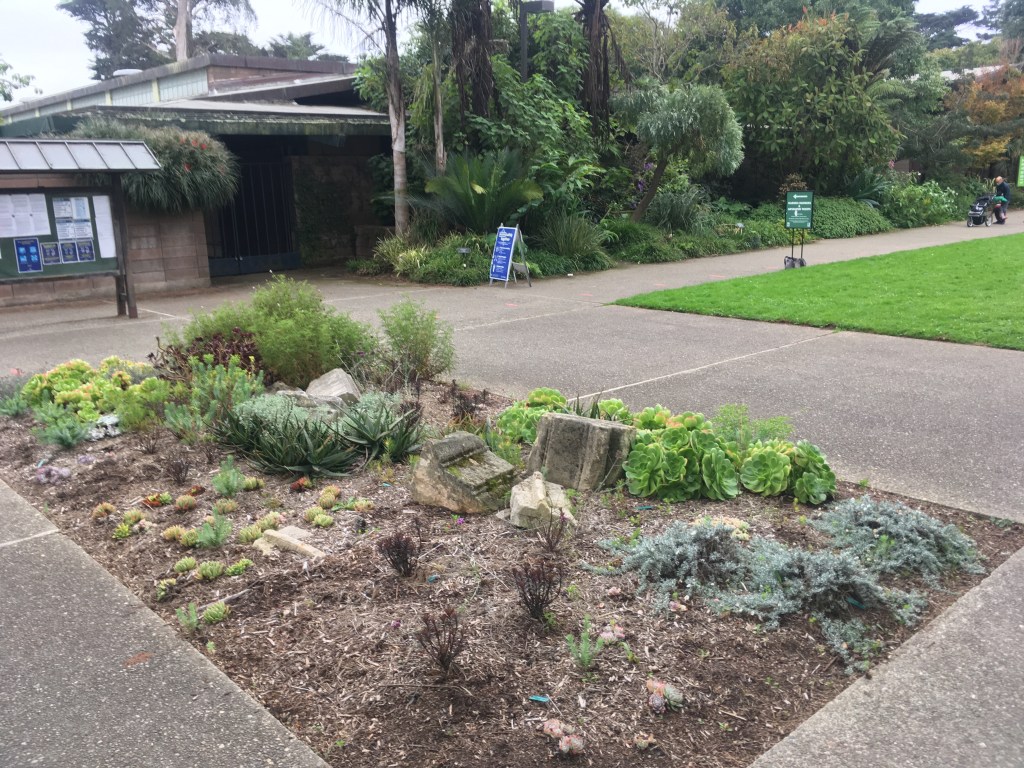
At the entrance, this is a piece by Guillou. While most of the plants have grown in, and its become a bit harder to discern the pattern, the number of objects is always in odd numbers. Threes, fives, and more. So there is that tension or asymmetry we discussed with regards to repetition of plants and the counter balancing of softscape with hardscape. Count em.
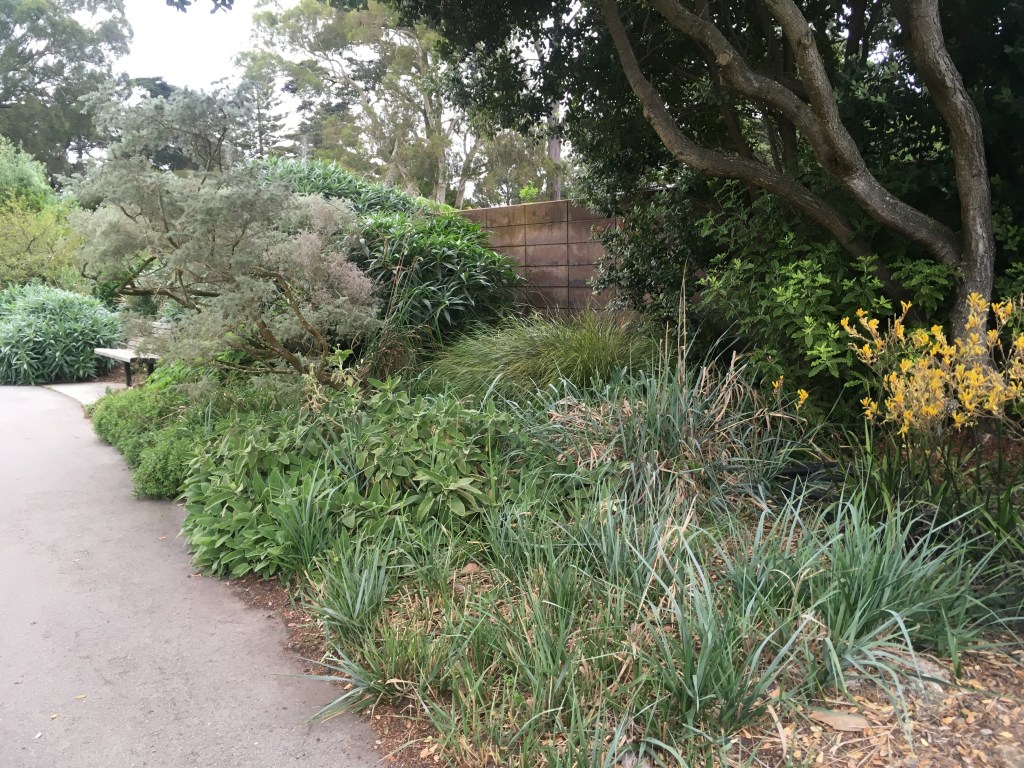
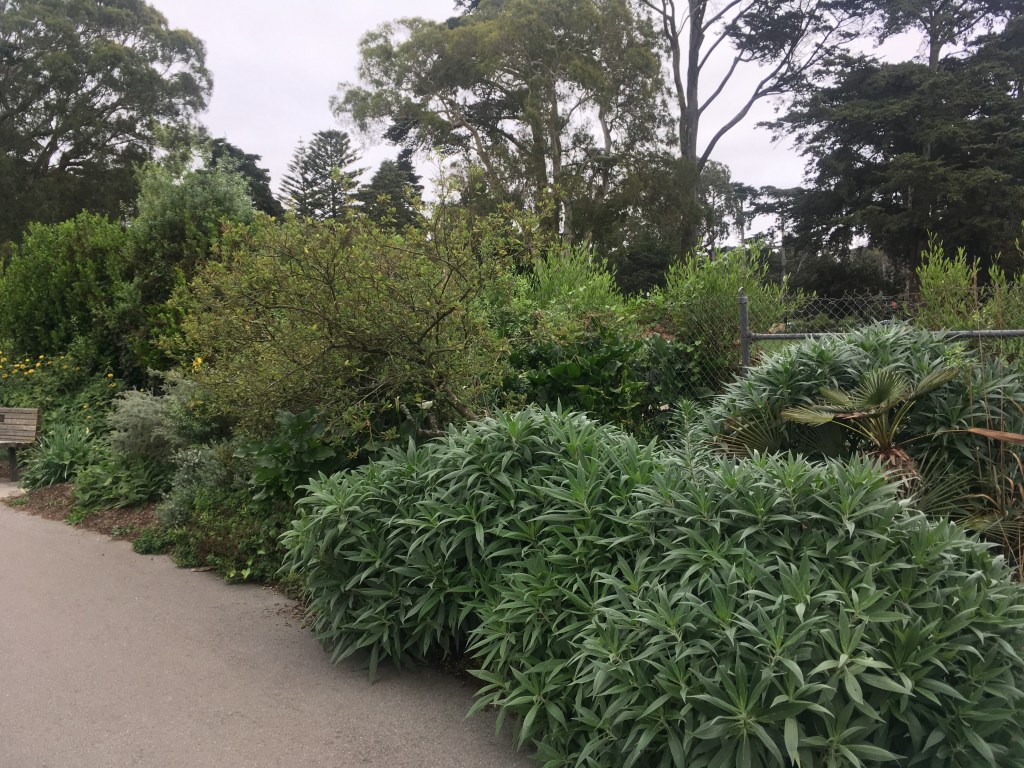
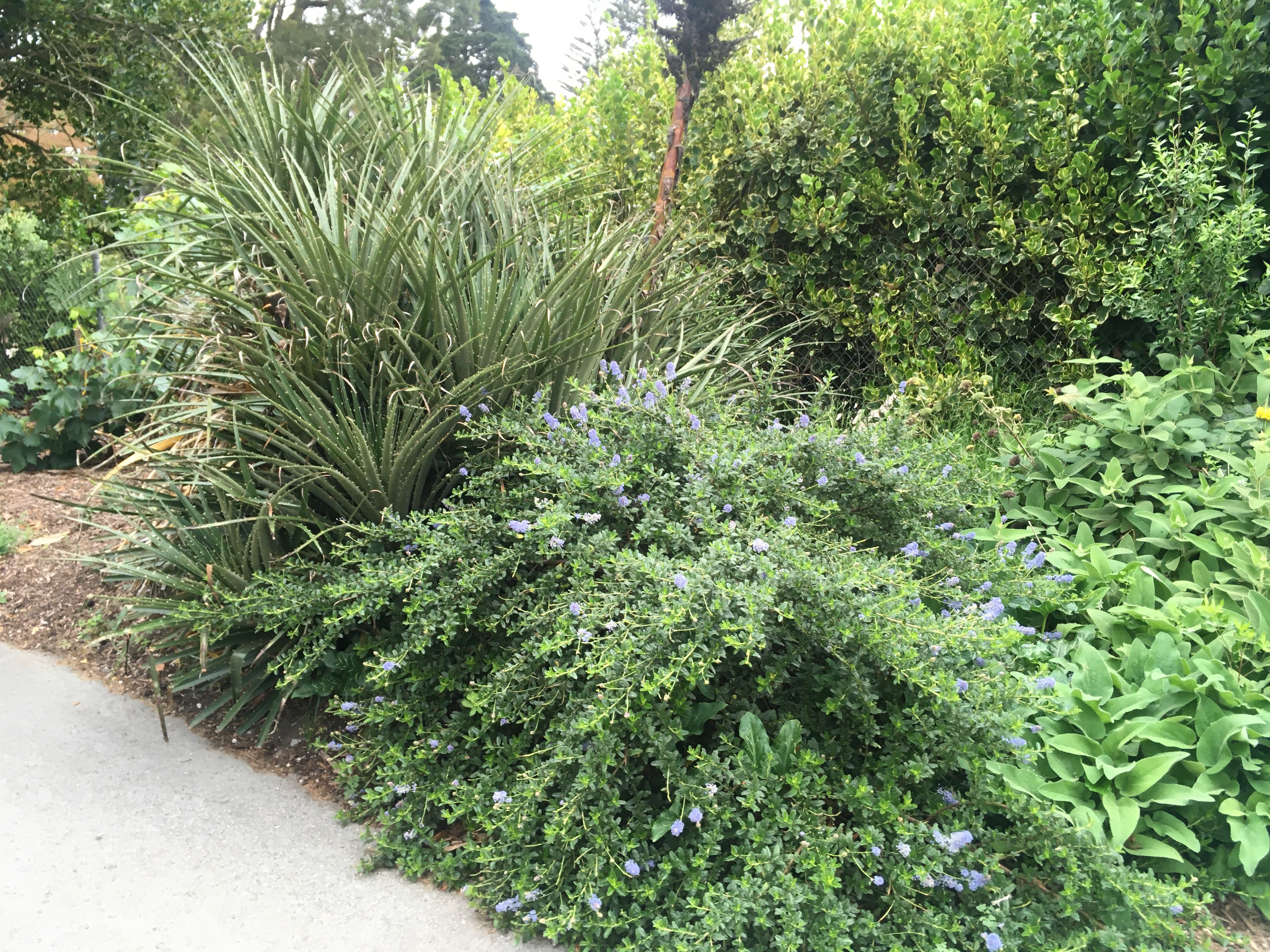
As we traverse the northern edge of the great meadow of lawn, take a look at the planting beds on the right side. The plants are grouped not by geography or rarity or ecology, but by color. All the plants are of the cool blue yellow and white wavelength. In the first picture there is the rhizomatous running grass Leymus condensatus, the yellow feet of kangaroo paws Anigozanthus, yellow flowered Phlomis fruiticosa, and the shrub sticking up is Melaleuca incana the grey honey myrtle. Further on there is blue Ceanothus, gray greenish Echium, and a Griselinia hedge with the variegated yellow borders. All super cooooool.
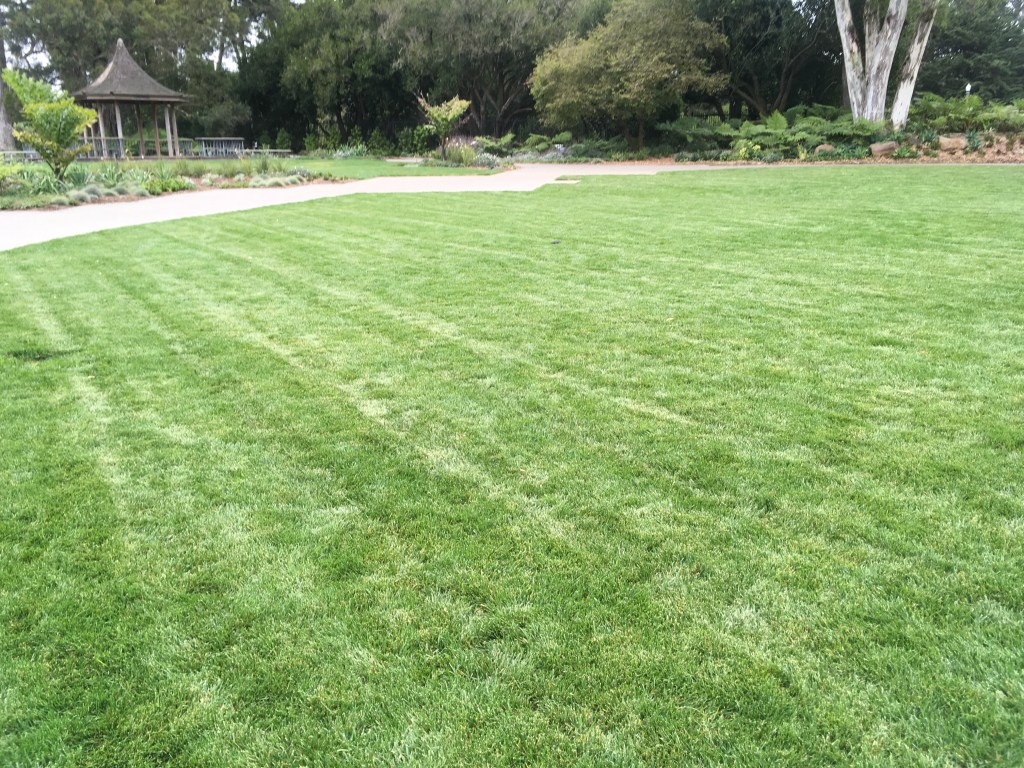
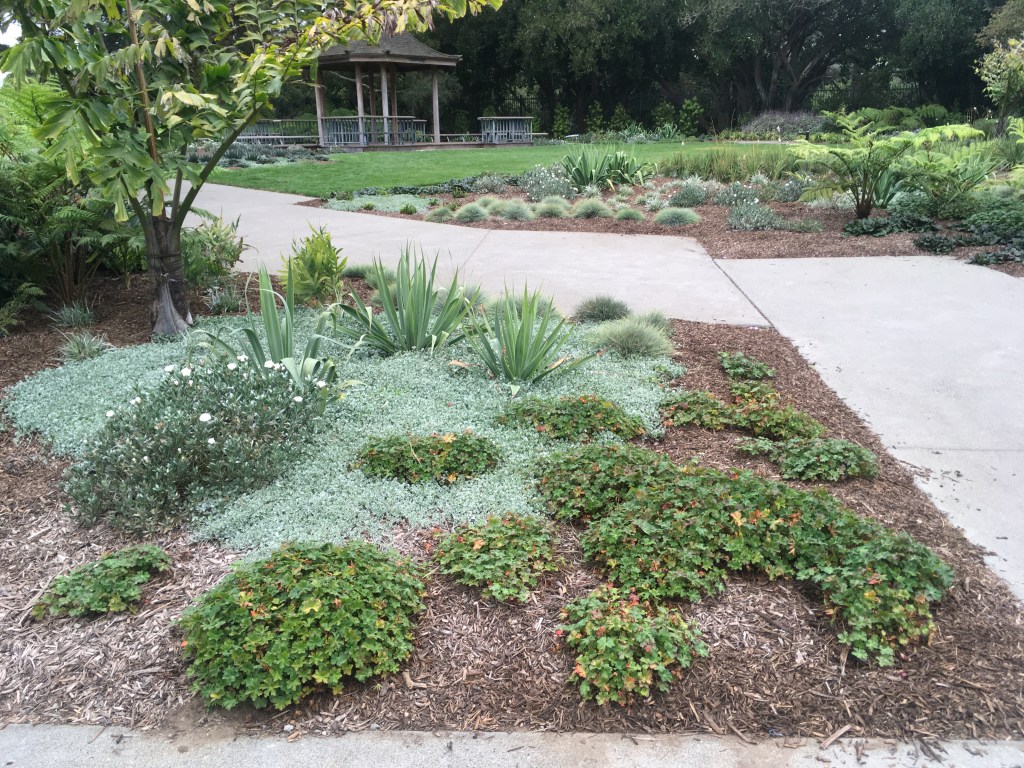
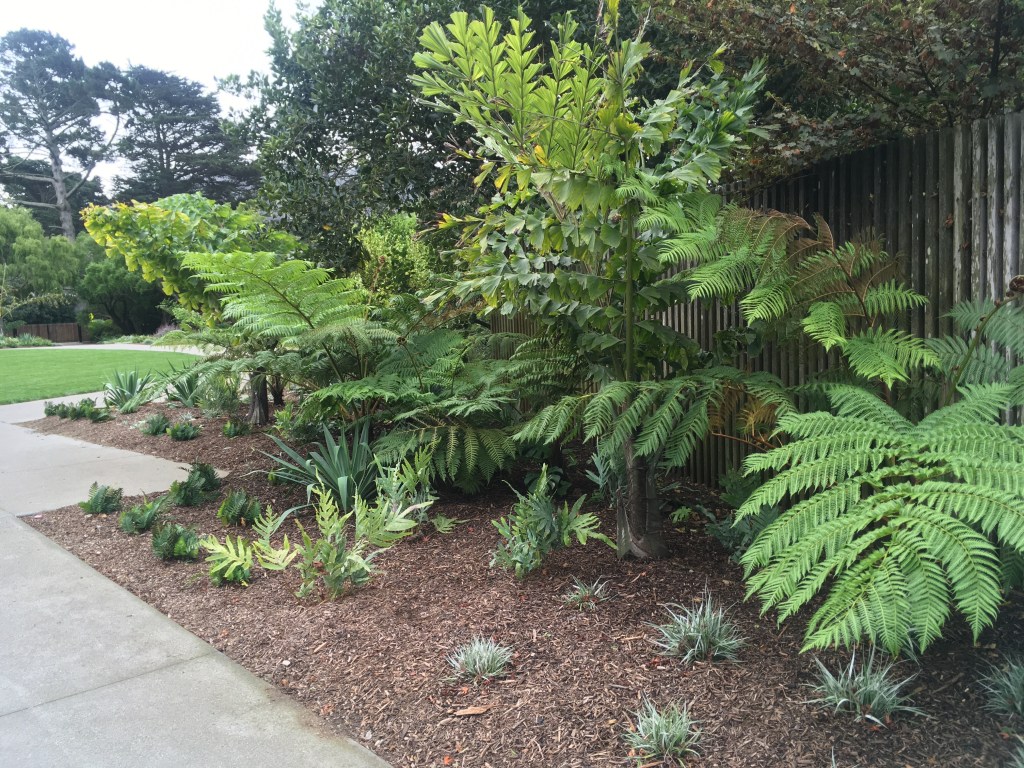
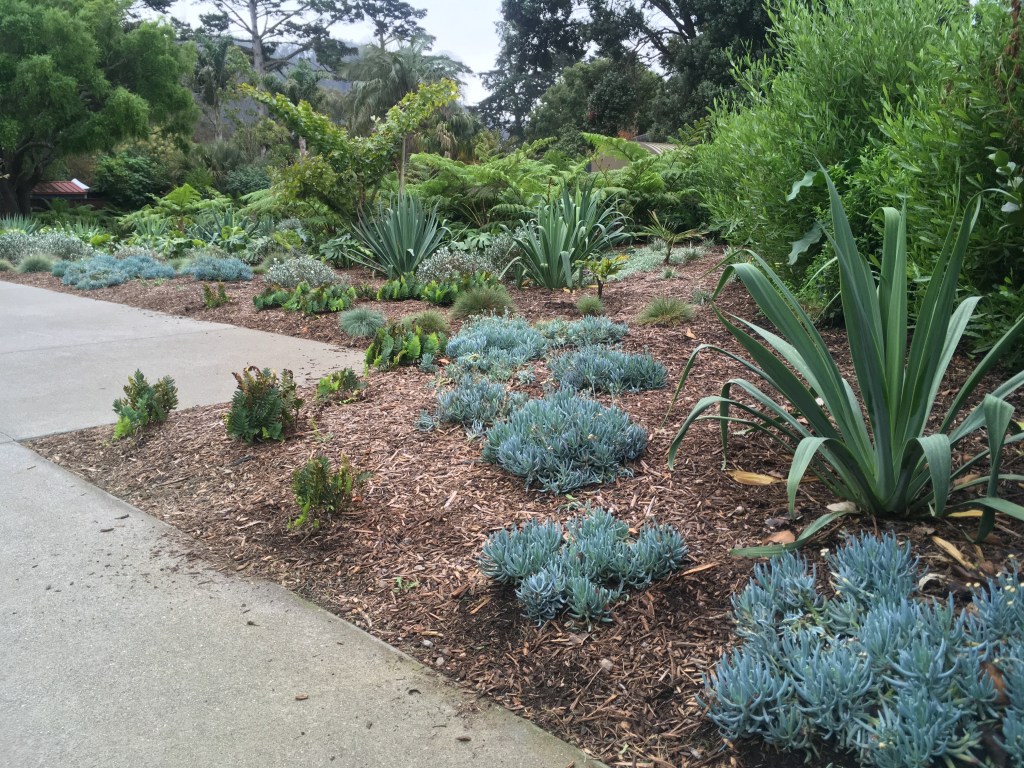
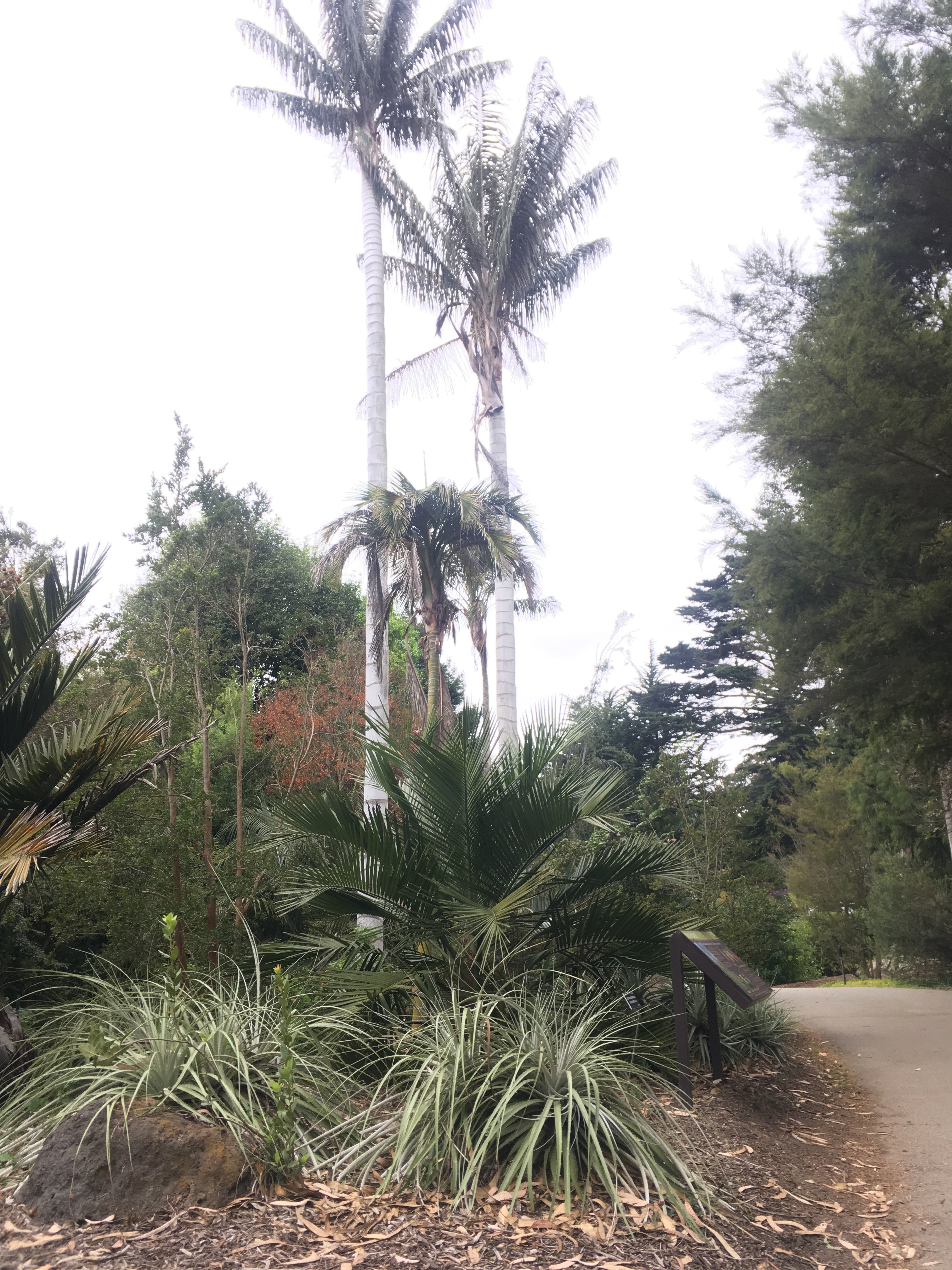
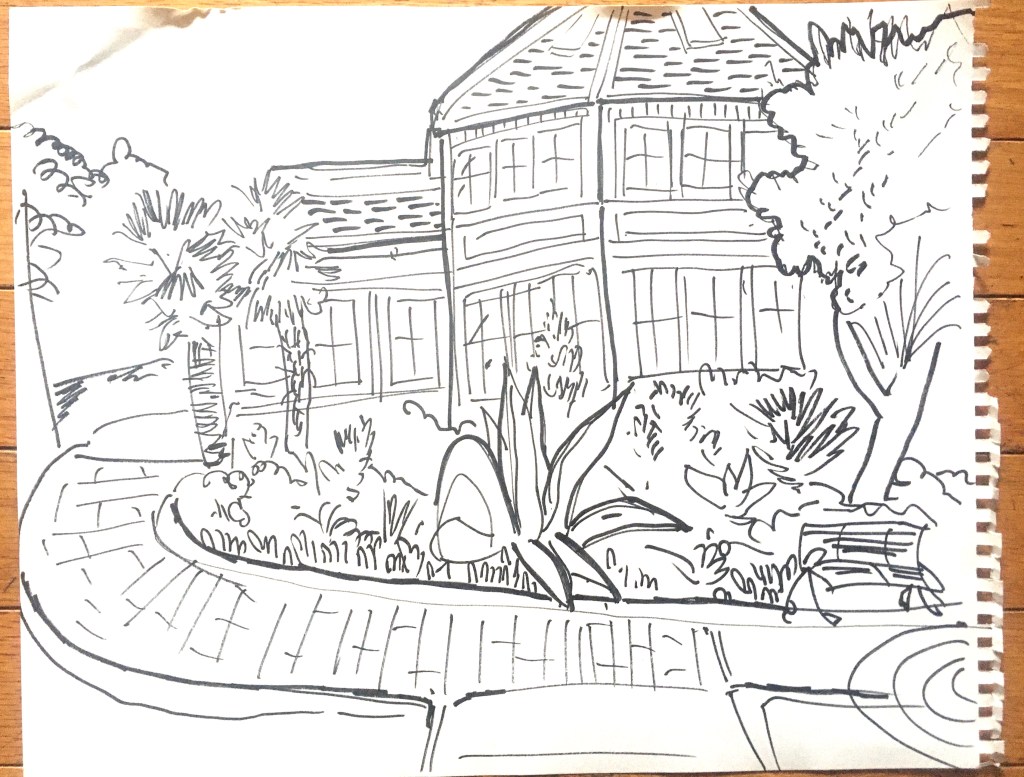
Go in to the new garden that has been designed by Lutsko and Guillou, it is called the Celebration Garden, a garden meant to be used as an outdoor venue for events. It replaced the demonstration garden; the only remnant of the past here is the pavilion designed by Thomas Church. This garden is also planted primarily based on color – whites, silvers, blues, greens. Elevation wise it is mostly flat and low. The tallest plants planted here are the large fishtail palms Caryota. In time, they are to be overtaken deliberately by the wax palms Ceroxylon. In maybe 40 or 50 years according to the staff.
This garden is defined by wide expanses of turf, followed by silvery Convovulus and low spreading silver Dichondra; tree ferns, silver spear Astelia; blue succulent Senecio madraliscae; blue fescue. You get the idea – color is cool, and the plants range from full sun to shade. The most challenging aspect is likely the litter under the tall Eucalyptus trees, the open and windy exposure, the meticulous nature that is crucial to a rental space, and the safety of 2-4 year olds playing near sharp agaves.

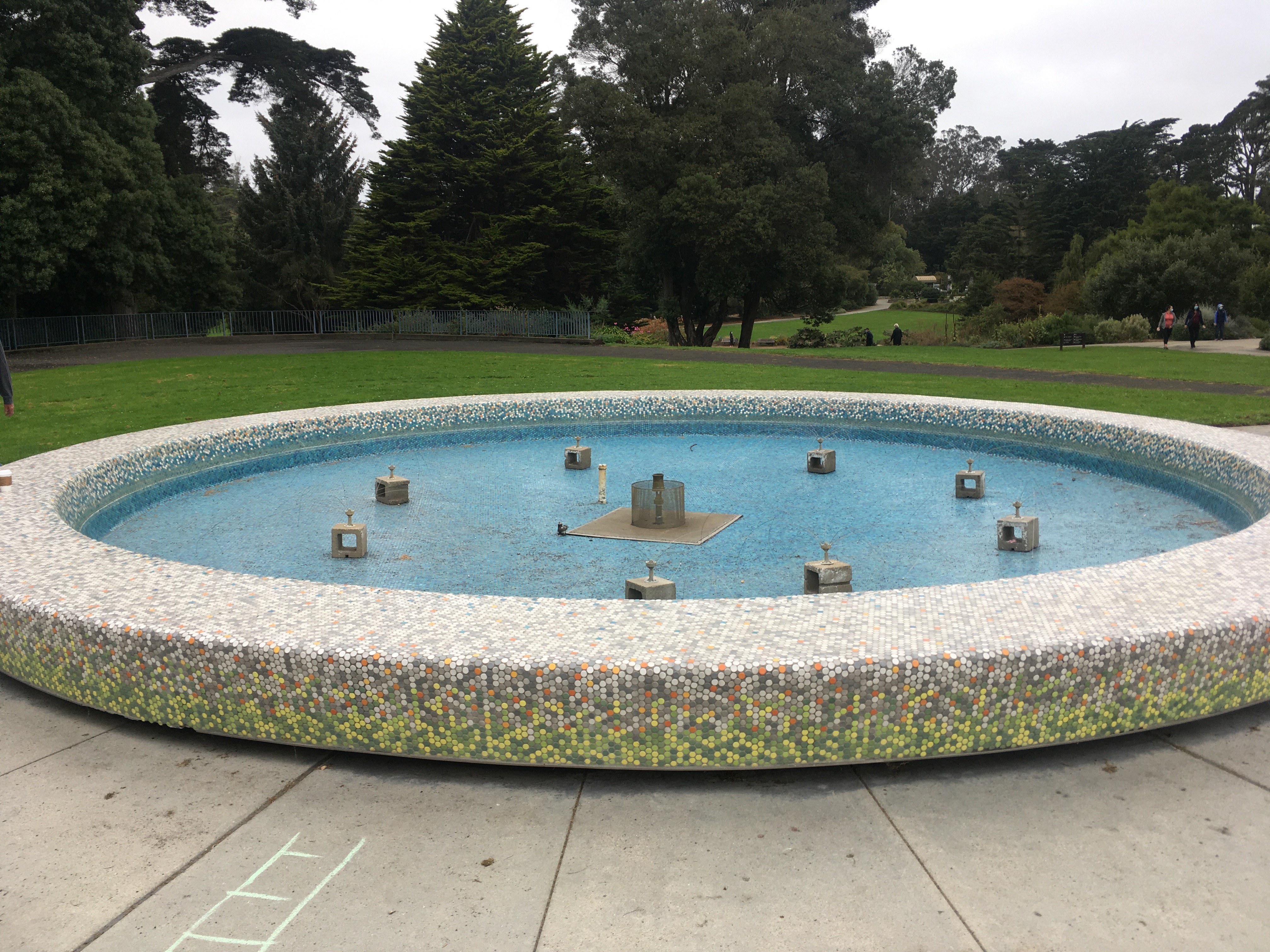
Water is central to a garden. In the old European style it is commonly a fountain in the middle, or in the Moorish style it might run along a trough through the center. San Francisco Botanical Garden is no exception. At the end of the great meadow is this beauty. It is temporarily not running due to construction or repairs. The cinder blocks with the wires on top is a bird deterrent that resembles a daddy long legs spider. It is meant to keep geese and other critters from going in the fountain and pooping there.
Walking over towards the Primitive Garden and you will notice the water trough that conveys water from the Japanese Tea Garden across the street to the large pond known as McBean waterfowl pond. The trough is made recycled materials – specifically it is concrete, aka urbanite. It is lined with a white clay that is called bentonite. A nice thick layer of bentonite will make it water tight and minimize leaks. It is a commonly used material for pond building, an alternative to the thick EPDM rubber liner.

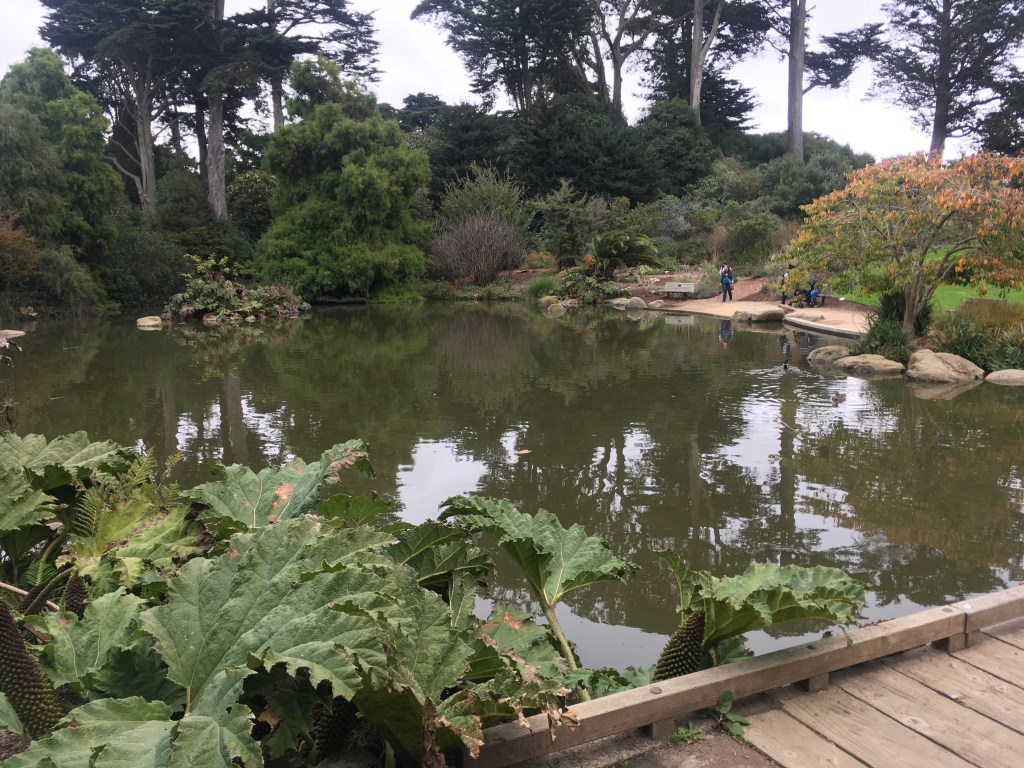
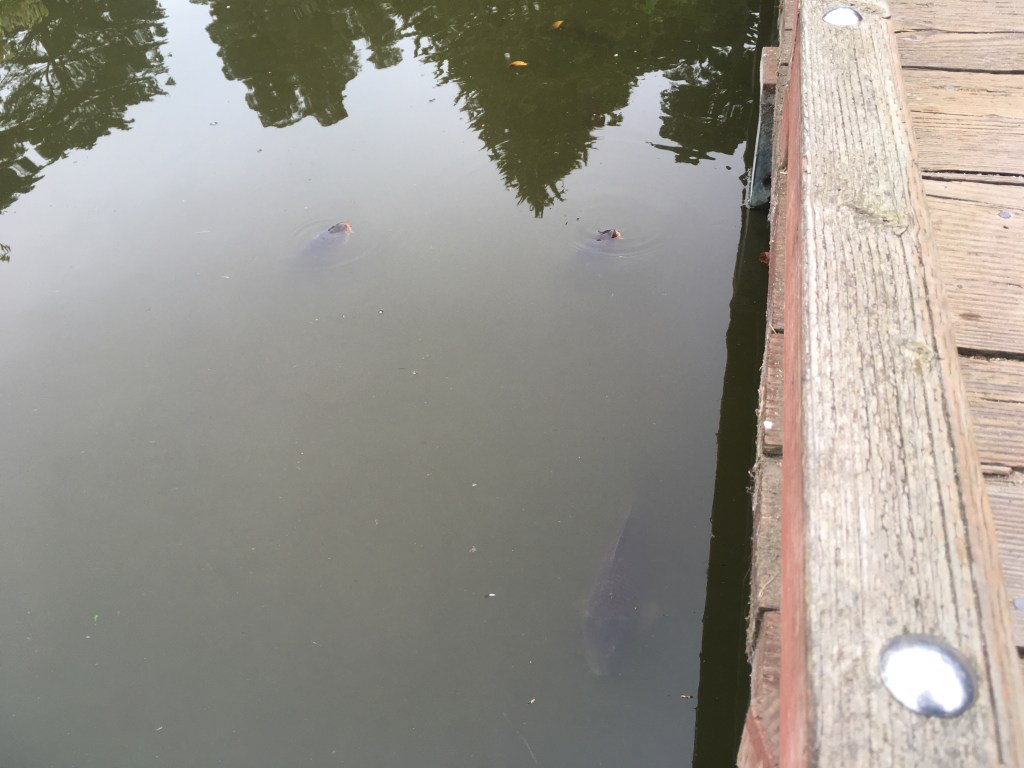
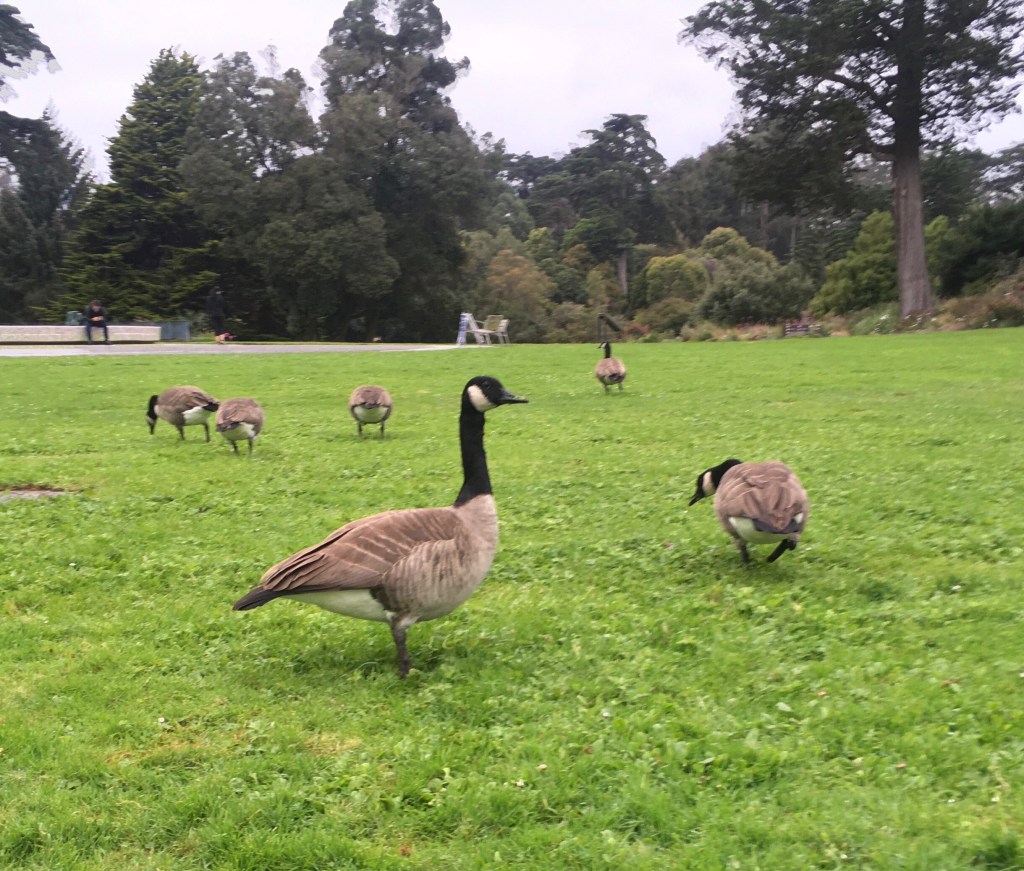
Big ol carp always come by for a hand out at the pond. They are not the fancy pretty koi, they are all gray brown colored. But they are the same fish – a chunky scaly fish with barbels around the mouth that thrives in freshwater that has low oxygen content. It likes a similar habitat as catfish. In many parts of the country the carp is considered an invasive species.
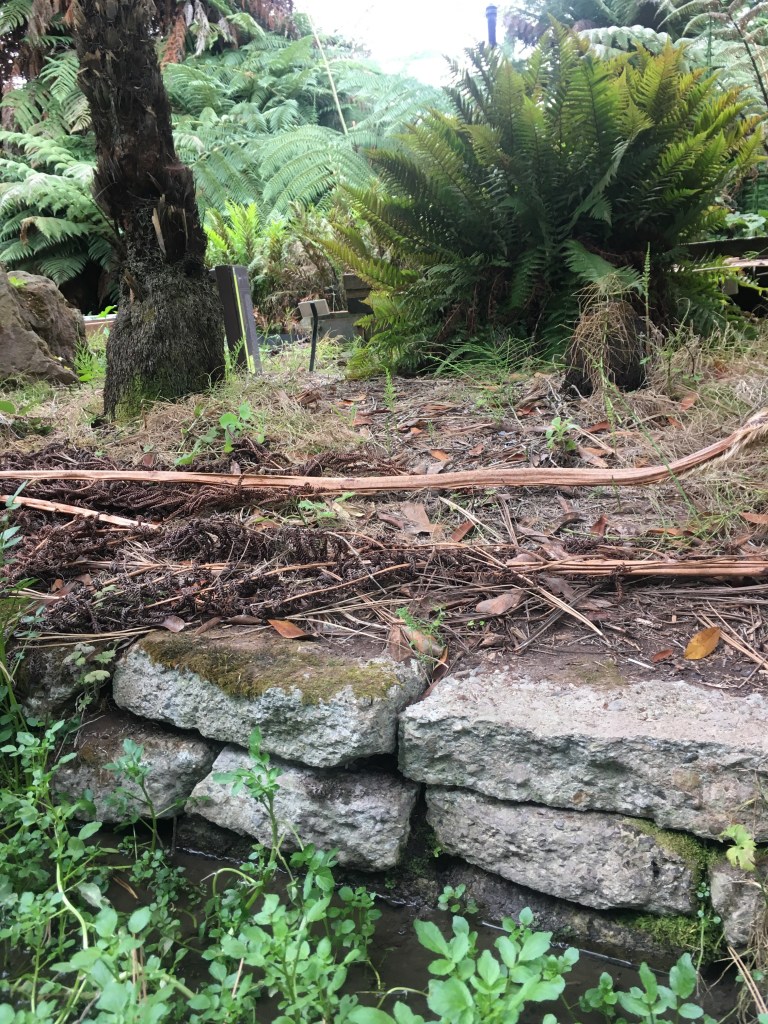
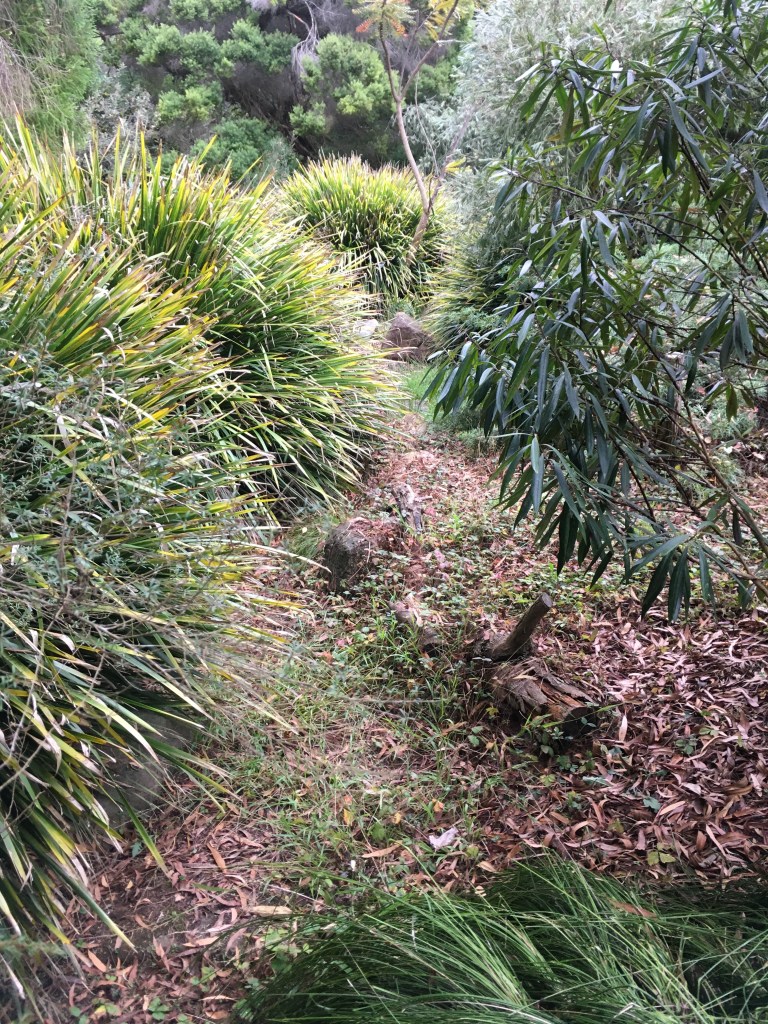
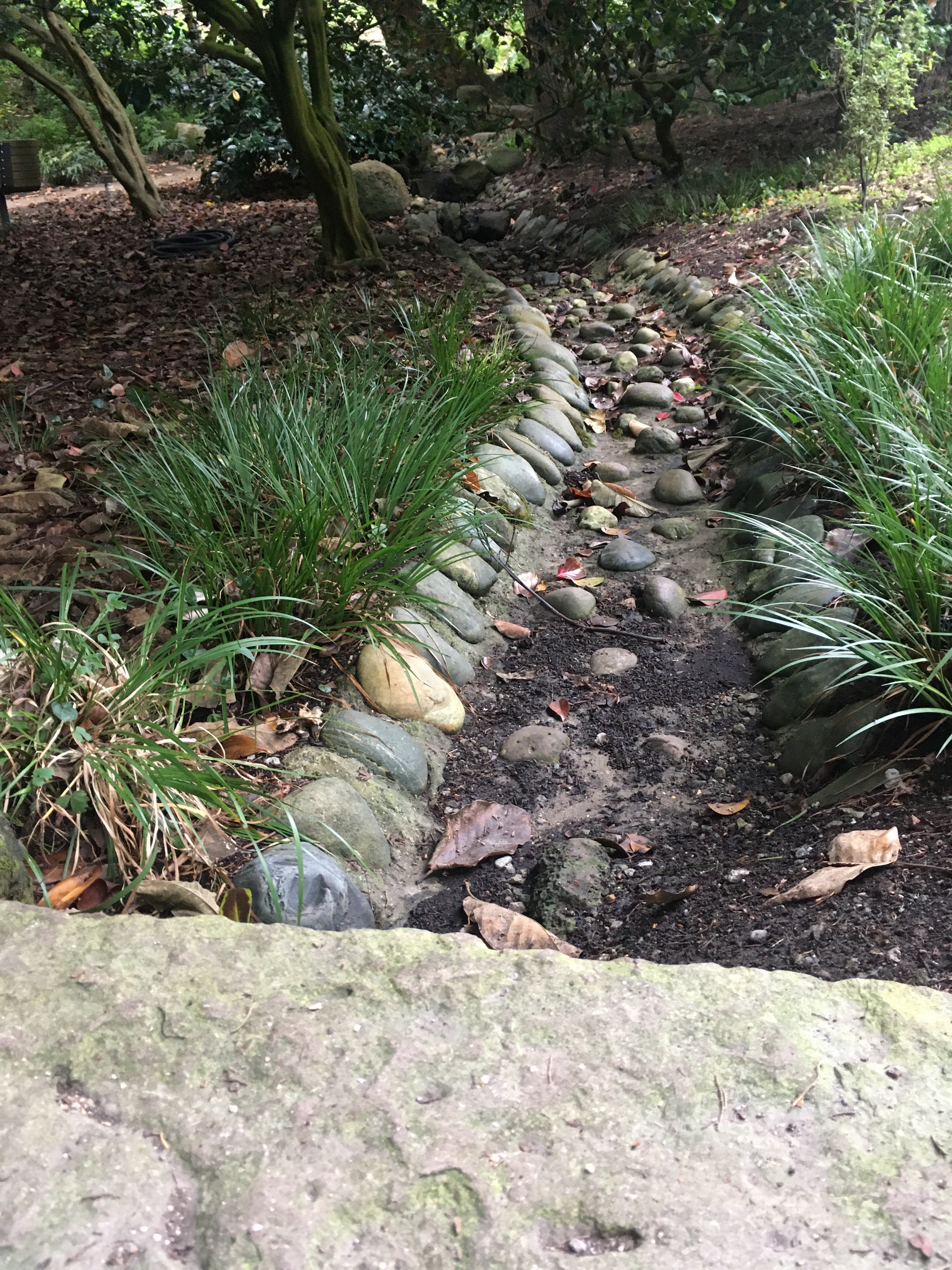
The Australia garden next to the Primitive Garden has a water feature that runs down the middle of it. It is a dry creek bed. This first picture is the end of the dry creek. Over the past ten or fifteen years, all the plants have grown up around this design feature, to the point that it is almost completely obscured by erosion and leafy debris and tall shrubs. But it is still there, the defining cohesive element of the whole design.
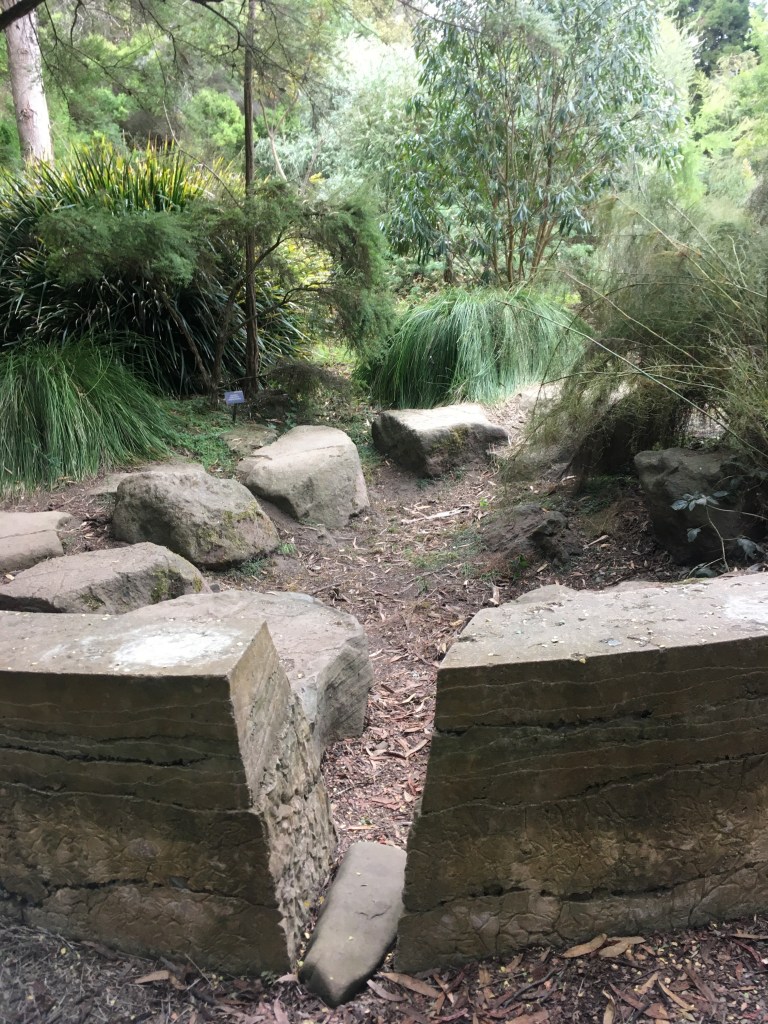
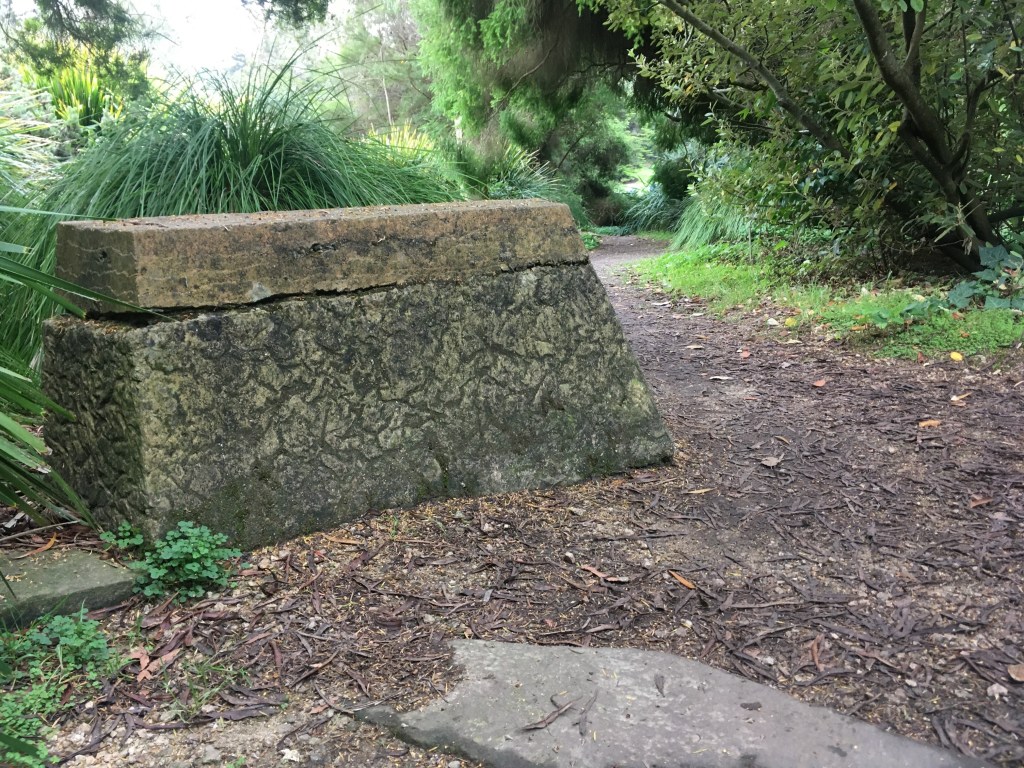
Besides water, stone and rock bring character to a garden. Mr Trainor had a neat idea here while making the retaining wall benches and seating. Rather than a smooth level gray concrete of a form, he utilized crumpled up aluminum foil and concrete colorants to create texture and geological age. Yup Australia is a really old continent and so the hardscape seeks to reflect this. I like how as it ages, the grooves and cracks and unevenness picks up the moss and stains of time.

We cruised through the Chilean garden and saw these Andean Wax palms, the tallest palms in the world. Imagine the Celebration Garden when the palms grow up tall! Well I’ll probably be dead by then but it is worth dreaming about…
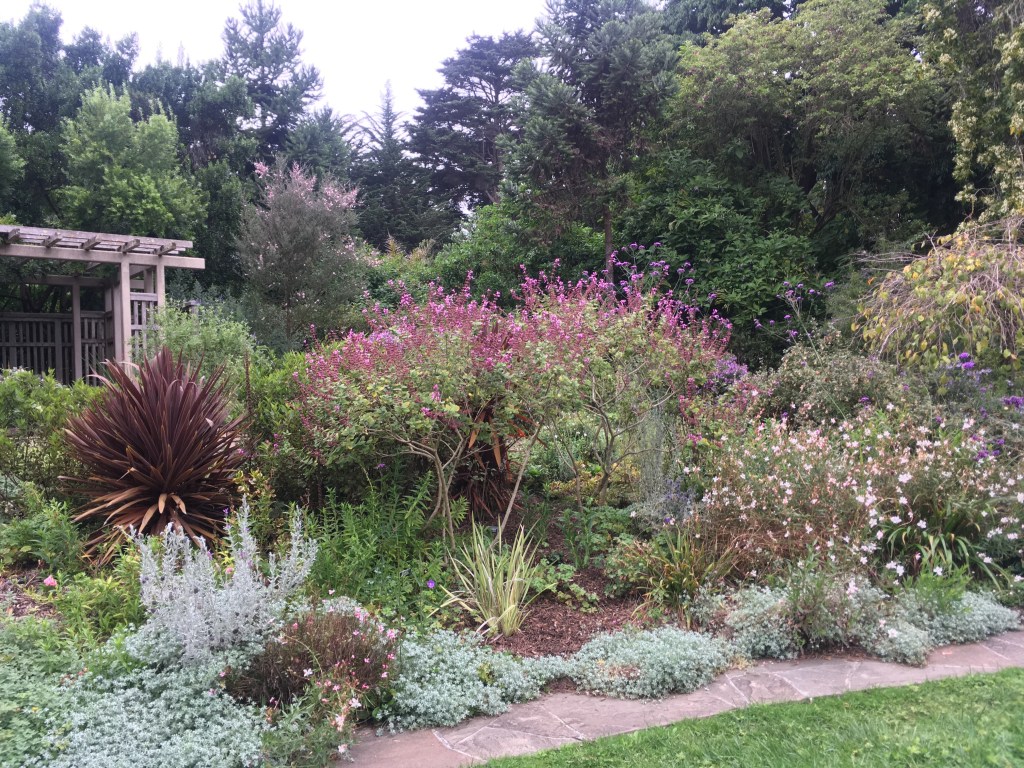
The Zellerbach Garden is a formal garden that is high maintenance. To look good the perennials need a lot of attention. Luckily it has some help from a group of volunteers who have been coming for over thirty years weekly. Deadheading, pruning, weeding, and so on. It is another garden that is not focused on diversity and ecology, its palette is based around the pinks and purples, with a smattering of red white and blue. So it is warmer in temperature and wavelength. There is a little bit of symmetry – the matching structures and trees – but it also has that English perennial border feel of happy exuberance and abundance. Notice how the perennials are for the most part herbaceous, not woody. Hence over time you get nice clumps of blooms, and not huge shrubs trying to take over and shade out everybody else.
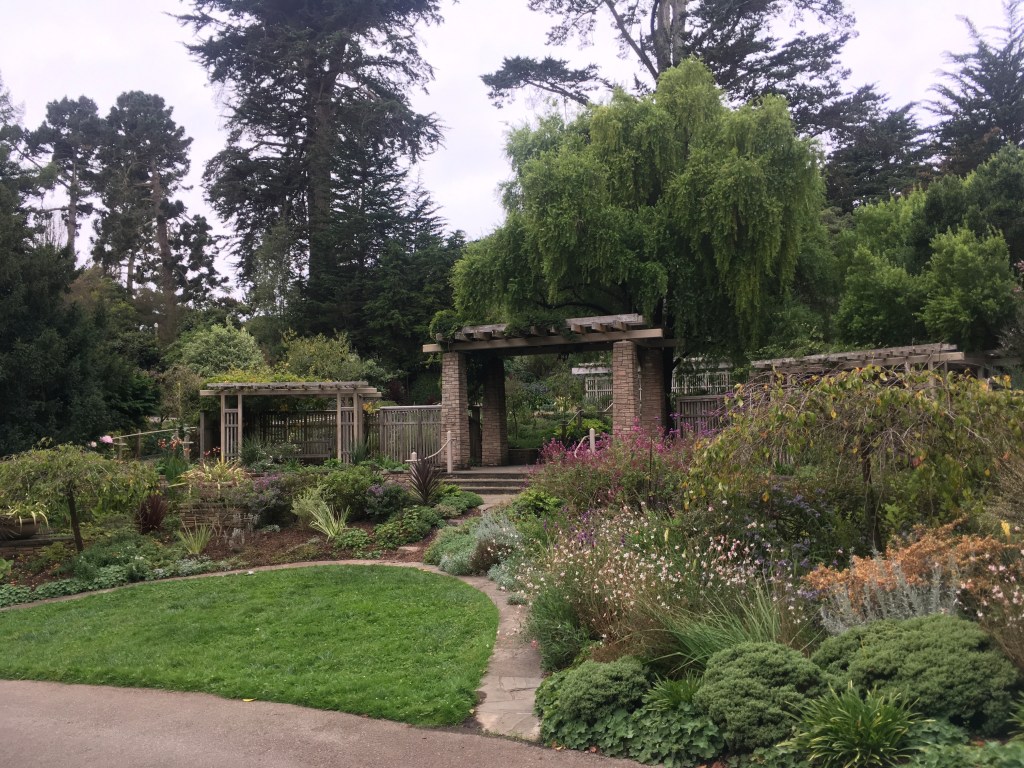
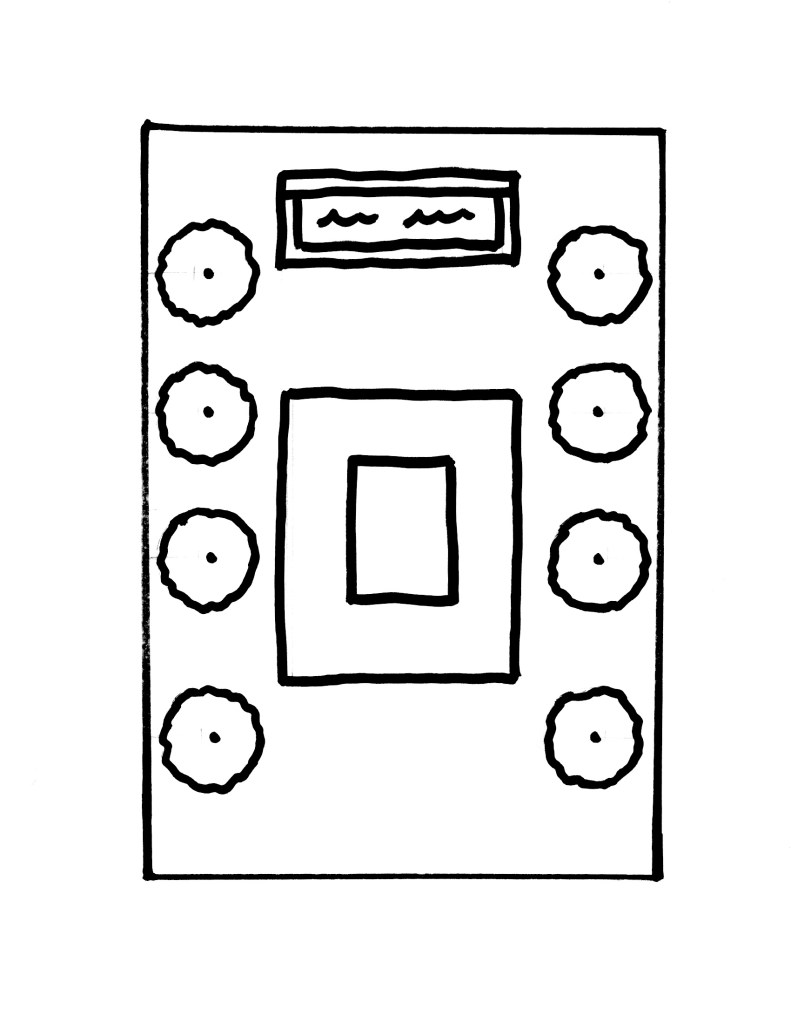
When you line yourself up under the gazebo, and look back at the expanse of the botanical garden, you will see the axis of view that defines the formal gardens inspired by European royalty. Ideally, you would be able to see clear across to the other side of the garden, with the water feature in the middle. Can you see the white rim of the fountain?


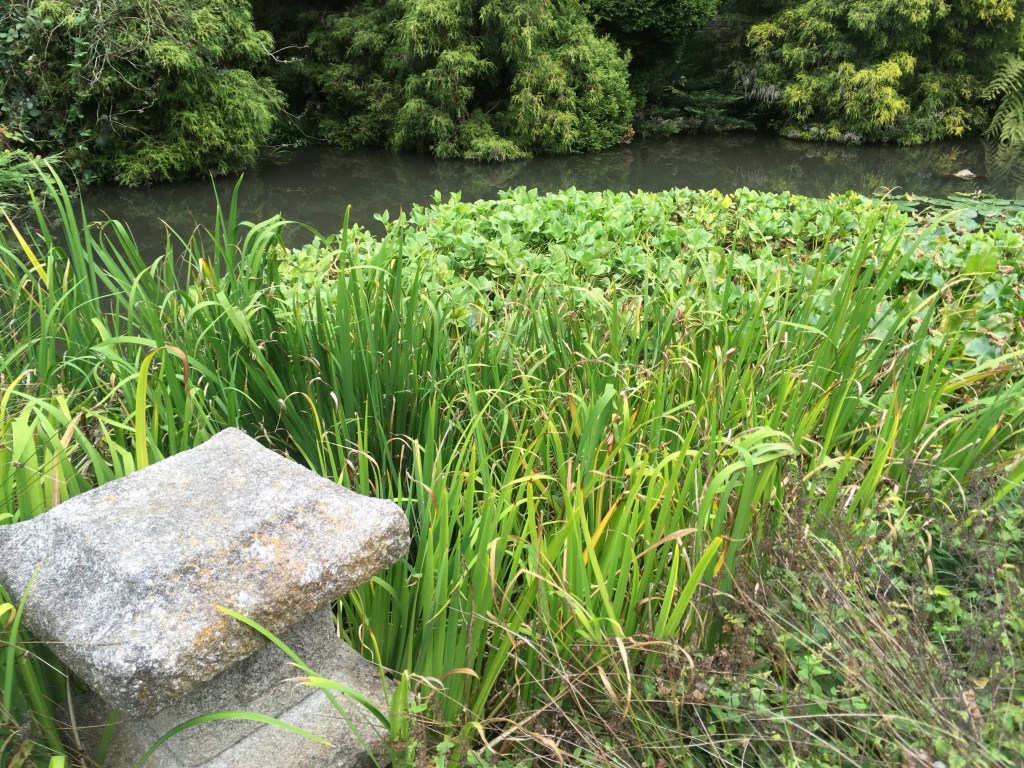
Back to water – the water trickling down the stones of the Moon viewing Garden. This water feature is constructed in an old fashioned manner – lined with concrete, with round river rocks pressed into it. It is the same method of construction as the ponds in the Japanese Tea Garden. On this day, the upper waterfall had water, but the lower troughs leading to the moon viewing pond was dry.
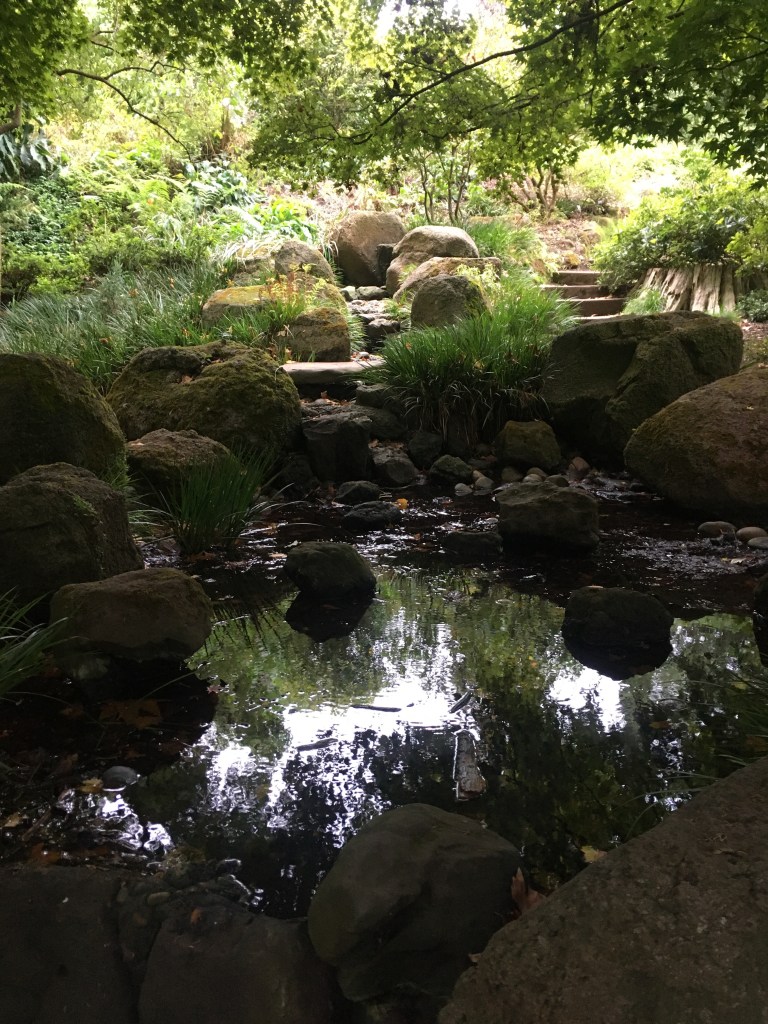

The deck and view of the pond was closed for a wedding. So sorry – could not get in to show you the sights. The pond there is shallow, and there are no fish in it. It is a raccoon hunting ground. What is a neat feature there is a small island in the pond that is in the shape of a turtle. And the overhanging Coriaria tree is quite a specimen too.
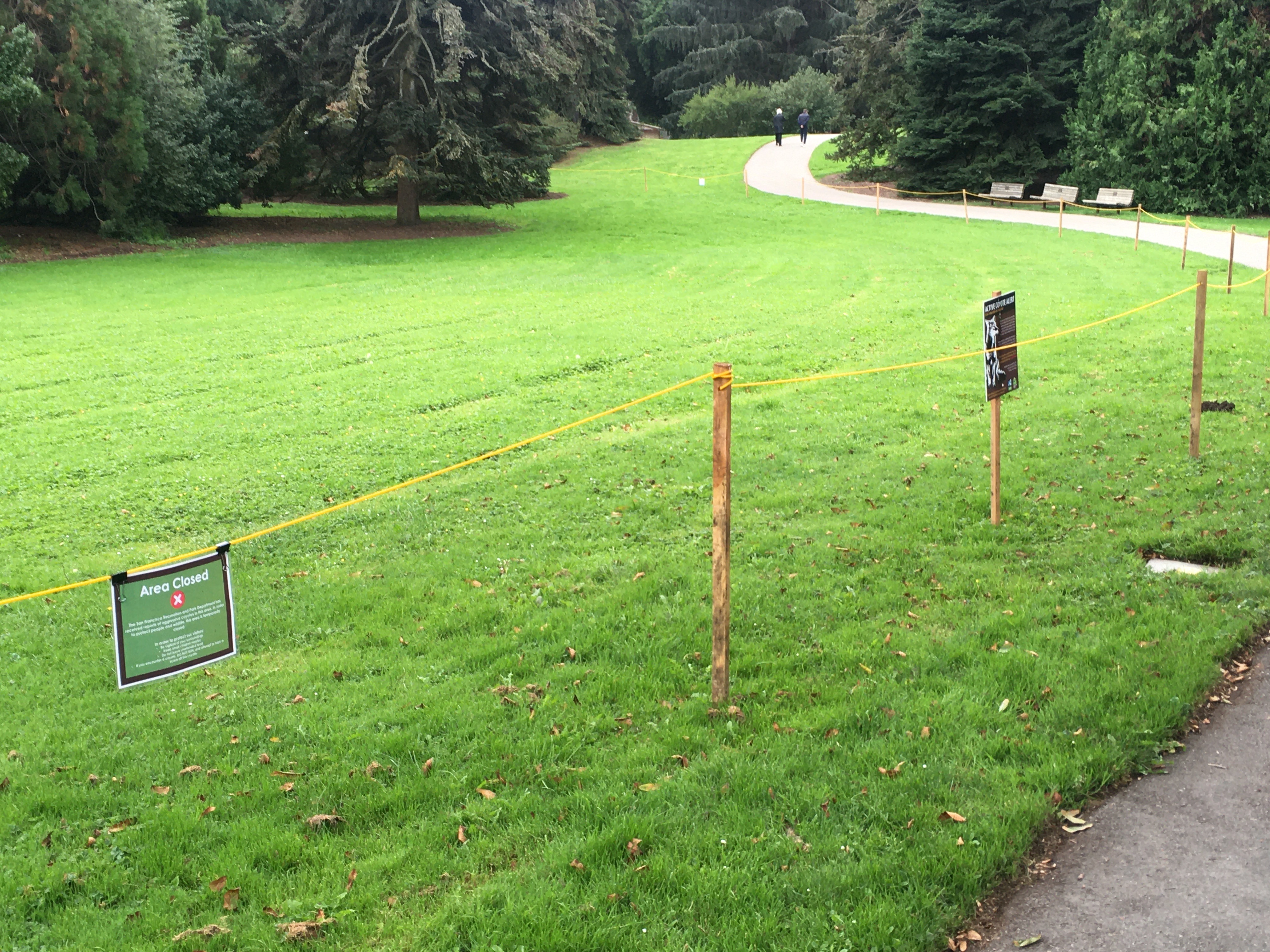
There was more closed area by the Conifer Lawn. Signs explain that a coyote had been sighted and perhaps threatening a garden visitor. This was the area that it was last seen in. What a drag. Between Covid and now the coyote.

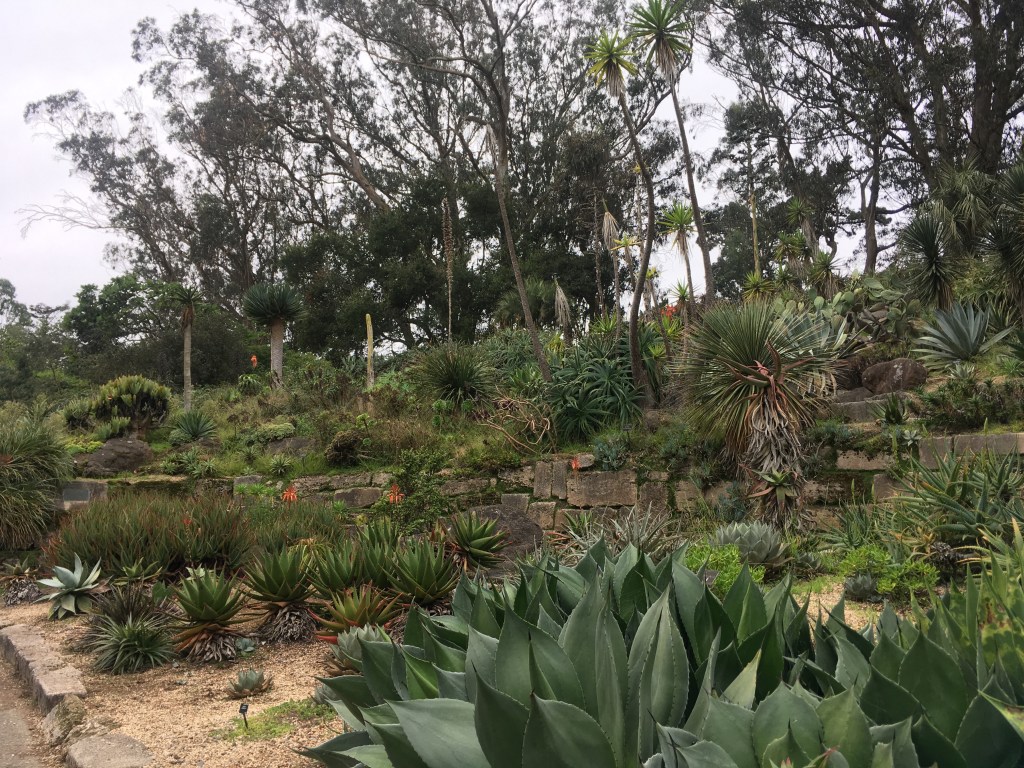
Finally at the top of the hill is the succulent and cactus garden. The placement of this garden took into account the ecological needs of this group of plants. They like it hot, with good drainage. The monastery stones used for the retaining walls have great thermal mass, and radiate the heat they have stored during the day, at night. There is a diversity of forms and colors here, they are united by the predominantly dry and desert like conditions of their native habitats – whether that be Africa or the Americas.
Back to water again as we go down the hill through the grove of coastal redwoods. It is running dry here as well, whereas in the recent past stands of skunk cabbage wet their roots here under the Sequoia canopies alongside ground covers of redwood ginger and redwood sorrel.
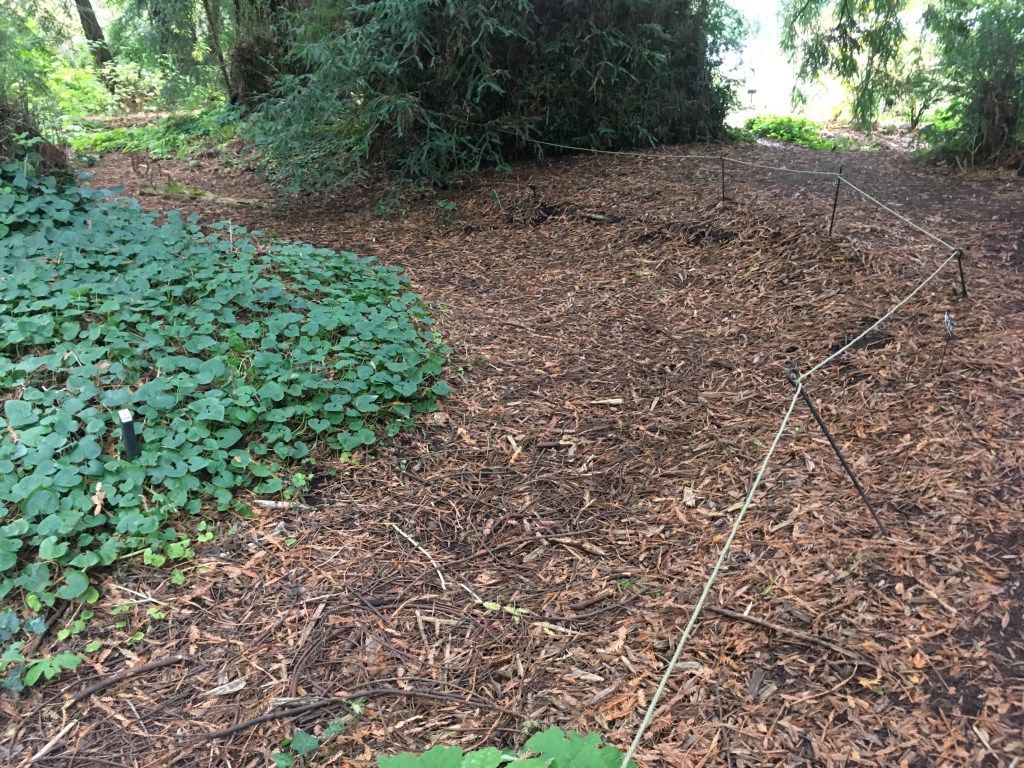
Water always descends to a low point. The lowest point in the botanical garden is by the Arthur Menzies Native plant garden and the old greenhouse. The water ends up in a big reservoir where a pump in a pump house, staffed by a stationary engineer, pushes the water back up the hill.


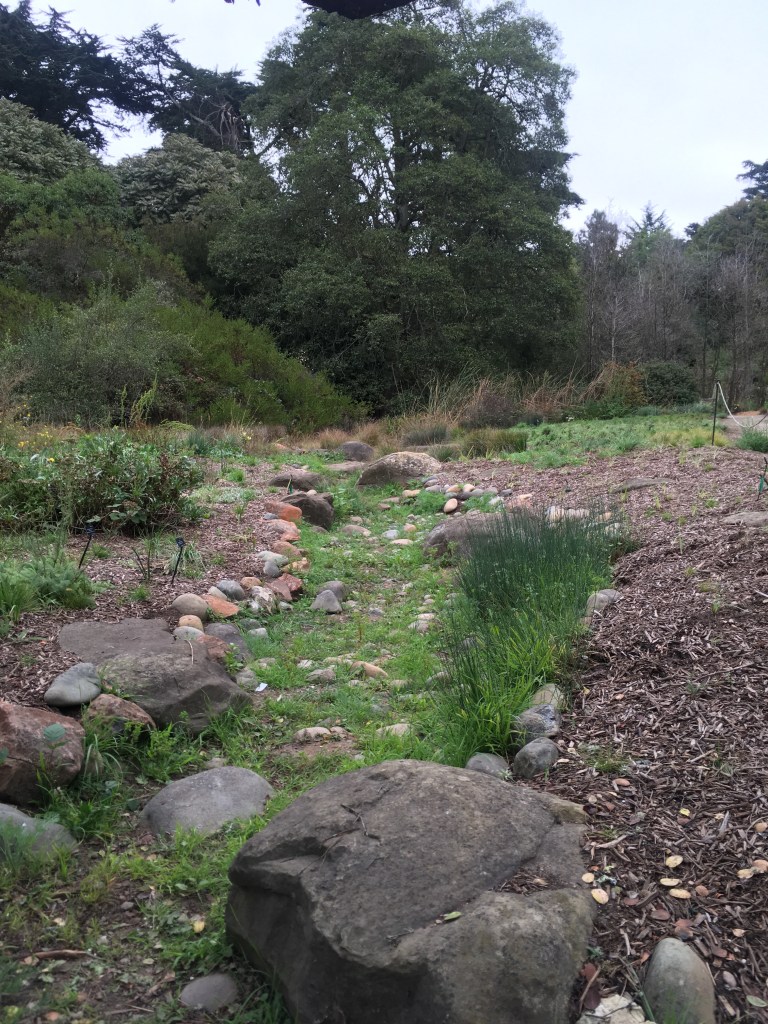
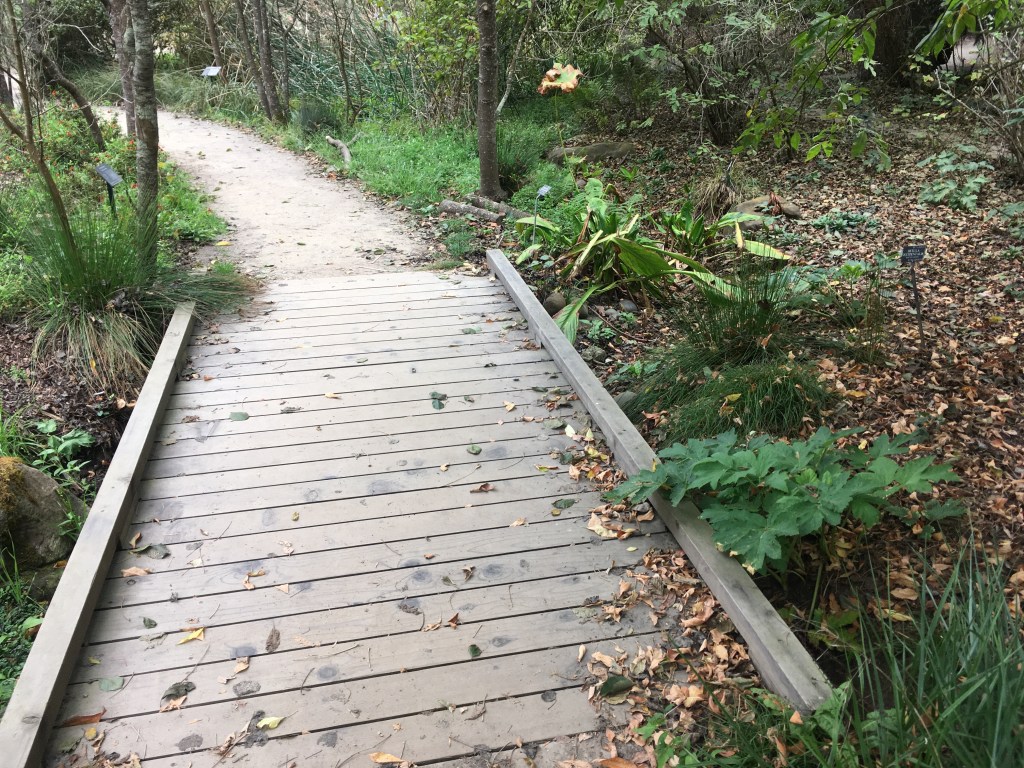
The main body of the California native plant garden is in the shape of a large oval, with a small pond and a bridge at the head of it, and a dry creek that runs through the garden. (This is a common motif, no?). Here we are looking from the end, or the base of the garden, up at the head. The asphalt road that cuts across it is a new addition – meant for easier access for supplies to the to-be-built new nursery. At the end of the dry creek is a tiny tule and cattail lined pond and an Alder tree, which is commonly found close to water in nature.
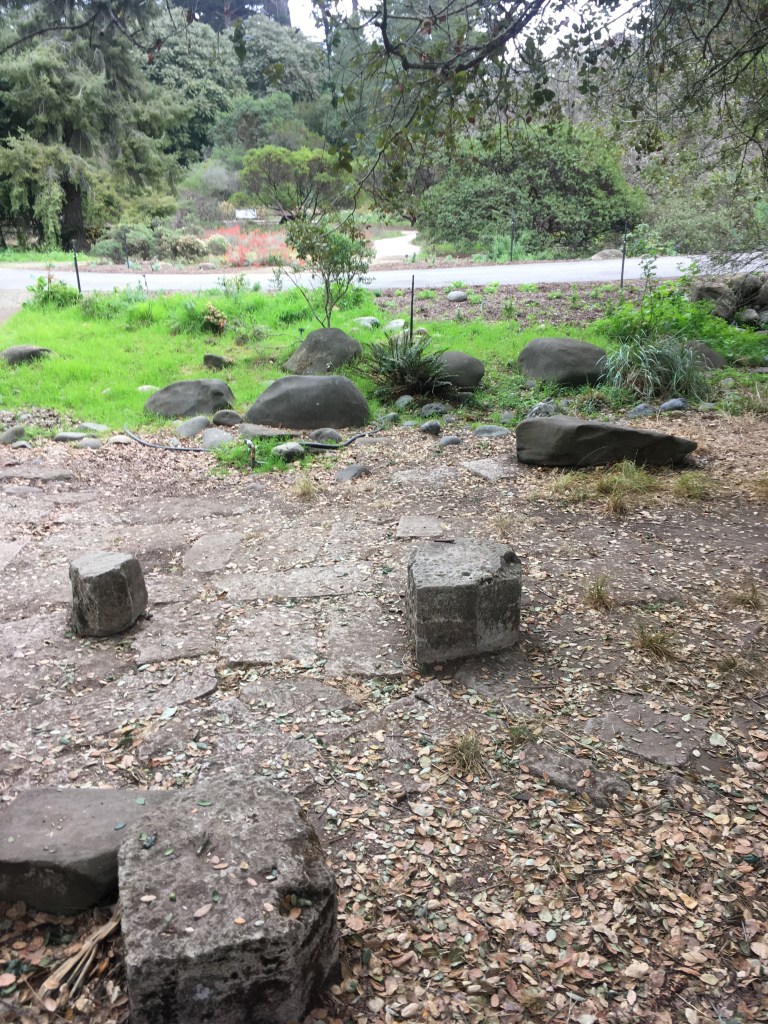
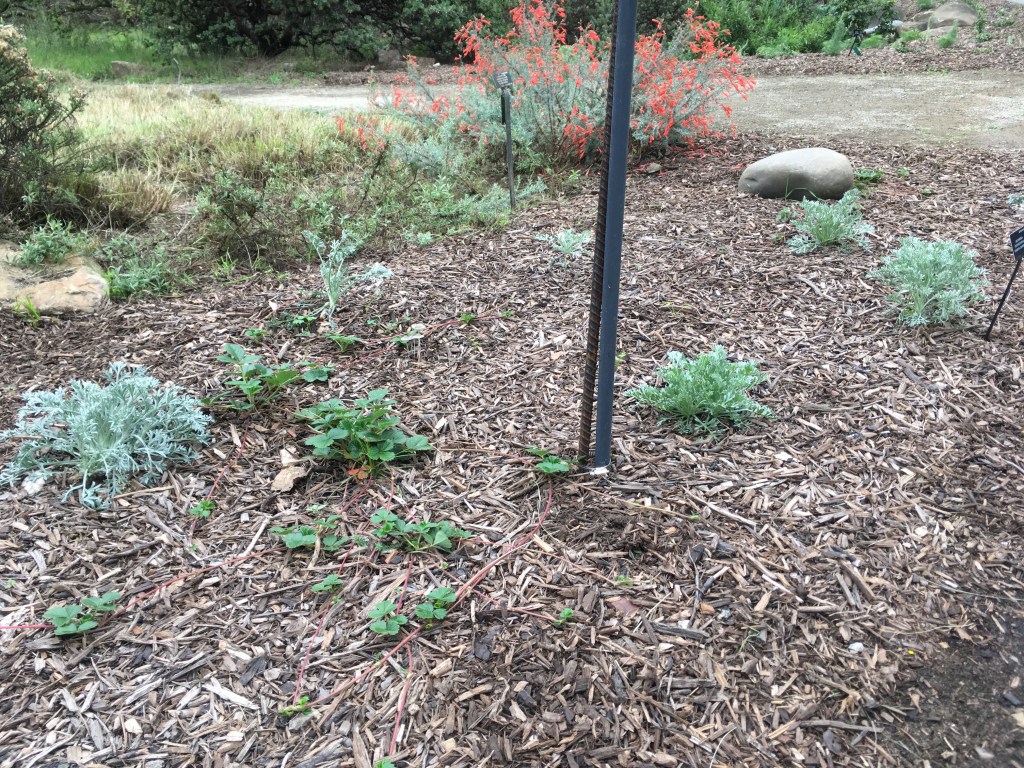
Alongside the new road are new plantings. On the far side are woody shrubs – sticky monkey flower, toyon, coyote bush, coffee berry. The dominant shrubs of the coastal sage scrub. On the side closer to the rest of the garden are low plants more commonly found on the beaches and sand dunes – beach sage and beach strawberry, plus some coyote mint of the clay rocky uplands too.

The original design plan of the native plant garden was to showcase the vegetation communities of California. The palette is an ecological one. There was the native bunch grass meadow that was common in central valley. There was the coastal scrub and chaparral of woody shrubs all knit together. There was the oak studded foothills and woodlands full of acorns. There was the serpentine outcrops of rocks and gravel and strange endemics. And there was the riparian riverine plants alongside small drainages and lakes. There was no desert biome represented, neither the low Anza Borrego desert flora nor the high Mojave desert flora.
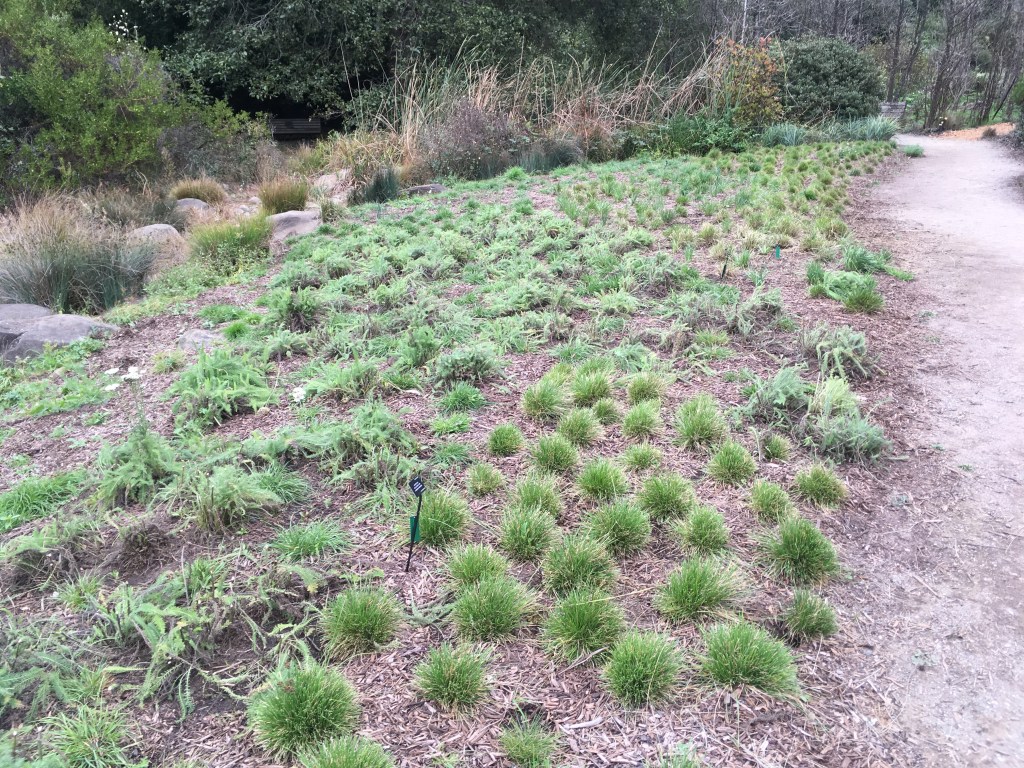
The bunchgrass meadow has been painstakingly planted. Heres Purple needle grass Nasella pulchra, tufted hairgrass Deschampsia cespitosa, and California oat grass Danthonia californica. You can still find these plants occurring naturally in San Francisco. Nasella and Danthonia form small stands at McLaren Park in the grasslands by Gleneagles Golf Course. They are periodically burned around the Fourth of July. The only place you will find wild tufted hairgrass in San Francisco is on Bayview Hill by Candlestick. It is in a few patches where it is wet and close to the groundwater seeps near the top of the hill. It is scattered and does not form dense masses.
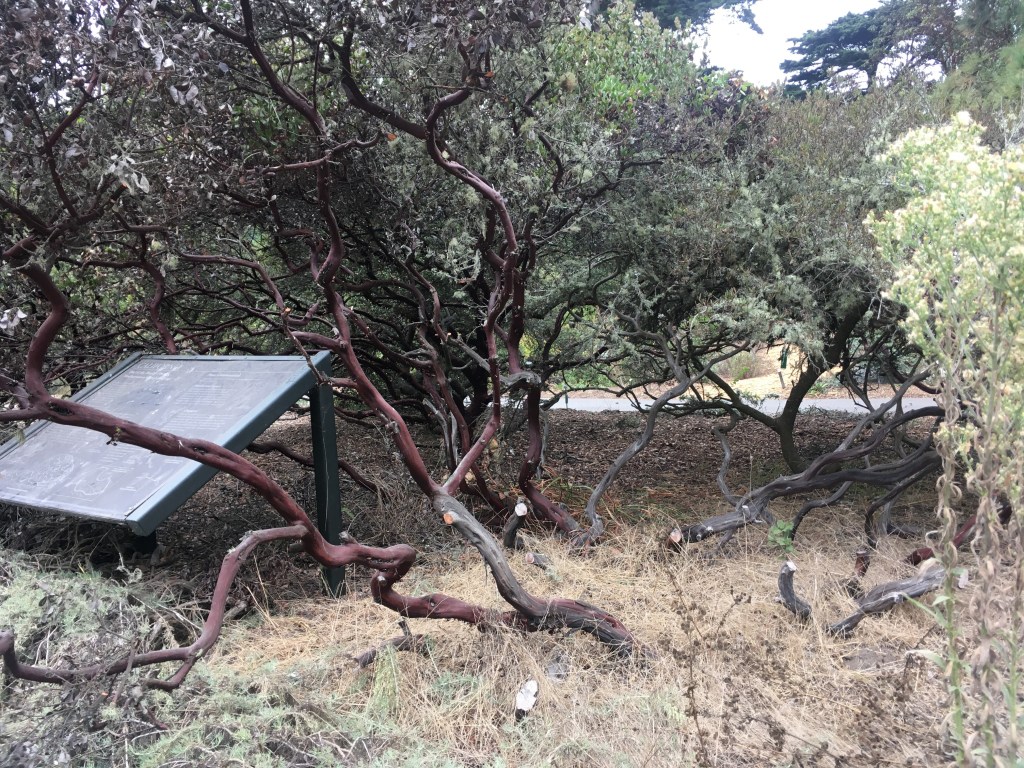
The chaparral is often dominated by manzanitas, yerba santas, chamise, and sagebrush. In the native plant garden the manzanitas have been heavily pruned to accentuate their branches and open up the views.

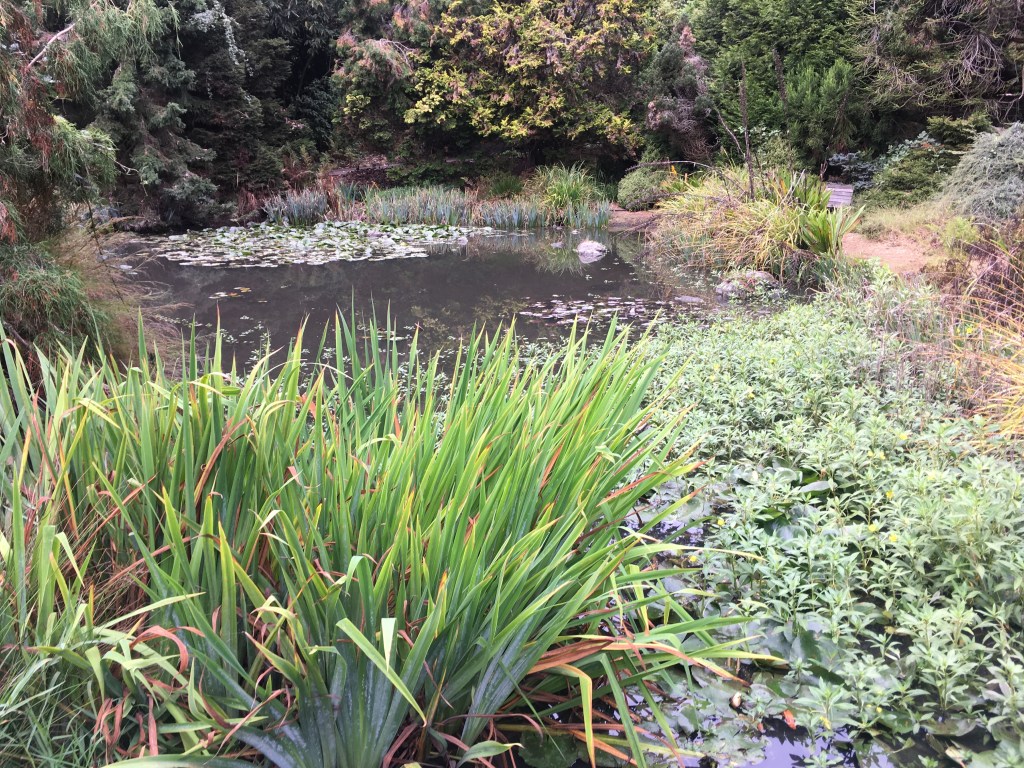
Okay. We are still following water, up the hill, past the California natives, up into the temperate Asia section of magnolias and dwarf conifers. There are four distinct ponds, all connected to one another by pipes and gravity. Simple and elegant design. The bottommost pond was dry, a pond that originally housed carnivorous plants. The rest had water. These ponds are also lined with bentonite clay. Occasionally leaks will occur at the edges where raccoon and coyote and skunk hunt for crayfish. Then the gardener has to fix the leaks… The ponds have names like bamboo pond, dwarf conifer pond, and Annelli Pond.


At the end of the tour we ended up back at the entrance, by the library courtyard garden, a garden enclosed by the Spanish monastery stones. With, you guessed it, a small fountain in the middle. There is a good history of the stones here: https://www.outsidelands.org/monastery-stones.php
Unlike a regular building material you go and buy at the store, the stones came in irregular sizes and shapes. So as a designer, there really is no way you can draw a plan and say make it look exactly like this. You can come up with a preliminary idea/structure, and then just let the stone workers run with it. It is in a sense off the books, improvised, and built in an organic manner. This is the same approach we use when building with recycled materials like granite curbstones or granite scraps from the cemetery dumpster.
Not sure about who did the work on this wall, but for a similar structure by the rhododendrons, they had to bring in four or five old time stone cutters from Oaxaca Mexico to put it together. This is not a common trade around these parts anymore, more like traditional artesanal craft. Pretty neat results.
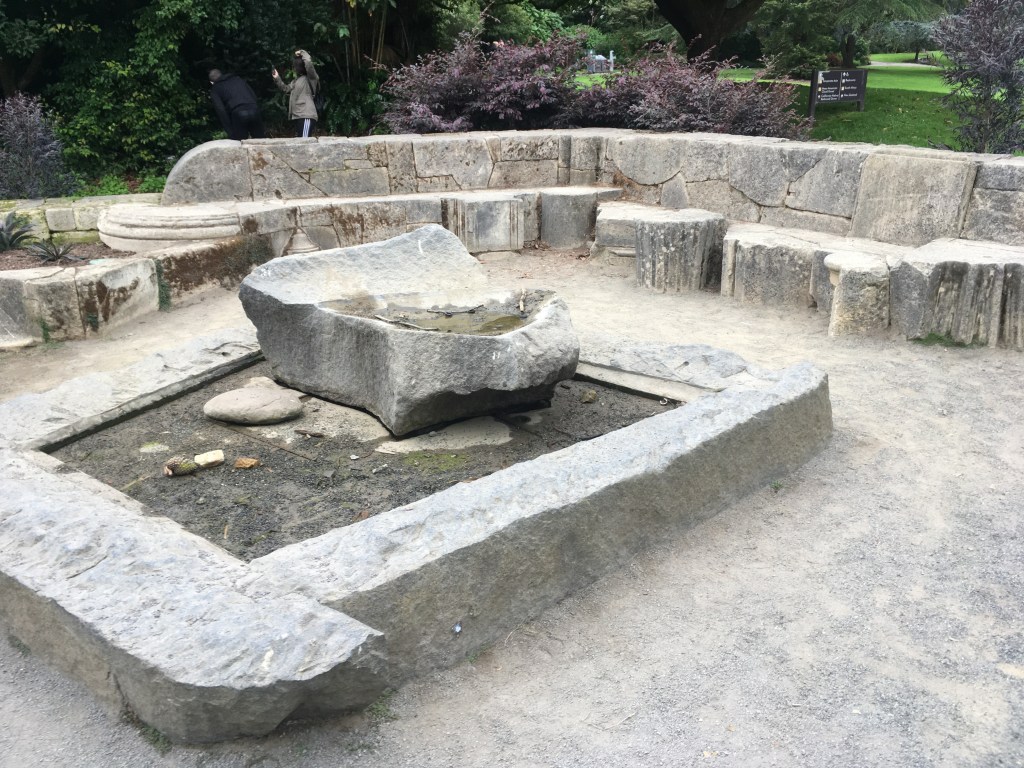
The fountain was dry. And the plantings? They are new. Another design by the current curator all in purple with a touch of orange from the Alstroemerias. A plant palette based around, for the most part, one color.

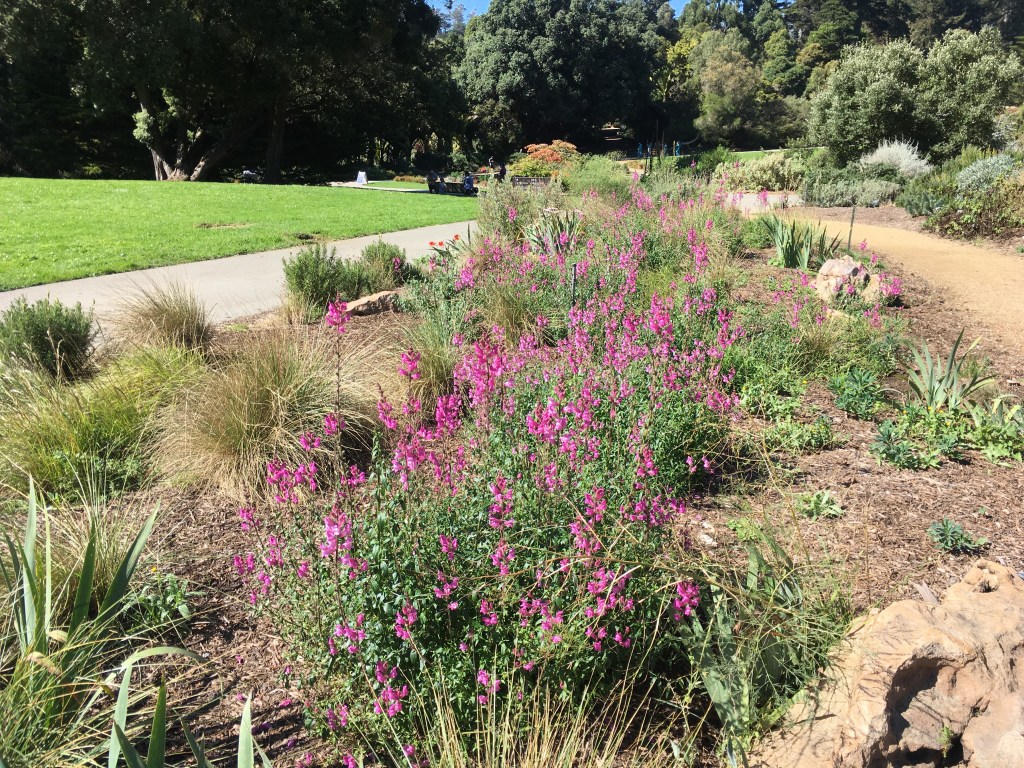
Well we will end the tour with a picture of plants wild collected from southern Spain – snapdragons, red poppies, yellow rockrose, esparto grass, and asparagus. A plant palette that come from a place, a community, an ecological niche, and a climate similar to our own. Well, enjoy, and see you in the gardens!























 Mission Azul