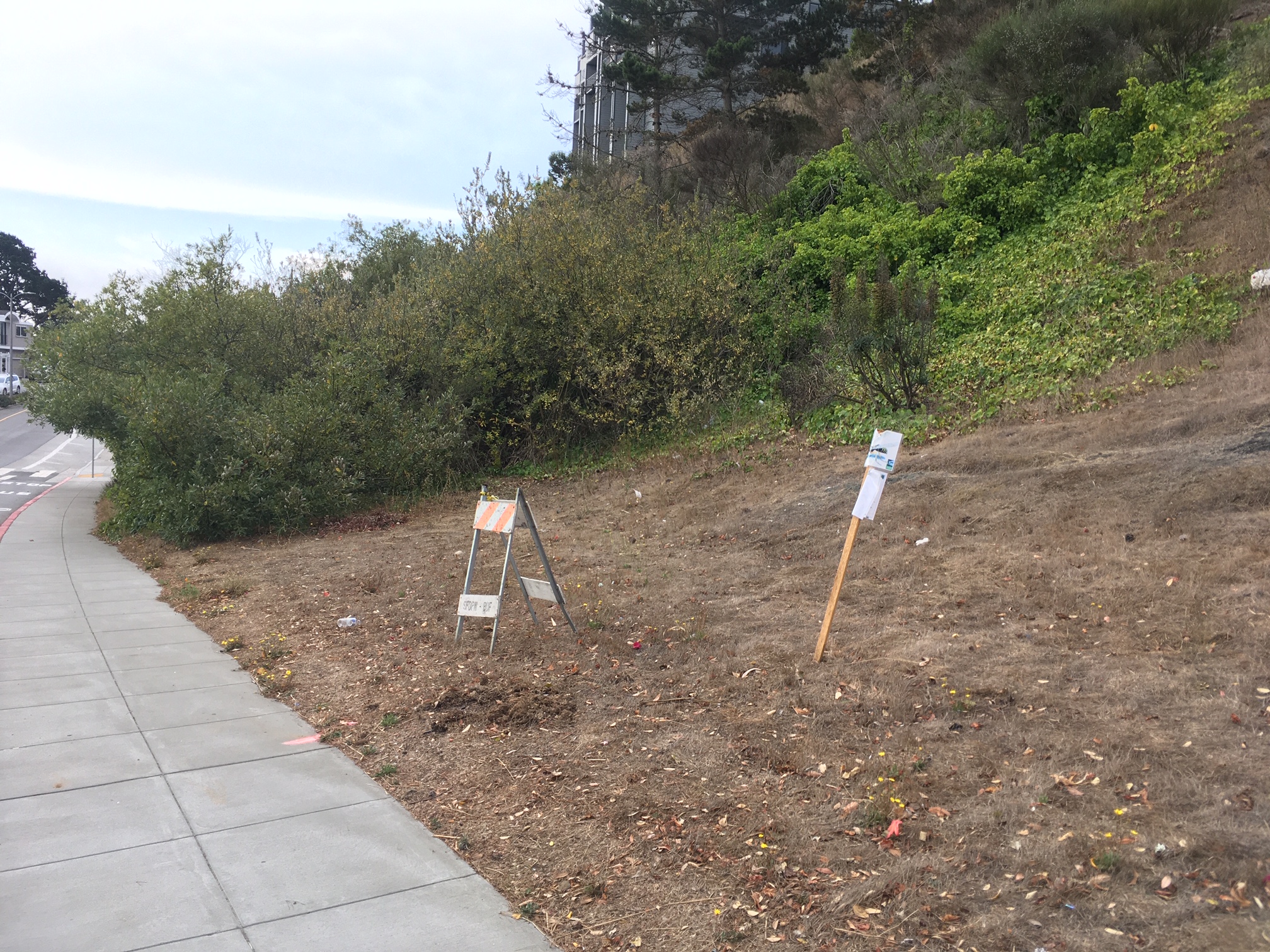
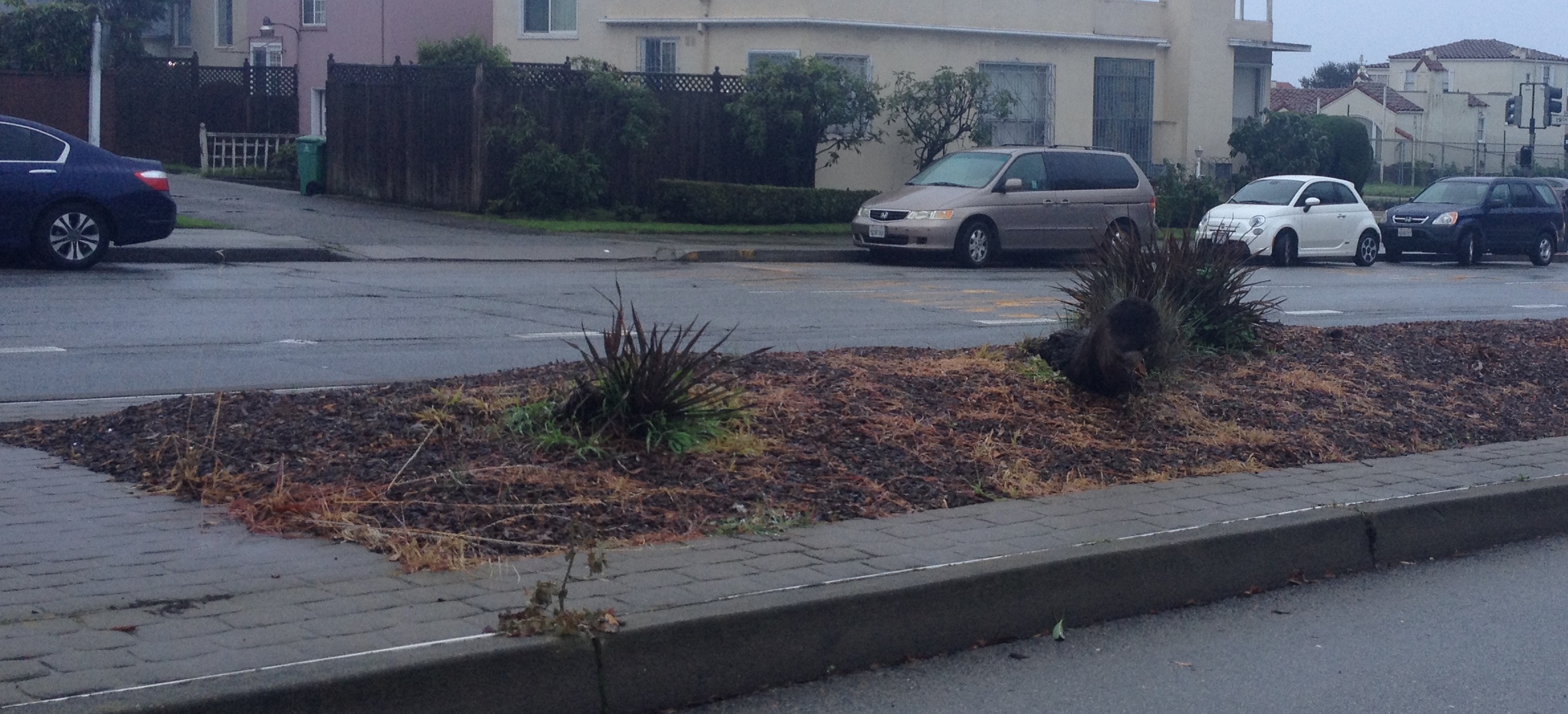
IMG_0541

Supplementary notes to
California Master Gardener Handbook
Chapter 2: Introduction to Horticulture pages 22-26
PLANT GROWTH
Water and light, those are key. In places that are dark and dry not many plants grow. Plants can tolerate the cold as long as there is also a warm period for them to grow and make more babies. If it is cold all the time – no good. Then they hunker down, slow it down, don’t do anything. They are still finding seeds in the arctic and Siberia from 30,000 years ago that when planted today are able to germinate. 30,000 years of Rip Van Winkling!

Plants survive on a variety of soils. From a granite crack in the mountains to the constantly flooding thin soils of the rainforest. From the icy permafrost tundra soils to shifting sand at the beaches. In general, its easier for plants to tunnel through loose soils compared to dense hard soils. That is why you plant your lettuce radishes and tomatoes in friable (easily crumbled) compost rather heavy clay hardpan where it would be strugglin’.

In some cases, the size of the plant above ground is reflective of and similar to its roots under the ground. Imagine the root systems of those oaks on the brown hill ranches all over the state. Four hundred years of massiveness. In other cases a small and nondescript plant above ground may have a huge long root system underground hidden from view. Think about a two hundred year old tiny little alpine plant that lives at 8,000 feet. Its small aboveground because of the wind and weather and snows, but down below it is snuggled and snaking deep into the rocks. You are caressing it saying “Oh you are so cute” and the plant is expressing “I’m old enough to be your grandma five times over”. Depending on its ecology and evolution, plants have a preference for either nutrient rich soils, or junky nutrient poor soils, and everything in between. Soils in riverine valleys that receive the floods and muds of centuries tend to be on the rich side. Soils that are ancient and worn down from millennium of erosion tend to be on the poor side when it comes to basic nutrients.

 
PHOTOSYNTHESIS
Simple sugars made by the plant are glucose, composed of carbon, hydrogen, and oxygen.  Sugars are inefficient to store, hence the plant converts them into carbo hydrate starches, oils, and fats. These are the seeds, grains, and fruits that we are familiar with: Oats, wheat, rye, rice, soy and corn.  Coriander, pepper, nutmeg, cardamon. Olive oil, sunflower oil, canola oil, safflower oil.  The same foodstuff we feed to our cows, pigs, chickens and sheep.

Plants combine sugars with nitrogen and sometimes sulfur atoms too, to make proteins like pinto beans, garbanzo beans, lentils, almonds,  chia, walnuts, and broccoli. It also combines the carbon hydrogen oxygen with nitrogen to make alkaloids such as caffeine (coffee), nicotine (cigarettes), quinine (gin and tonic), mescaline (peyote or san pedro cactus), theobromine (chocolate), tubocurarine (blow dart poison and surgical anesthetic). Well you get the -ine idea of the alkaloids which are basic in pH and have a bitter taste.

Plants transform sugar molecules into plant hormone molecules. The plant hormones help the plant to grow roots, ripen up, elongate and develop, and enter or exit dormancy. In addition, plants make a wealth of other compounds useful as detergents, dyes, tanning agents, waxes, medicines. All of this from photosynthesis and from nutrients absorbed from the soil.

RESPIRATION
Respiration is what we all do, we breathe. Breathe in oxygen, exhale carbon dioxide. This is true for bacteria, bugs, worms, animal, people. This is not true for a group of bacteria which like to live in places with no oxygen at all, those are the anaerobic bacteria. The anaerobic bacteria thrived before plants took over and spewed tons of oxygen into the atmosphere. They did not like that.  Nowadays these anaerobes are still ever present, but just not as dense or as visible. The best way to acknowledge their presence is to put some cut flowers in a vase and let the flowers sit. Let them sit until the flowers are all wilted and go brown. Let it sit for a few more days. Then go and smell the water inside the vase. There you go. Anaerobic bacteria eating the decaying plant matter. Yuck dump it!

Plants breathe in carbon dioxide and breathe out oxygen in photosynthesis. Plants can also breathe in oxygen and breathe out carbon dioxide when they are respiring, and using some of their stored energy to grow and develop. They are producers of food and oxygen, as well as consumers.

CYCLING OF PHOTOSYNTHESIS AND RESPIRATION
Photosynthesis is like – a gain, you are making food and storing it. Respiration is a minus, you are spending the energy. As a plant, if you spend more than you make bad news, you get stressed, and go dormant or die. Your balance, going forward, must be positive.

WATER AND NUTRIENT UPTAKE
A nutrient like calcium is present in the soil as whitish chunks of rock or tiny bits of dust. Nutrients like magnesium iron zinc potassium and copper are metals that are present in the soil bound up in some mineral chunks, or present as a crystalline solid by themselves in a vein. When water comes along it dissolves these substances and they become a part of the water flowing through the pores of the soil. The plant roots are turning this way and that way, digging with the lubricating goop tip of the root cap, while the root hairs spread out to suck up any available water. There is an exchange of electrical ion activity at the root zone and the nutrients are pulled and start going up up up into plant.

 
TRANSPIRATION
The movement of water up the stem or trunk of a plant is similar to you sucking on a straw at the milkshake in a cup. Or, it is like trying to siphon gas by sucking through a plastic tube. In a plant it is the leaves with the stomata open, breathing, that sets in motion the movement of water up up up. Imagine that the sun is out, theres tons of water in the soil, and your energy factory (the leaves) is in full swing. So bring up that water, breathe in that carbon dioxide through the stomata, and make food make food make food! Move it! Store it! More food more food! When the sun is not shining, then the stomata are closed and so is the energy factory. Time to rest.

TRANSLOCATION
Plants need particular compounds in particular places at various times in their development. When it is actively growing green leaves, the plant needs nitrogen for those new sprouts. And if nitrogen is in short supply, the plant will move it from the older leaves to the younger leaves. If it is in really really short supply, that is when you will see stunted plants or leaves going yellow green in color.

PLANT DEVELOPMENT
In general we divide a plant’s development into two phases – the vegetative phase of getting bigger and growing a lot of leaves, and then the reproductive phase of flowering, fruiting, and dispersing of seeds. This can happen very quickly on a one time basis for annual plants that live a few months. Boom and bust. In a long lived plant the phases alternate back and forth, back and forth. And if the conditions are not ideal the plant will sometimes skip the reproductive phase and hang out until the conditions are right. Or they may give a a one last hurrah and just all in, go for it, but then die afterwards. These phases often coincide with planetary cycles of warm and cool or wet and dry.

Supplementary notes to
California Master Gardener Handbook
Chapter 2: Introduction to Horticulture pages 10-22

INTRODUCTION TO HORTICULTURE

The relationship of care and sustenance between people and plants comprises our everyday life and existence.  Materially speaking, we are inseparable from plants and horticulture.  The fruits and vegetables in the market are horticultural products, as is the morphine drip in the hospitals. Horticultural or agricultural work drives peoples across state and country lines to pick and harvest. In the recent past, the need for labor in plant work moved peoples from Africa to the Caribbean and North and South America, it moved Filipinos Portuguese East Indians and Japanese to the Pacific Islands.  Or, in the case of plant disease, a sickness of the potato brought the Irish to the Americas. Or ask some elder folks in Appalachia about all the dead chestnut trees in the woods at the turn of the 20th century. Horticultural cultivation of plants drugs like coca, marijuana and opium fuel economies and cultures worldwide.  Stimulants like coffee, yerba mate, and tea keep everybody awake for work. Horticulture is also beauty and pleasure – the blooms of forsythias and roses, a grand row of magnolias along the street.  The importance of horticulture is absolute.   Our lives are totally and completely dependent on living and dead plants.  This is not to mention oxygen, fossil fuels, meat production, rubber, pharmaceuticals, and other industries wholly or partially originating from, and dependent on, plants.

WHAT PLANTS ARE

According to the amazonian indians, plants are sentiment and conscious beings who are more ancient than us, and are our teachers. This view comes to us from a culture that evolved in the rainforest for the past 15,000 years + alongside about 40,000 different species of plants. Plants of course do not speak our language or have concentrated focussed intelligence centers like our brains, nor are they ‘mobile’ in being able to walk around. But you may say that their ‘intelligence’ is spread out through their roots and connected to the soil and all the creatures that create and enable life on this planet. This has been the direction of recent scientific research into communication and the ‘mind’ of plants. Plants have been around for about 470,000,000 years, while we are a relatively newcomer at 200,000 years. Ratio wise plants are about 2350 times older than us.

An easy way to observe the cementing agent in plants known as pectin is to make jam. Many fruits when cooked, boiled down, and cooled, gel together nicely. That is the pectin in action. If a fruit is lacking in pectin you can buy some to put in the pot while you stir it. Try to make some jam with either the ripening blackberries around town or lesser known fruits of garden plants like strawberry tree Arbutus unedo, autumn berry Eleagnus umbellata, or fuchsia berries. Make it a fun day long activity that starts with a hike and baskets, pauses in the kitchen in the middle while jam is cooking, and ends with a PB and J on the sofa for dinner.

PLANT STRUCTURE

MERISTEMS
Meristems are the actively growing cells that make a plant grow wider or grow taller. The taller you get or the wider you spread the more leaves you grow – the more food and energy you can make.

ROOTS
The roots are usually in the soil and anchor the plant in place. Another function of roots is to spread out in the ground and gather whatever water and nutrients it can find and suck them up into the plant. Nutrients are dissolved in the water as electrically charged ions. Kinda like that vitamin water is always advertising. The ion nutrients have names like calcium, phosphate, magnesium, and so on.

They say some 85% of all plants have an association with fungi in the soil whereby they are friends and help each other out. The plants give sugars to the fungus, and the fungus will channel and give the plants water and nutrients from miles and miles around. This is a symbiotic and mutually beneficial relationship. Roots can go very deep and very wide. The fescues in the Midwest prairies have roots that go down 10’+, and a big 100’ tree can have roots that extend outwards to three or four times that (300’ – 400’). Sometimes you will see roots growing right from the trunk itself out in the air. Around here it is most prominent on the commonly planted street tree called New Zealand Christmas tree. If you see these long red strands hanging off of a tree, those are roots wanting to reach the ground and become another trunk.

STEMS AND SHOOTS
Stems conduct materials up and down the plant. On the stem are buds from which emerge leaves,stem shoots, flowers, and sometimes even roots. When a stem goes sideways above ground it is called a stolon, like on Bermuda grass lawns. When its underground going sideways it is called a rhizome, like bamboo or ginger. When it becomes swollen with the food energy it is called a tuber like in a potato.

It is confusing – the potato stem tuber, versus a sweet potato, which is classified as a tuberous root. They both just look like swollen chunks of starches. Well the best sense I can make of it is that in cultivation and growth they are different. The potato tuber has those little sunken ‘eye’s all over it, each is buds that can sprout. So if you cut it up into a few pieces they can all grow. It can grow from all over. But a sweet potato, a tuberous root, has a more up and down orientation whereby only one part of the chunk grows. It does not have buds all over it.

sweet pot

When you look at a stump or a piece of cut lumber, you can see the growth rings which show this system of channels moving substances up and down. In general, there is the xylem tubes which conduct water and nutrients, mostly going up. Then, there is the phloem tubes which conduct sugars made by the leaves down, up, and even side to side. This depends on where the plant wants to store it, or on where the plant wants to use it as an energy source.

When you tap a sugar maple tree in the springtime, you are catching the rising sugar sap in the xylem. Aside from the xylem and phloem there are also other tubes in which flow other substances. The thick sticky gooey stuff that comes from a cut wound in pine trees – that is a resin or pitch. It is good for making varnish, for incense, or for hafting a stone ax to a wood handle in the olden times. With time it turns into amber. The sticky resin on the hairs of cannabis flowers – that gets made into hash which is a big commodity in North Africa into Europe. Latex is a white sap exuded by plants in order to defend against insects eating it. Chicle chewing gum is a natural latex, as is the rubber used in tires.  Especially tires in airplanes.  The dried substance from opium poppies is also a latex from which both legal opiates as well as illicit ones are derived.

BUDS
If you look or feel a branch you can sometimes identify the buds readily. They are funny little nuggets or bumps that are all along it. They are arranged in different ways that make a plant easily identifiable even if you cant see the leaves or flowers. In some plants the buds are hidden under the skin the bark, but as soon as they are called upon to activate they will spring into action. They are called dormant or epicormic…  Say theres a sunlit opening in a gap of the shady canopy.  Grow that way!

LEAVES
Leaves are the energy factory of the world. Plants breathe air through little holes on the leaf called stomata, and leaves receive water and nutrients though the roots, stems, and veins. As light passes through the stacks of green cells called chloroplasts in the leaf, the plant is able to make sugars from the carbon dioxide it inhales and the water it sucks up. It then stores the sugars as starch or as oils for hard times, and it exhales oxygen as a waste product of its energy production.

Carbon dioxide makes up about .04 % of the gases in our atmosphere. It is a product of stuff burning and dying. It gets released into the atmosphere when volcanos blow, forests catch on fire, and bodies decompose. In plants, that same carbon from the CO2 gets strung up or bound in rings into the molecules we call sugars and carbo hydrates.  The oxygen in our atmosphere that we all breathe is made by algae and trees. It is about 21% of our atmosphere’s gases.

FLOWERS
A showy flower attracts insect or bird or animal pollinators with pollen, nectar, smells and colors. Pollen is male plant sperm which is a yummy protein rich food for many insects. Nectar is sweet liquid, sugars good for energy. Smells can be really sweet and come on only in the evening for moths, or smell like putrid flesh if the flower wants to attract flies.

Many flowers are not showy. They do not have to attract anybody because they rely on the wind and occasionally the water for pollination. These flowers are often small and insignificant and produce copious pollen because their method of pollination is like a scatter bomb approach.

Many plants do not have flowers at all. These are the cone bearing plants like pines and firs, the ferns and mosses and horsetails, or the weird cute little plants in moist places called liverworts. These plants also rely on the wind and water to get together.

Pollination is the touching of male and female parts of a plant. The male pollen touches the female sticky part called the stigma. After the parts touch, eventually the sperm makes it to the egg cells. This results in fertilization which means the plant is gonna make babies. The babies are called seeds. And the seeds are usually sitting in some kind of a structure. The structure is sometimes a woody cone whose scales open when mature to reveal the seeds, or the structure is some kind of a container or vessel called a fruit. The fruit can be juicy and tasty, or it can be dry and hard, or any number of other variations.

SEEDS
The seed is the product of sexual reproduction. Female and male. Many plants make seeds sexually through pollination and fertilization, but also reproduce asexually (without sex) by cloning and dropping themselves on the ground in some way. Both strategies are useful and help survival. Seeds are comprised of the baby plant itself (the embryo), a little bit of food to help it along in the beginning, and a coat that protects the whole package.

FRUITS – OR CONES
After fertilization, the flower fades away because its job is done. Then the ovary of the plant which is the storehouse of the seeds grows big and becomes a fruit. There are yummy fruits which attract bats or rodents or elephants to eat them and disperse the seeds in the dung. There are exploding fruits which throw the seeds several feet away like the squirting cucumber or the impatiens. There are fruits that can float on the sea for years until they dock on desert island sands like coconuts. Sometimes what we call the fruit is not the swollen ovary but the plant part at the base of the ovary, like in a strawberry fruit with its little seeds all on the outside not on the inside.

CLASSIFICATION OF PLANTS
We will lump the classification of plants into three broad categories. (1) Folk, (2) horticulturist/gardener, and (3) scientific. Folk is what everybody around world does – teach their kids about the plants useful in day to day life. That way when you are out foraging, you dont take the poison hemlock root home thinking it is a white carrot root crop. Or when you are gathering firewood, you don’t pick up all that light pithy termite filled wood that is no good for cooking and burning and keeping warm. You want that dense hard wood. Some cultures developed their folk classification systems to a very high level. One such culture was documented by the local botanist Dennis Breedlove along with anthropologist Robert Laughlin in the book The Flowering of Man: A Tzotzil Botany of Zinacantán. The following is category (2) – the ways gardeners classify plants:

GROWTH HABIT
More appropriately lifespan when talking about annual, biennial, and perennial plants.

STRUCTURE OR FORM
When you go to the nursery, usually this is how plants are grouped. Trees are in one section, vines in another, and so on.

LEAF RETENTION
If you lived in a place that got really cold in the winter with the sun low in the sky, then at some point it is a waste holding onto all them leaves because they are not doing anything. They are not making energy or doing work. Better to drop em and grow them again come warm spring. This is the fate of many trees with names like sweet gum and oak and maple and beech and larch.

In another scenario it gets so hot and so dry in the summer that the leaves are breathing and breathing and pretty much gonna endanger the whole plant because its losing tons of water. So then the plant decides to drop all the leaves and grow them again in the fall winter months when the rains come. This is the fate of shrubs and trees with names like sagebrush Artemisia and red bud.

All of these are deciduous plants. Winter deciduous or summer deciduous. In the wet tropical rainforest the plants are more likely to be evergreen, not deciduous. This means that they keep leaves on all year, but still they will drop a few leaves time to time – the old leaves, the leaves that are not working so well anymore cause they are in too much shade.

CLIMATIC ADAPTATION
Look up zone maps. There are two that are commonly used around here, one is by the U.S. Department of Agriculture, and the other is put out by Sunset Garden. Look both up, and see if you can figure out what ‘zone’ you live in.

USE
Use is going back to folk classification, category (1).
One more system or criteria we neglected here is based on the plant being ‘woody’ or herbaceous. Woody is hard and stiff, breaking when sufficient force is applied. Herbaceous is soft and bendy. Trees and shrubs – woody. Leafy perennials like anemone heuchera pansies – herbaceous. Taken as a whole, you can have an herbaceous evergreen perennial, for example new zealand flax. Or you can have an herbaceous deciduous perennial that dies back to the ground, like a hosta. Maybe somebody would say well that is not deciduous.  Sigh.  Okay.  Then herbaceous diebackalacious perennial.  How about the banana tree? Herbaceous or woody? Gotta go squeeze and push on one to find out…

BOTANICAL OR SCIENTIFIC CLASSIFICATION
This is the classification system which grew out of Europe in the 1700’s and is now worldwide. It groups plants into families based on the characteristics and structure of the flowers, for the most part. For example there is the Brassicaceae Cruciferae family with flowers that are four petaled and shaped like a cross. A crucifix. There is the Lamiaceae Labiatae family with flowers that are like labia with lips up and down, and often but not always square stems. Sage, mint, rosemary, oregano, thyme, lavender, and basil are all in this family. Go check out their flowers!  The current estimate is about 300,000 species of plants and anywhere from 150 – 200 – 400 families. Botanists do not agree on the number because nature is very diverse and the plants do not fit easily into boxes.

Within each family are its similar members grouped into genera and species. In cultivation we further classify particularly useful individual clones/populations as cultivars (cultivated varieties). The cultivar is always written with single quotes like this   ‘ ‘. So in apples there are European crab apples Malus silvestris, and Japanese flowering crab apple Malus floribunda. The apple we eat is Malus domestica. Domestica means something like lives with people. And by the way sativa means cultivated.  The apple cultivars have names like ‘Red delicious’, ‘Gala’, ‘Pink Pearl’, etc. You can do this same exercise with wine grapes, plums, and so on.

If you are going to be a designer or landscaper it is good to learn the names of plants using their scientific names. Not only is it cool to know a little bit of Latin and Greek, it will also ensure that you are talking about the right plant when communicating with others. Not “Yeah the one with the blue flowers, you know, blue bells or blue devil or blue eyes or something like that. The one with the green leaves. Let me show you on my phone. Grr… the battery is dead!”

In the end, maybe it doesn’t matter at all. What plants you choose and where you plant them. Plants are beautiful, they are all beautiful. Even the ones with the teeny rinky dinky flowers, even the ones with the careless sprawling habits, even the ones with the stinky carrion scented flowers. Plus, isn’t beauty in the eye of the beholder? So then how do we evaluate the ‘correct’ grouping and layout of plants in a garden? Okay, we are going to put beauty aside, and leave each person’s aesthetic choices to themselves. Instead, we are going to focus on factors that are more easily quantifiable and comparable. And afterwards, look at a few scenes around town, and encounter some challenge questions.

Criteria:

Water use. Like all things in nature, plant distribution is often cyclical. With regards to human society, it is also trend and fashion based. In a hot and dry landscape such as central and southern California, the wild plants get by with about 15”-20” of water a year. Gardens, thats another story. In the rush after large scale water works projects like big dams and thousand mile long aqueducts, people are happy to show off their new found control and utilize some that liquid impounded in the reservoirs. So then deserts of big basin sage and juniper turn to flat green lawns that guzzle and suck. Annual, ephemeral meadows of lupines and phacelias that bloom because of winter rains – those places become transformed into a four month long celebration of english perennials and the likes of gladiolus and roses, with the irrigation coming on everyday at 5 am for fifteen minutes.

This goes on for a while, until the drought hits, or the general consensus turns against wastefulness and creating too much illusion in the face of stark reality. The water bills go way up and rationing starts. Then, the lawns start to get switched out for dry land succulents; xeriscape style gardens of the Rocky Mountain plateaus become in vogue; on the front page of design magazines are plants adapted to an environment with water in short supply. So economics, status, and emotions all help to dictate the palette of plantings.

Granted, there are always kind folks holding down the fort of the idyllic eternal spring landscape. Folks who don’t mind paying for water no matter how exorbitant the cost. Folks that aren’t going to start playing golf on a course made of gravel and plastic turf. There is just something about that criss crossed fresh mowed lawn on the outfield of the baseball field. These folks are great clients, and can really help your career along. You may also have clients who are a little more mindful of their wallets, or what their neighbors are saying. Maybe a little bit more common sensical with regards to water use. So design a smaller lawn, or suggest a hillside of thick perennial grasses and sedges filled with poppies. Plant more plants from the mediterranean climate that is seasonally dry like ours, rather than plants from a temperate climate with abundant rainfall.

In and of itself, there is no right or wrong with relation to the use of water. In general, if there is a lot of it, use it! If there is not so much, take it easy! Balance. What is important is that you give each plant the correct amount of water for its health and well being. If a plant is accustomed to high montane slopes and seasonal dryness, it can suffer from too much water – often the result of being planted in a spot with poor drainage, or irrigation gone awry. This poor plant would then have trouble breathing, get root rot, go brown and die. This is what you want to avoid. Sick plants, dead plants.

Sun and Shade. Okay, look at a yard or a garden. Now watch the sun move overhead. Watch the sun for a whole year as it passes over and through the garden. Where is the sunniest spot? Where is it shady? In the far corner? Next to the house? Does the neighbor’s huge tree block all of your sunlight? What about the new addition they did without pulling the permits?

Now go hiking. On a southern slope, what are the plants growing there? Go to the north slope, underneath the trees, or along a wet drainage, what plants are growing there? If you do enough of this kind of exercise, you will notice that plants have preferences for particular sun exposures, and have spent thousands of years becoming comfortable in those situations. Some plants are ‘generalist’ or ‘not picky’ or ‘easy’ and ‘adaptable’. They seem to grow well no matter what the kind of bungling mistakes you make with regards to sun or shade. Others are not so tolerant and flexible with regards to their comfort zones. If you plant them in the wrong place, They suffer burn marks, they look sad and wilty and floppy. They just sit there and don’t grow at all, or they become pockmarked with fungal spots and covered with hard shells of scale. They are like ‘just kill me already’, but around here theres no winter cold snap to take them out of their misery. And, they look just hopeful enough that you are like ‘well I’ll give you another chance’…

If you want to plant a fruit tree – a tree whose fruits ripen because of the sun. Where do you plant it? In the sunny or the shady spot? Do you space it out so that it gets plenty of sun? Or do you cram a bunch of em in there because you think ‘more trees, more fruits, yeah!’? This is a basic criteria, but often neglected. The amount of light, it makes a big difference! And the awkward microclimates of any yard, especially in San Francisco, makes a difference!
Wind and air. On the coast, it is windy. Mostly windy in the summer, in the afternoons. But in the spring also, and the winter too. Fall the wind occasionally goes offshore, blowing from inland out to the sea. Otherwise, it is onshore.

When they established Golden Gate Park in San Francisco, the engineers and architects and planners knew they had to contend with the wind. And the sandy soil. You cannot stop the wind. We have really good technology, but we cannot stop the wind. I am sure somebody is working on it. Harnessing it for energy and such. But until then…To avoid wind tunnels, park creators established winding roads and pathways. To break the wind – plants. But what kind of a plant could tolerate such howling conditions? A plant from the coast, or a plant from the stillness of inland plains? A perennial shrub, or a bunch of annuals that wither in months? A plant with tiny waxy leaves, resistant to dessication, or a plant with juicy big leaves constantly demanding more more more more moisture?

Wind dries everything. It dries the soil, it blows the water right outa plants. It tears up the leaves, and can be, well, annoying. If a plant is used to the wind, like the Pelargoniums of Africa or tea trees of Australia, they just chug along and do their business like usual. They be bloomin, singin, laughing like those 20 knot gusts are no big deal at all. Now, if you are usually happy in a calm woodland setting, and not used to the wind, like for example a kousa dogwood, then you are hunkered down and trying to survive. Doin nothin. Even if you have enough water. Even if you have all the nutrients you need. No flowers, no fruits, no nothing. Just catatonic zombie waiting. Waiting, holding out. Hoping it will stop one day. The wind.

Too little wind, like in tight corner with no flow. Or an over planted sheltered garden with buildings on all sides – that can cause problems too. Imagine you are in a 10’ x 10’ room, cant move, with twenty other people. Bugs are gonna take notice, disease is gonna set in, and a cough or a sneeze is gonna cause problems for everybody. A little ventilation, a window, a fan, a little more space for everybody. That is good plant health for long term designs.

Soils. By now you might be somewhat disturbed or curious. Wow! There is so much to figure out with regards to proper plant selection and placement! Its so complicated! But wait… There’s more! Get out the shovel and start digging. Not just one spot, not just five inches deep cause you hit a hard spot. Go deeper, try different spots. Wet it, squeeze it, check the drainage. Get a soil test. What do you have? Maybe a cart load of lead and cadminum? Now theres a consideration if you are planning an edible veggie garden. All sand with no nutrients? Well those apples and plums are gonna need some amendments and fertilizers. The soil test says tons of cation exchange capacity? That could be good or bad, depending if you want an orchard or a whole collection of Australian plants that prefer poor soils. So no, you cannot just plop any plant anywhere and make it work. Unless you are sticking to the new zealand flax, agapanthus, and rosemary. The ten easy plants you see in the gas station islands and shopping mall parking lots. Then, take into account the interaction between water and soils and plants… Did you know that our oaks like to have a bit of summer dryness in the roots, so don’t plant a lawn all around it? Or that the plants they are using in rain gardens are from the perennial wet zones, not seasonally wet zones, and are not actually appropriately planted? Even though they are natives? Just cause you were here five hundred years ago does not mean you are adapted to every single site. You got preferences just like any plant.

Maintenance and time. Here’s one that makes a lot of sense, but gets forgotten always. For most gardeners and arborists: it is easy and fun to cut branches off a tree, time consuming and tedious to pick it all up and haul it away. It is a joy to cook and eat, not so much to bus and wash the dishes put everything away. In the garden, many designers have a great knack for the install and first couple of years, but it tapers off real quick after that. The lack of thought and consistency for maintenance is the fate of many a landscape.

Again, the key is a balance. You can be picky to the point of madness in the garden. Remember, this is mother nature we are talking about. You are not in control! This is not a war or a competition. It is more like a dance back and forth. Try to see the big picture and enjoy the sunset and birds chirping. On the other hand you do not want to be sloppy and unkempt and derelict in your gardening duties to the point of neglect either. Somewhere in between.

There are high maintenance gardens that require frequent daily to weekly attention. Golf greens, corporate lawn, fine tuned english perennial garden, European formal garden, the edible vegetable garden. A couple of weeks of workers calling in sick and these places will start to show the overgrown edges and weeds popping up. It goes downhill fast if nobody is on it. These gardens in general require labor, machines, and chemicals. Thats what it takes. High maintenance. Neat and crisp, but on edge, not relaxed.

There are medium maintenance gardens that require weekly to monthly attention. This could be a garden with some long hedges or an ivy covered wall. A garden with rhododendrons that require deadheading, some orchids that need to be repotted, and sages that have to be cut back when they get too big. An irrigation system that has to be flushed and cleaned and run, leaves from the deciduous trees that have to be raked up and bagged. So some work has to be done. Not all the time, but once in a while.

There are low maintenance gardens that require monthly to quarterly to biyearly to yearly attention. They just need a trim and a sweep every so often. They are either densely planted like a wild area, or sparsely planted but smartly mulched. The plants dont need much water, or pruning, or fertilizers, just a touch here and there. If you fall asleep and wake up three months later, its okay. The garden more or less takes care of itself and still looks pretty good all the same. Plants are probably a mix of native and non natives, chosen for their hardiness and ecological fitness for the site.

There is no zero maintenance gardens. Gardens are work! If you want zero maintenance concrete is the answer.

Well that’s most of the measurable criteria that we can use when selecting and placing plants. Besides these factors, we also base wise plant choice on the prevalent diseases in an area and the susceptibility of the plant to that disease. Growth rate and spacing is another consideration. As is diversity and ecology as relates to birds, butterflies, amphibians and reptiles and the like. Well we will talk more about those another day…

Water use is measured in gallons, or in inches of precipitation (one inch of rain is about 623 gallons per 1,000 square feet). Light is measured in its brightness (lumens), its duration (hours), and in its spectrum (Infrared to UV and everything in between and beyond). Wind and air is measured in miles per hour or knots, and the direction is always taken into account. Temperature is in there too somewhere between sun and shade and wind chill. Soil tests take into account the amount of clay, silt, and sand; the amount of ions present such as nitrogen, phosphorus, potassium, iron, lead, chloride, etc. The tests also measure pH, the amount of organic matter, cation ion exchange capacity. The soils will give a clue to the drainage of a site, and indicate whether amendment is needed. So listen to the earth. Finally, there is maintenance. There is a wide range when discussing all facets of gardening. In general, the more complicated and diverse a plant palette, the more knowledgeable is the gardener. So in a botanical garden, or a primary rainforest, the gardener is at the level of a PhD botanist – ten twenty years before you know all the plants and their culture, before you are proficient in your job. For example, in San Francisco Botanical Garden, back in its heyday, a gardener’s beat would entail caring for two thousand distinct, somewhat uncommon to rare species, in a six or seven acre area.  A rare species is like the only plant of its species of its kind in say a three or five six hundred mile radius.  In contrast, the basics of mowing a lawn well and edging it, that you can learn to do in a few days. Its the subtle nuances of a terrain that takes many more years to figure out.

In general, the more legit, the more professional, the newer the truck, the more expensive is the gardener. However unlike workshop tools, in gardening, fees and cost are not necessary indicative of quality. That is to say, sometimes there is some super nice humble happy gardener university trained or life trained horticulturist who is charging only $25 an hour for the best most amazing work. While in the same city a fancy smooth talking gardener who doesn’t know what they are doing is getting $90 an hour for poor quality work. If all gardens were exactly the same, and there was only one way of doing things, we could standardize the work. But gardens are distinct, and every place is different from the next.

In a high maintenance garden weeds are a constant concern, due to their fast growth and prolific nature. Unless you have a crew of gardeners working non stop, you will not be able to keep up. Therefore, many places will resort to the use of chemicals. If done legally signs are posted, proper safety gear is used, people are trained and proficient. More often than not, spraying is done after hours or illegally, so keep an eye out for a patch of green that suddenly turns yellow. And do not pick the edible weeds that are growing in such places. Then, if we are going to play the blame game, whose fault is it? The worker on the ground trying to hold it together, making the place neat and tidy? The middle management supervisor under pressure to perform more than is humanly possible and turning a blind eye? The unrealistic expectations and lack of connection to nature on the part of the boss? Or the overall vision of how we work and relate to the earth herself? This is a bigger discussion than fits here…Forget playing games, just get your shovels out and go to work!

Here are a few pictures from a town walkabout. Take a close look. Using what we just discussed here, try to interpret the scene – the relationship between the plants depicted and the water, soil, sunlight, air, and maintenance over time. I will give you a fair amount of information about the first scene.  Give you a little bit of information about the second scene.  And give you almost no information about the third scene.

Choose one of the three scenes, and write a couple of paragraphs describing what is happening. Also, answer these questions as they pertain to the picture –
Do you like this garden design? Is it something you would do?
How would you change or improve the design or the maintenance of this garden?

Okay here we go. Remember, only pick one scene to write about. (A), (B), or (C).

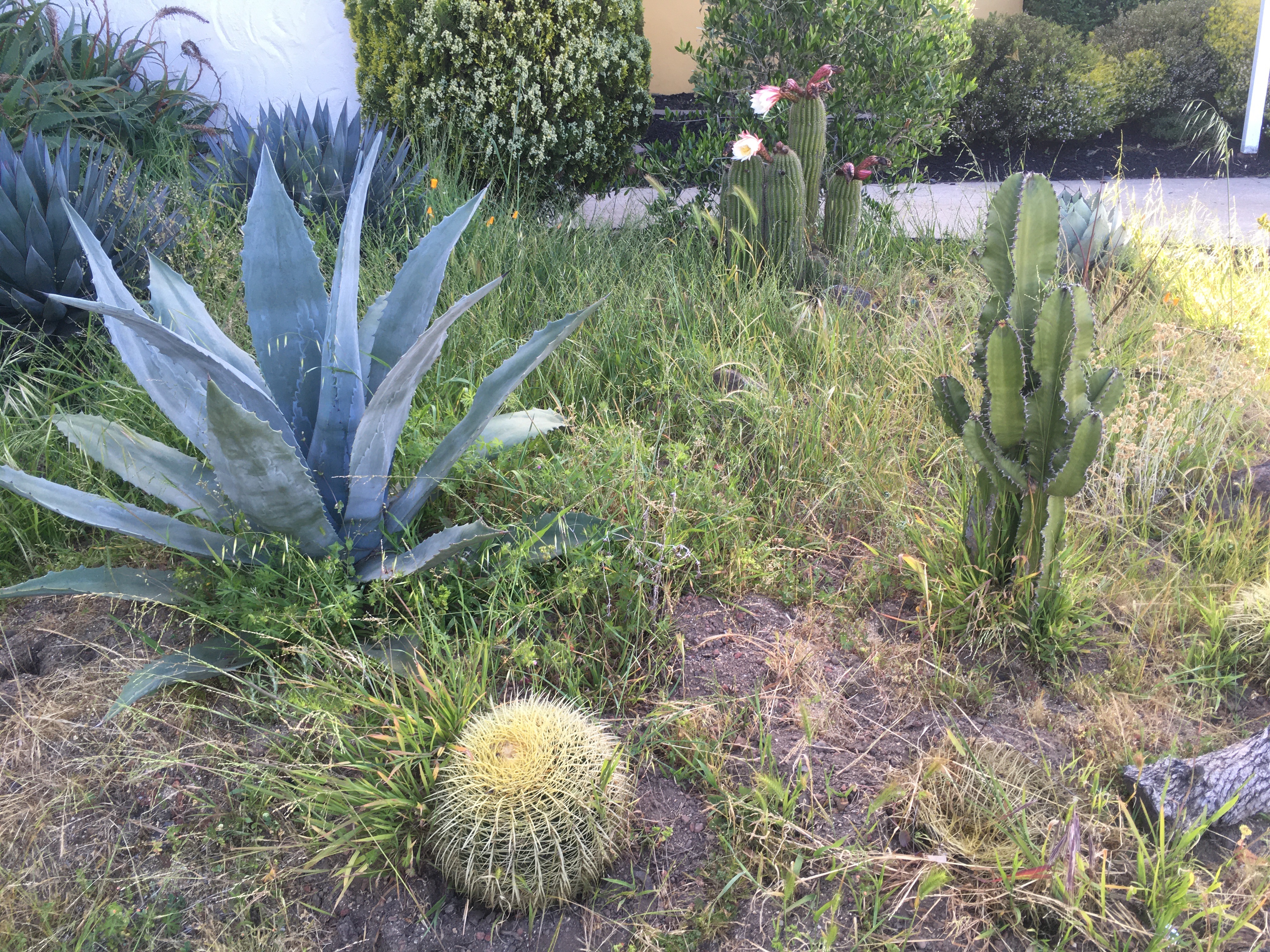
(A)  Okay a few clues and hints.  The soil is clay.  This garden sits on a curvy wind tunnel of a street on the shady side of the street.  Plants are Agave on the left, barrel cactus in front, Euphorbia maybe ingens on the right, and another cactus in the back I’d have to ask a cactus person, cereusly?  You dont know it? water
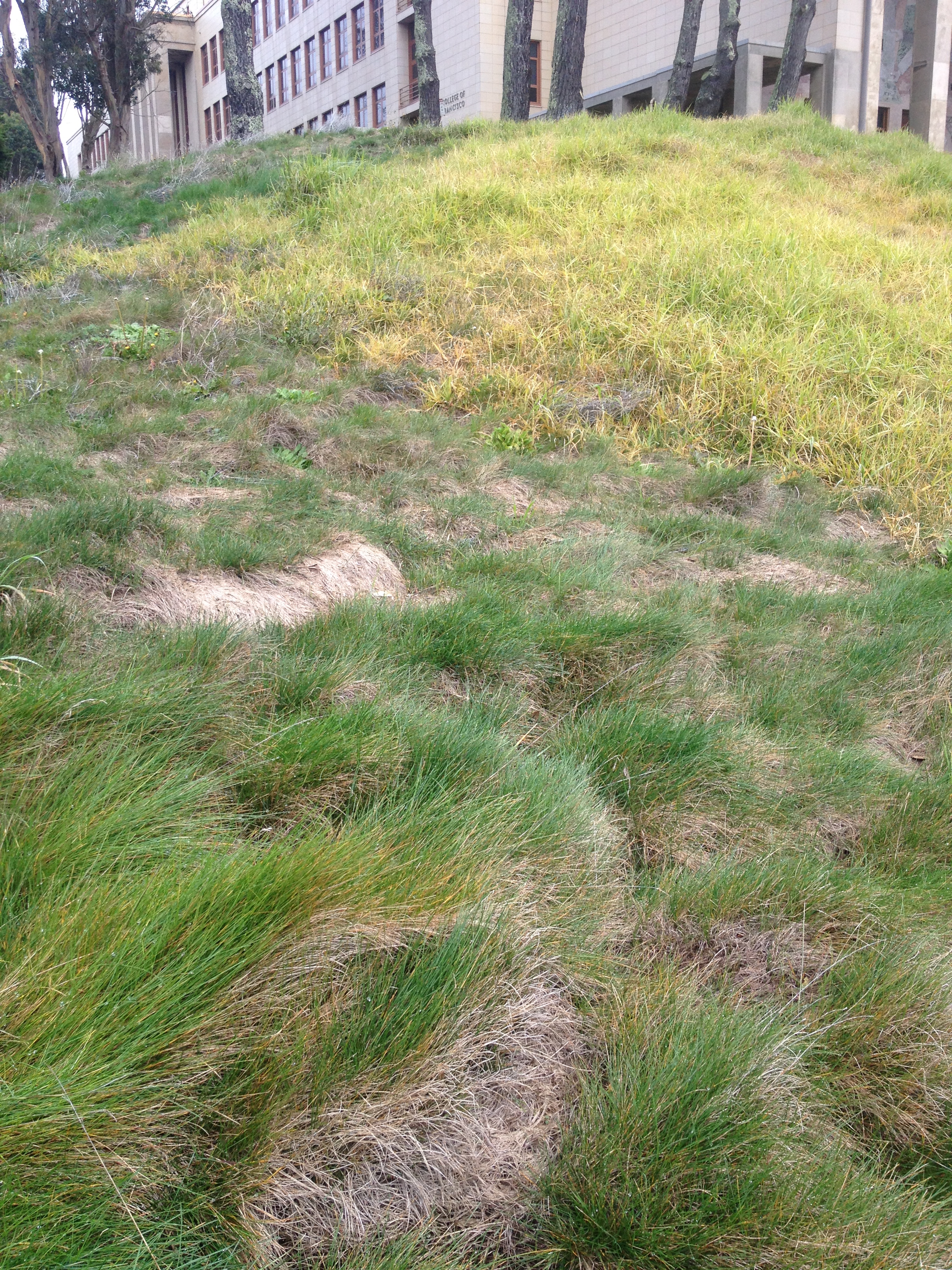
(B) This site is a south facing hillside in a clay soil.  Irrigated by rotary pop up sprinklers.  You will have to figure out what the plants are, and your opinion about them.IMG_9898_2
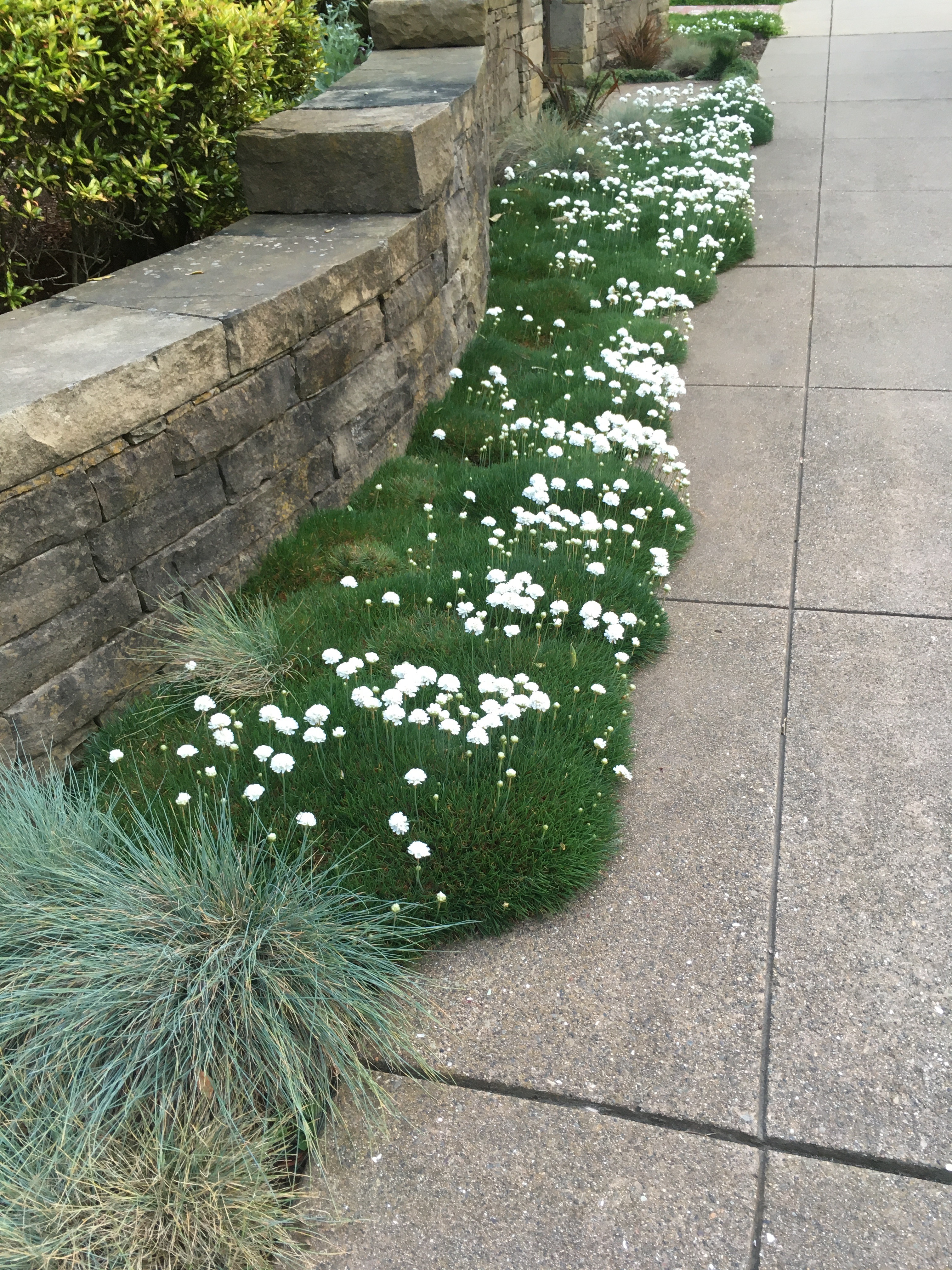
(C) The plant is a  plant of the Cali coast called sea thrift or Armeria maritima.  Usually in nature it is pink not white flowers.IMG_2559
Gardening: Pruning

Your lab this week, if you choose to undertake it, is to prune two to three shrubs

I will describe three basic types of pruning, and we will go from there
you can take your pick:
(1) Hedging and topiary, (2) light ornamental prune, (3) heavy ornamental prune.

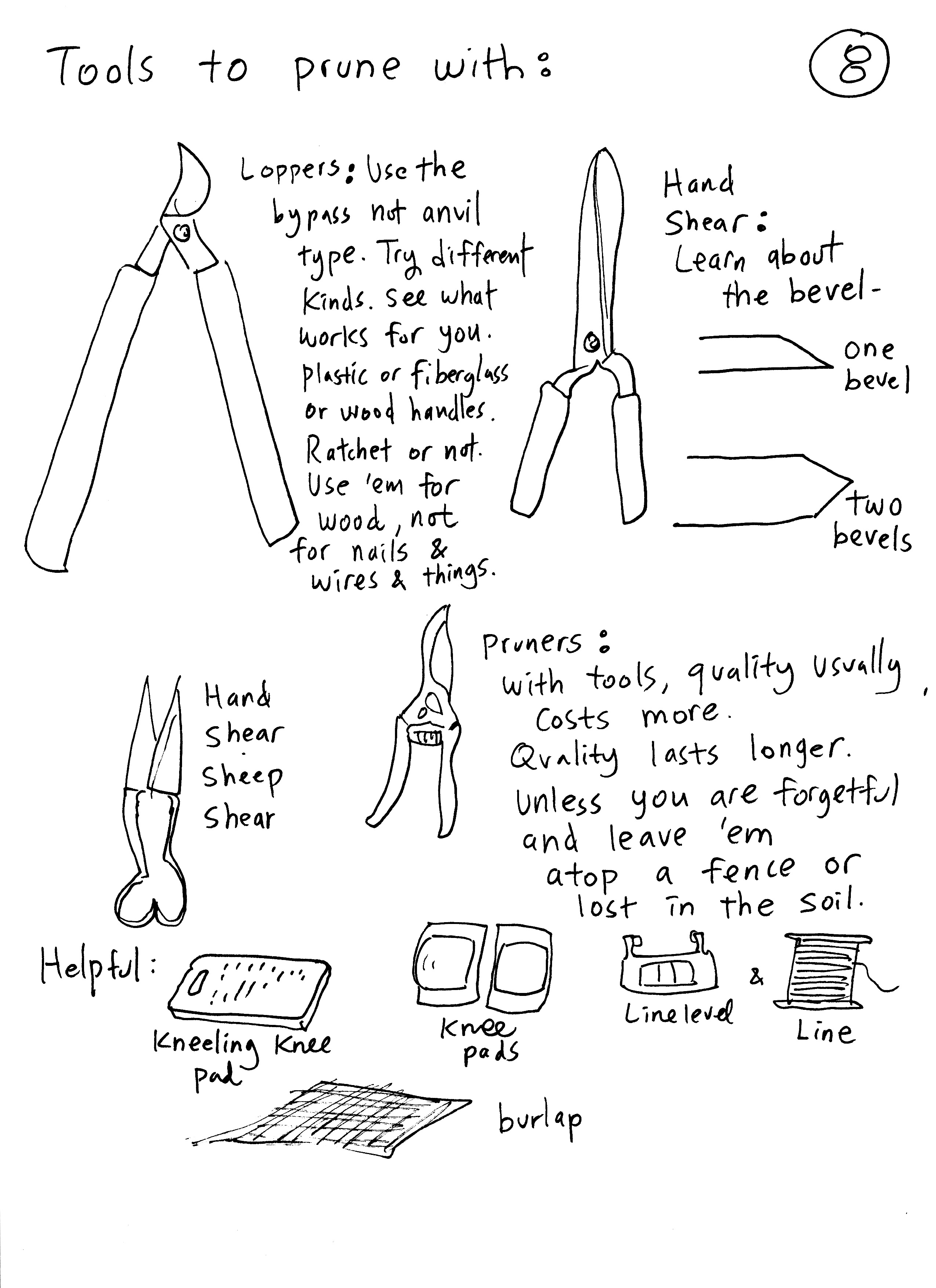
The equipment you will need are pruners, shears, and loppers
also, for safety – gloves, close toe shoes or boots, eye protection, sun protection if sunny
and, for cleanup – a burlap tarp or the yard waste paper bags, compost bin, rake, broom, scoop shovel

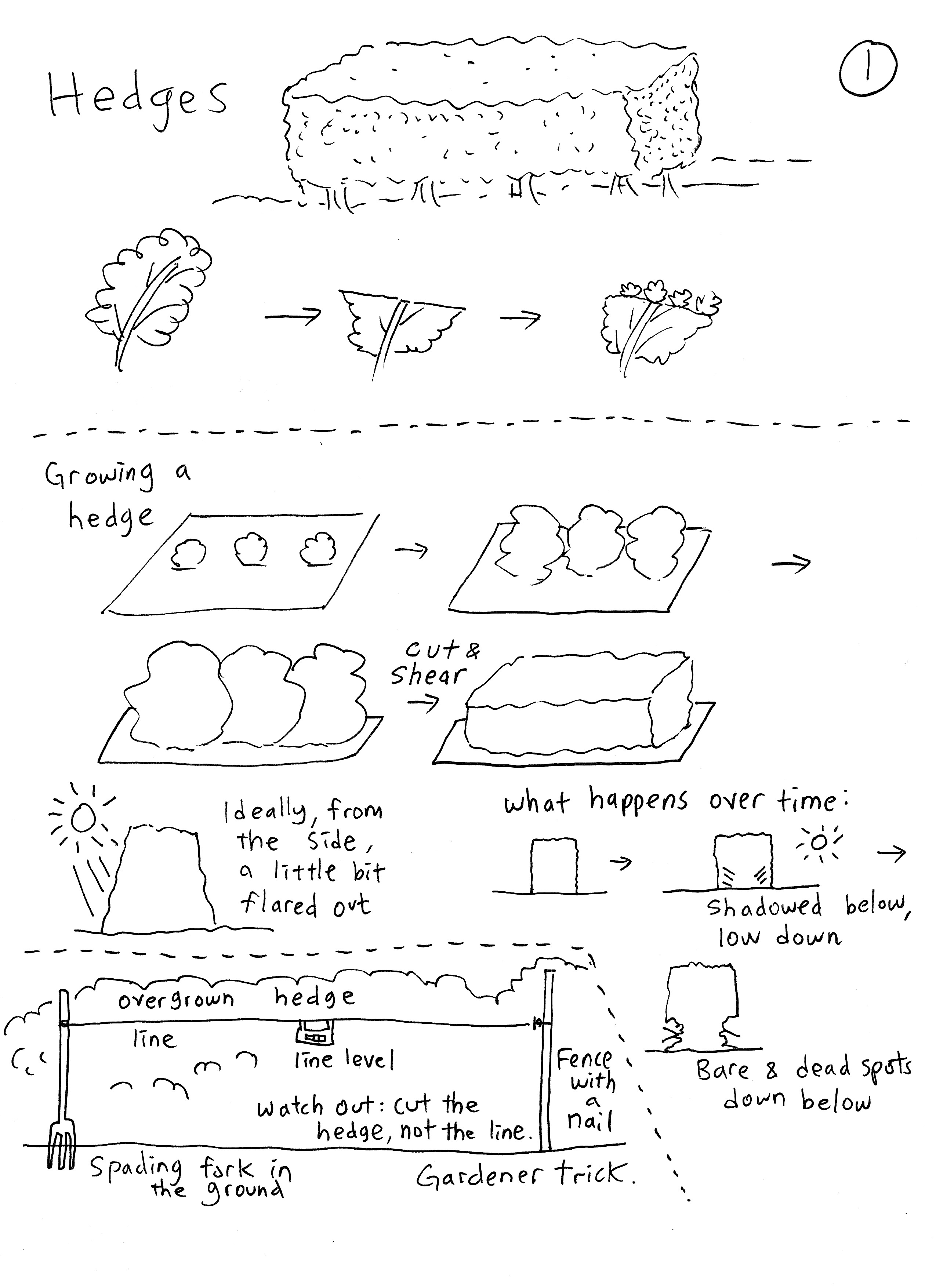
(1) Hedging and topiary
This the neat geometric look
rectangles squares and balls of green

prun1


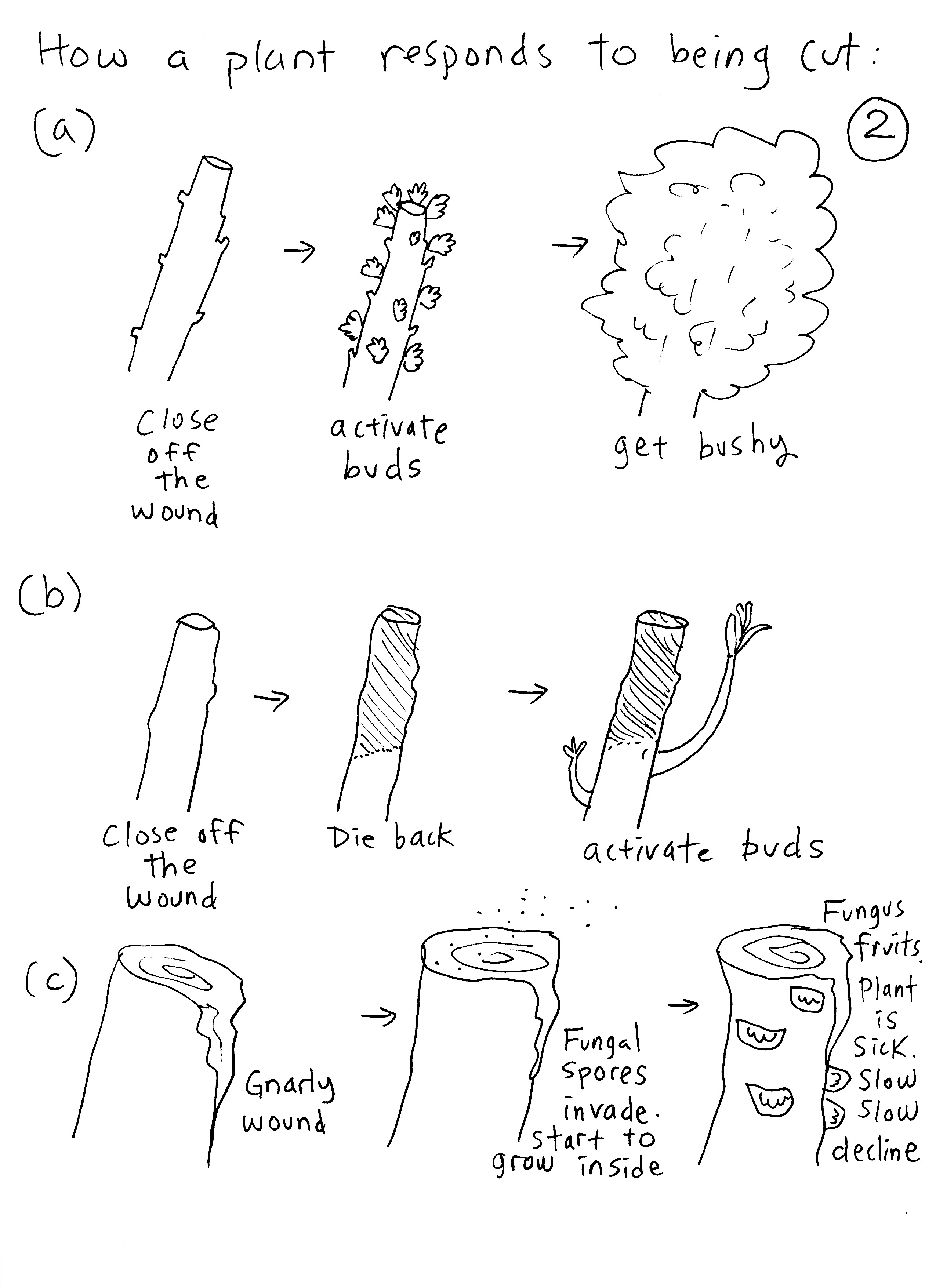
Plants will react differently to being cut

prune2
Common shrub plants we use as hedges around here include: Escallonia rubra, Juniperus communis, Ligustrum species, English and Japanese boxwood Buxus sempervirens and Buxus microphylla, Rhaphiolepis indica.

Some less common shrubby plants we use around here for a line of vegetation that forms a clumpy mass are: Coleonema pulchra, Hebe species, Bouganvillea spectabilis, Camellia japonica, Leptospermum scoparium.

Alternative plants we could use more of around here for hedges include Myrsine africana, Myrtus communis, Myrica californica, Pleioblastus chino ‘Vaginatus variegatus’ (keep this bamboo in bounds with concrete gravel and asphalt, or block it with a body of water) (vaginatus means sheathed and entry by the way. Not sure why the chino is in there).


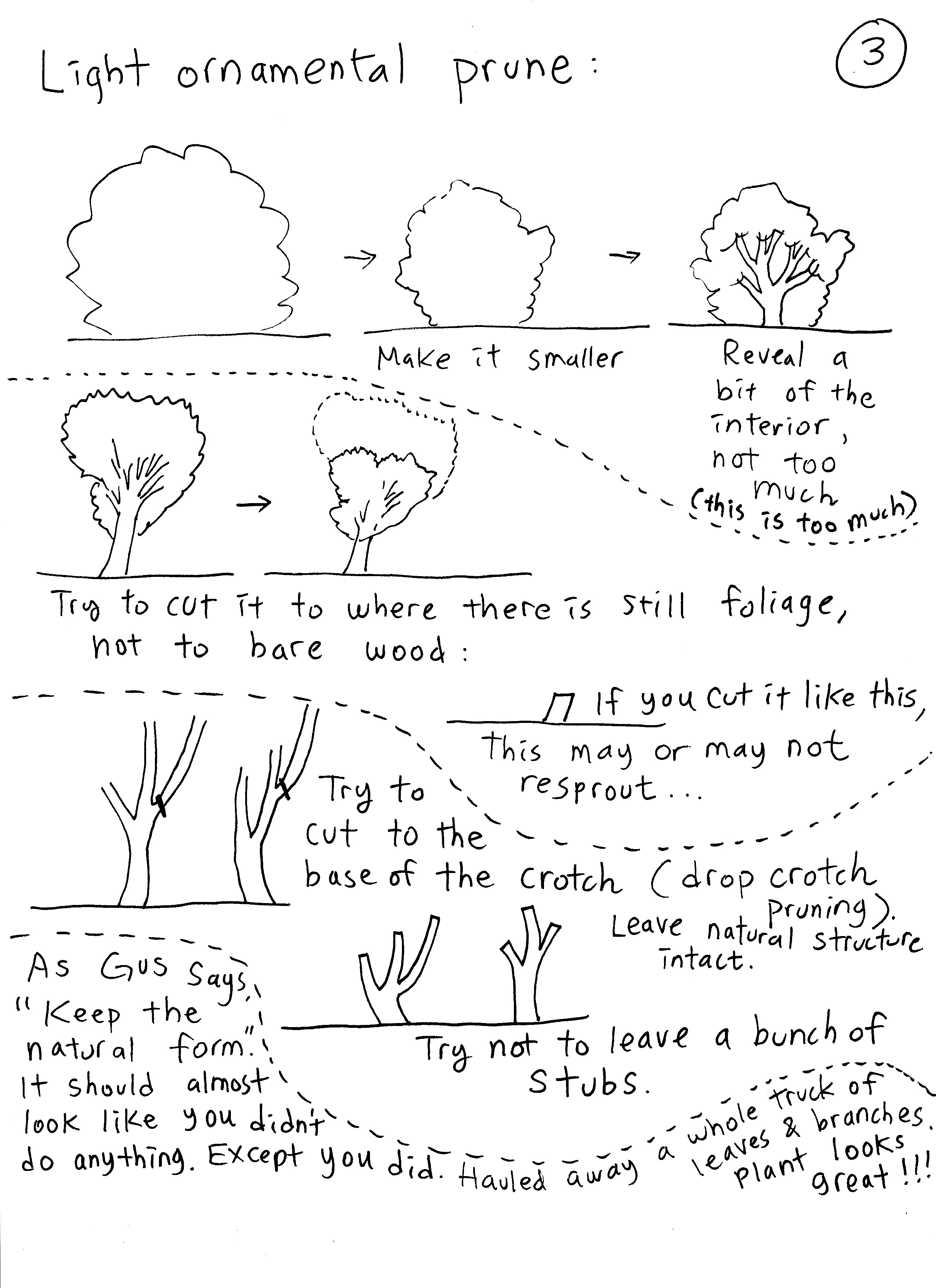
(2) Light ornamental prune:
If the shrub has gotten a little too big
and is starting to block the sidewalk, or overtake its plant neighbors
then you ought to take a sharp metal blade to it
just a little bit, keep it in line
imagine that you are an herbivore
a nibbling deer a munching cow an indiscriminate goat
crunching it here and there
nudging it into shape

prun3

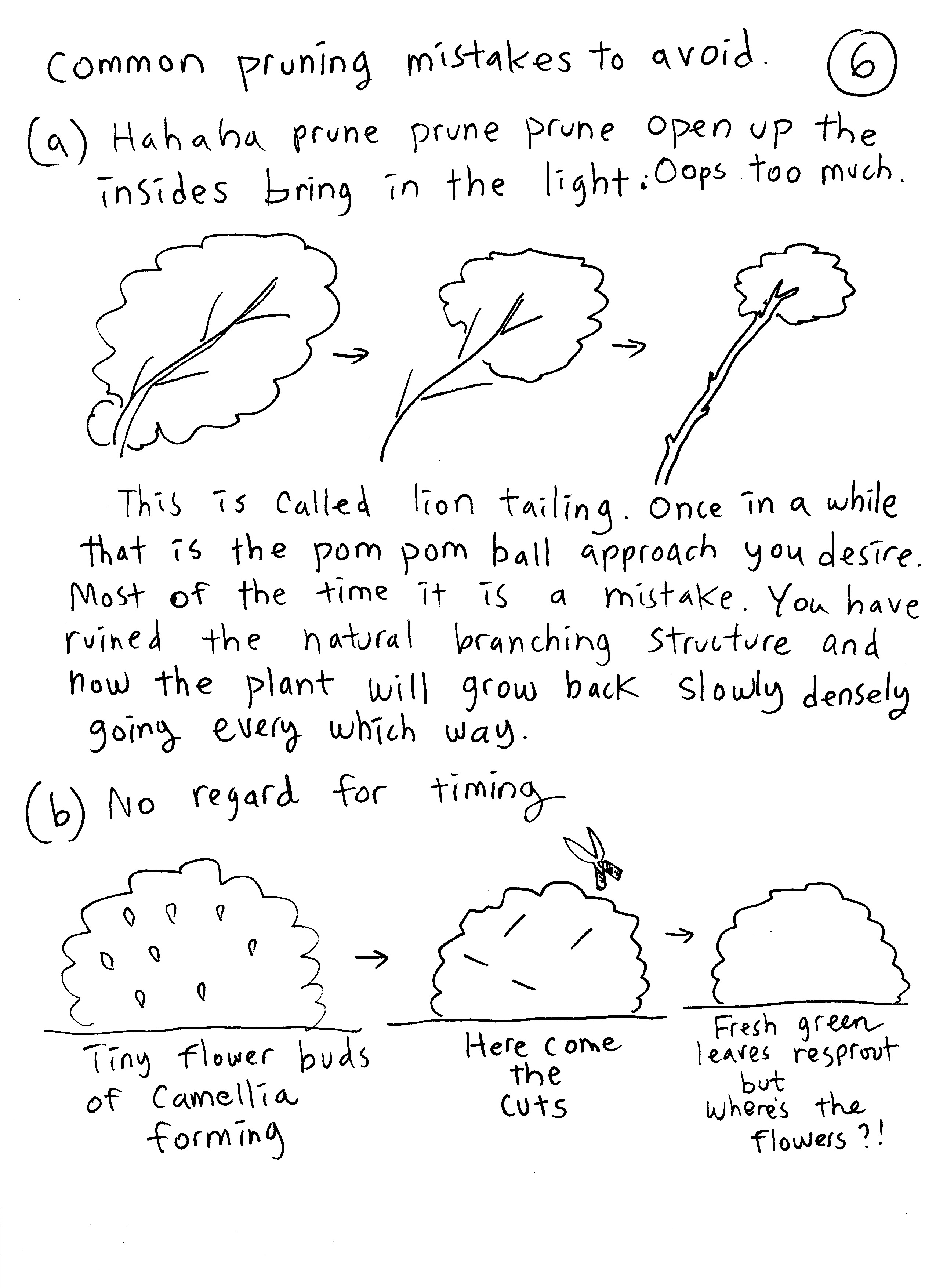
If you cut the shrub when you see the tiny little flower buds forming
you will set it back, and it may not flower for you this year
back in the day working for the parks
there was long rows of Trachelospermum jasminoides star jasmine in granite container beds
okay Trachelospermum is not really a squat woody shrub, more of a viney leggy bundle of curls
anyways
the architect said “I want it to be one foot tall, one foot wide, hedged every three weeks, it must not overstep its boundary”
I said, “You will be pruning away the best part of this plant, which is the tiny fragrant white pin wheel flowers. People will fall in love and remember this plaza because of this smell. They will forever correlate shopping with heavenly scents. Would you consider letting it billow over the edge a bit? Its not healthy to be constantly pruning a plant. Plus this plant is going to be dripping that white apocynaceous poisonous sap when cut.”
architect, “No. Green. Orderly. Straight edges neat and crisp. That is what I see for this garden.”
Me – “Okay” (thinking, guess you are not a gardener or flower lover)

prun4

If you cut the shrub when it is dormant
it may not do anything for a while, even if there is abundant moisture and water
it will wait for when it is warm, wait for when there is more light – to grow again
if you cut out the interior of the shrub to show off its branching pattern and ‘form’
it will likely want to fill up those spaces again, when it can
because all that is lost real estate, real estate that could be producing energy and food
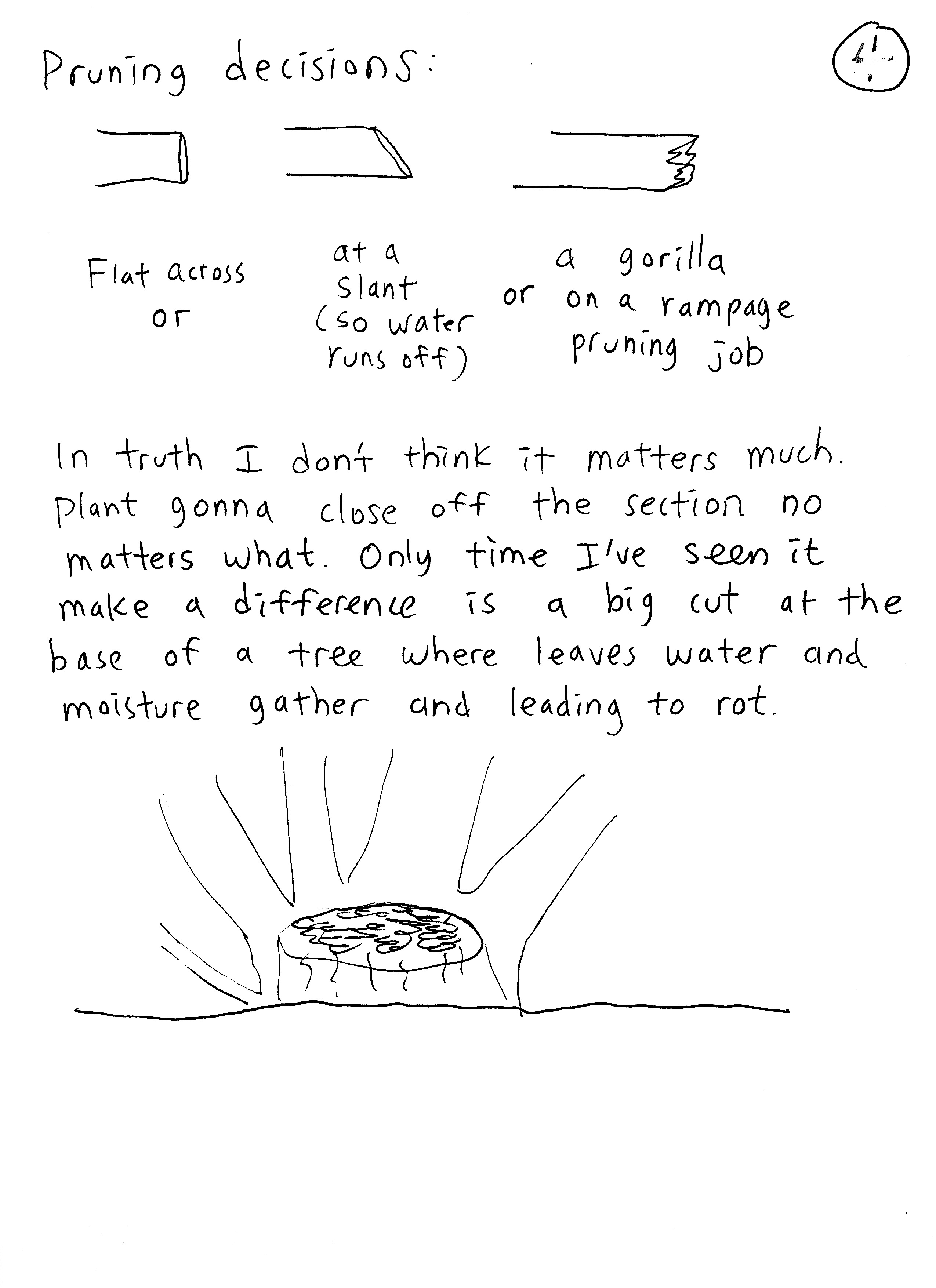
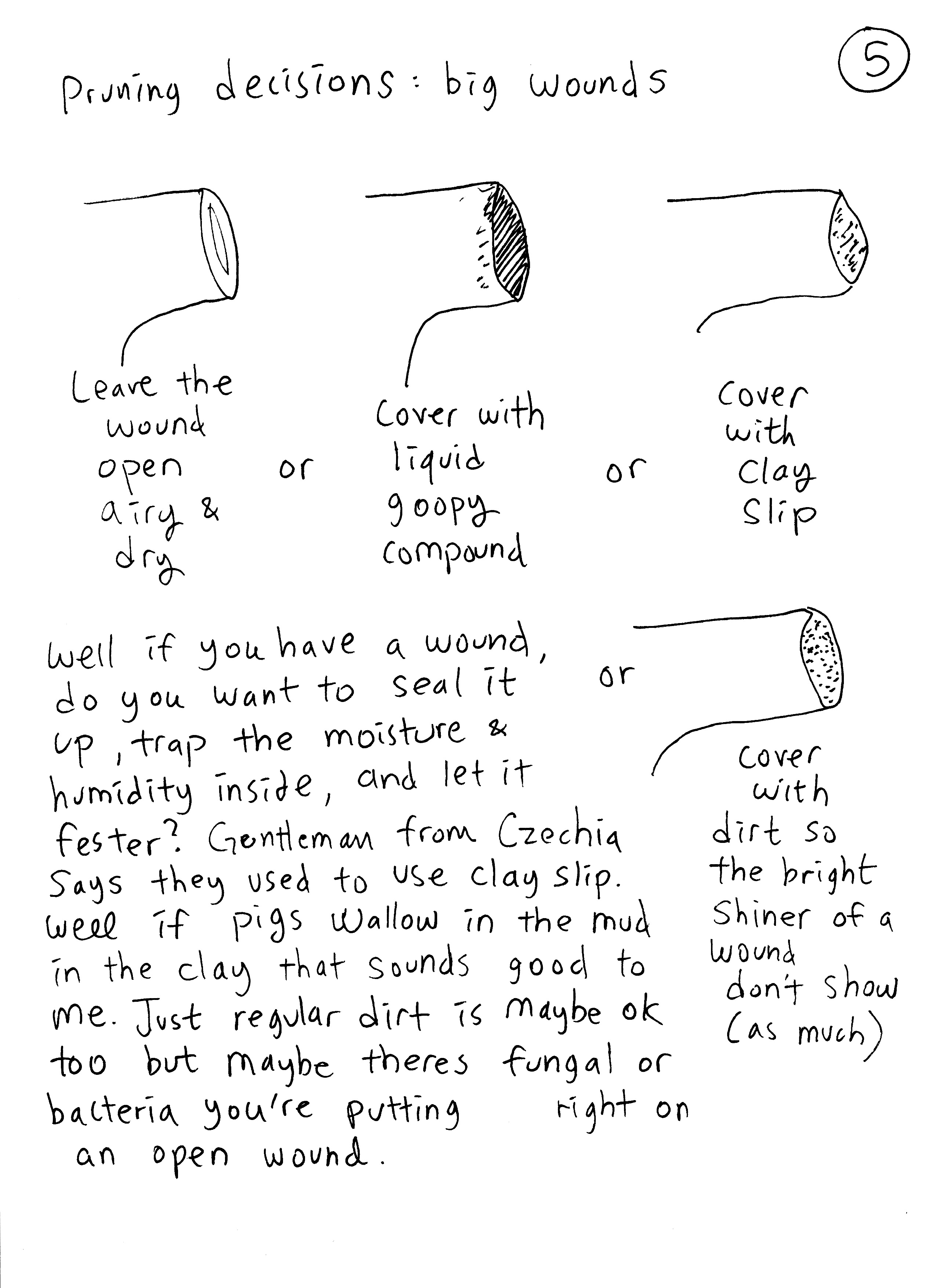
if you accidentally make a huge cut on the shrub, and split open its innards up to disease and pests
it might die on you
or it could heal up easy, and keep going like nothing happened at all
depends on the plant and where it is planted

purn5

prun6
(3) Heavy ornamental prune
Some plants get really really huge
relatively quickly
could have been your fault for thinking oh its so small and so cute, lets put it in the ground
could have been some designer’s fault, for packing it in super tight
cause they wanted it to look good ‘right away’
could be the gardener’s fault, for being absent in their duties, yup probably the gardener’s fault
oh well, you are going to take care of it
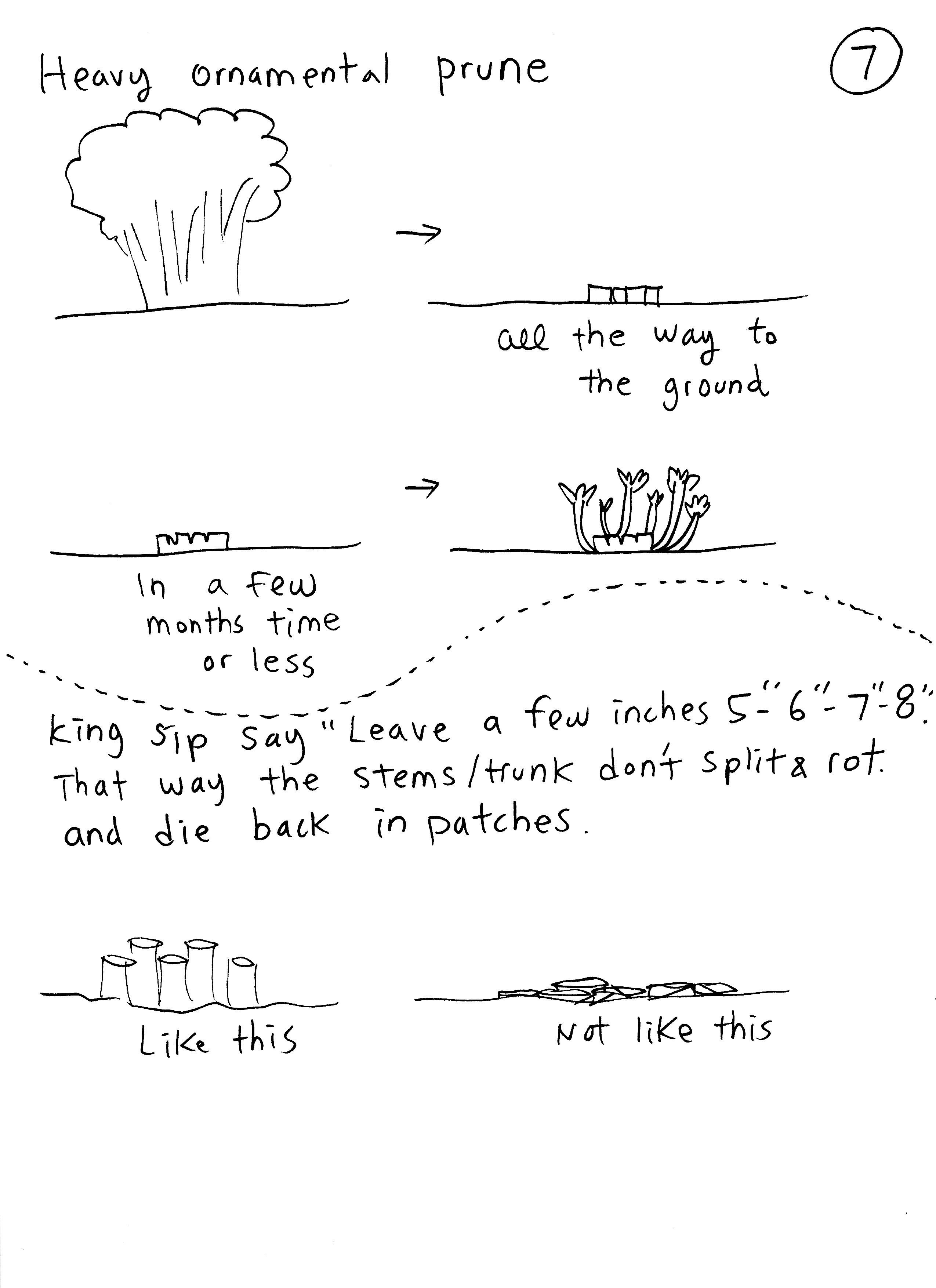
you are going to cut it all down, all the leaves, all the stems and trunks
till its just a bare thing on the ground

Imagine that
you are the fire that burns through the outback
you are the fire that scorches the chaparral
you are the fire that cuts everything down to the ground
this way, the plant is actually renewed
its used to this treatment, it has evolved with this cycle, it is adapted
it has dormant buds on its trunk and stems
it has thousands of seeds in the ground waiting
waiting for just such an event
when a shady, dark overgrown world
becomes open and full of light,
with the ground full of nutrient rich fertilizer
so a heavy ornamental prune is okay for some plants

prun7

Check out this Salvia.  Sometimes you can see where it has died back itself then resprouted already.  This is nature in action!  So get out your pruners and just prune last year’s growth down.  Open it up.  Take away the dead stuff.  Then the plant looks fresh and rejuvenated and you do too.

IMG_4174
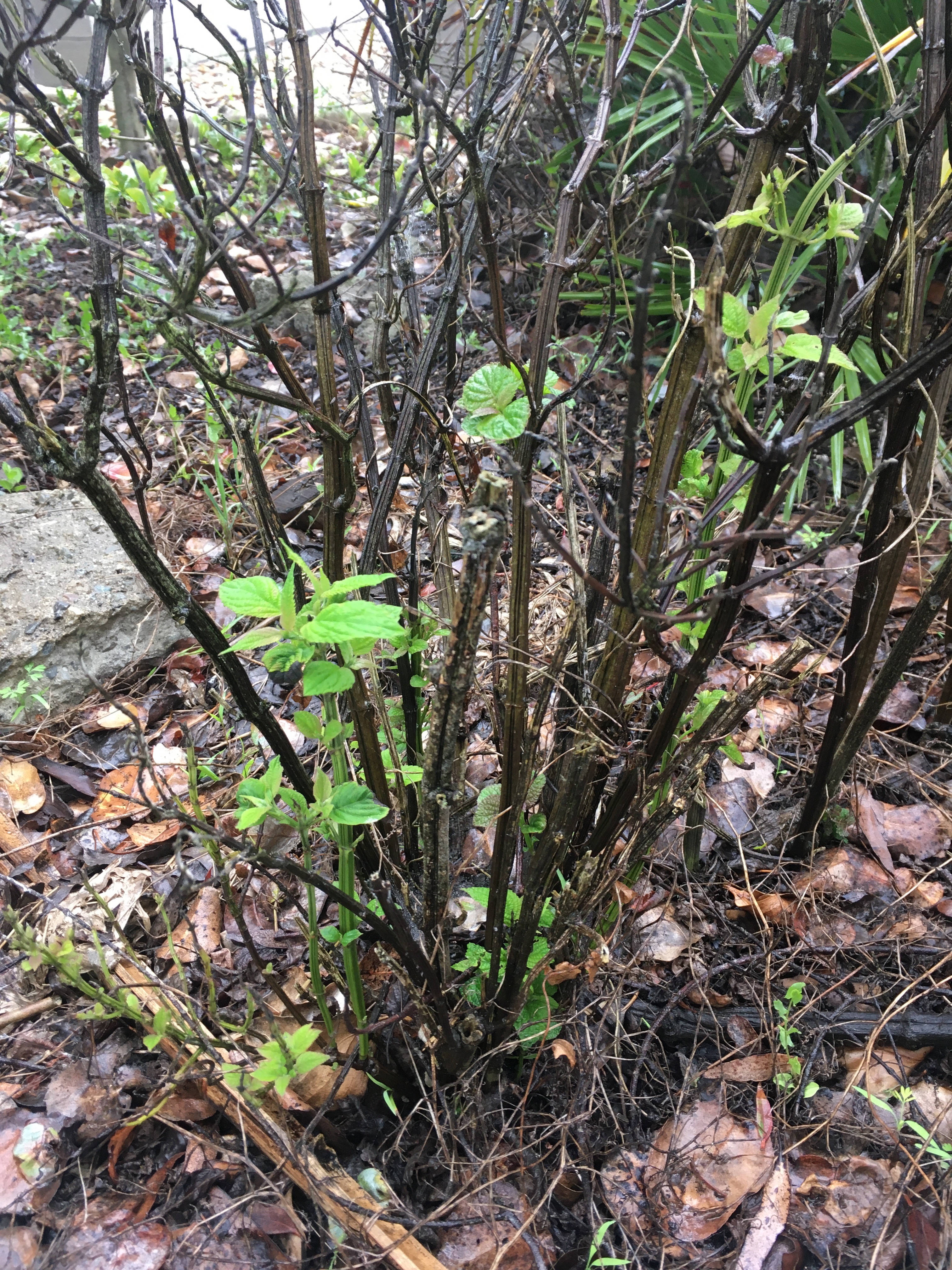
In some cases, the plant does not come back and resprout
sometimes it is the timing, sometimes it is the location
say you are already stressed out
water stressed cause its been dry
or sun stressed because you got planted in the shade and not in the sun like you like
soil stressed cause whoever planted you didn’t break up that puffy airy peaty potting soil and just threw you in the ground with girdling going-in-circle roots
stressed out living

then a person comes along and cuts you down, hard
the person is like haha I know you, you can take it
you are one of those fire adapted mediterranean climate plants my instructor said its okay to cut all the way down really really hard
then you, the plant, just says bye bye thats it
but if the plant is healthy and not stressed
it will come right back, sometimes within a month or two
because it has reserves in its roots, is super vigorous, and loves to live

prun8

Common plants that we prune heavily on a yearly or two times a year or once every two year basis include various species of Salvia: Salvia leucantha, S. karwinskii, S. iodantha, S. corrugata, and so on. All to the ground. Other Salvias you can cut em, and they will resprout. But their growth structure is somewhat wonky and they don’t repeat the dense mass. Instead they are arching over here, arching over there, sprouting here but not there. Salvia mellifera, S. apiana, S. spathacea are in this group.

Buddlejas can take a heavy hit as well. Most common around here are Buddleja davidii, but we have also planted B. salviifolia and B. forrestii.  Usually we don’t take em all the way to the ground, just leave them at about four five feet tall of bare wood. Kinda of a ‘standard’ looking shape. If you do not hack em hard it can get big. Old reference books used to say it stops at 15’ or 20’. But there was one tree in the park nursery that grew to like four stories tall like 60 feet tall. It was at a low spot in the nursery, growing in sand with easy unimpeded root growth. It was drinking the irrigation that ran off the potted plants with a teeny bit of that fertilizer in it. So just grow and grow – its woody trunk was a good 2-3 feet in diameter.

Another plant tolerant of being chopped to bare wood is Euryops pectinatus, the yellow daisy bush flower from South Africa. Once in a while in a shadier spot I cut it down. It takes a little while longer than in a sunny spot. It waits for an extra month or two. I almost start to get worried like ‘are you gonna come back? are you okay?’. But then sure enough, here come the young green leaves bursting out of its skins.


Okay thats all.  If you choose to undertake this lab, work safely and at a good pace.  Stand back time to time to take a look.  Then stay focussed on your work.  Take it easy,  it is ‘together time’ with a plant.

SITE SURVEY NOTES:

What you are looking for, at the survey site, are the following:

Climate and exposure

Site drainage, water flow, ground water

Soils and slope

Windbreaks and wind tunnels

Existing plants and weeds as indicators

Utility lines


With this information, you can then design the garden with consideration for:

Access and flow, paths and walkways

Borders, walls & fences, edging, delineation of spaces

Furnishings and lighting

Usable space, patios and decks

Fire and cooking spaces

Recreation, kids and pets

Relationship to surrounding architecture, neighborhood,  wild lands

Safety, views, and privacy


In this site survey exercise, you are going to pick out an area and examine it closely.  Usually, in class, we walk around the campus and pick out three gardens.  We work on it together, then work up to doing it all by yourself.  Now, it’s all up to you from the get go.  Straight to the deep end of the pool.  Let’s try it!

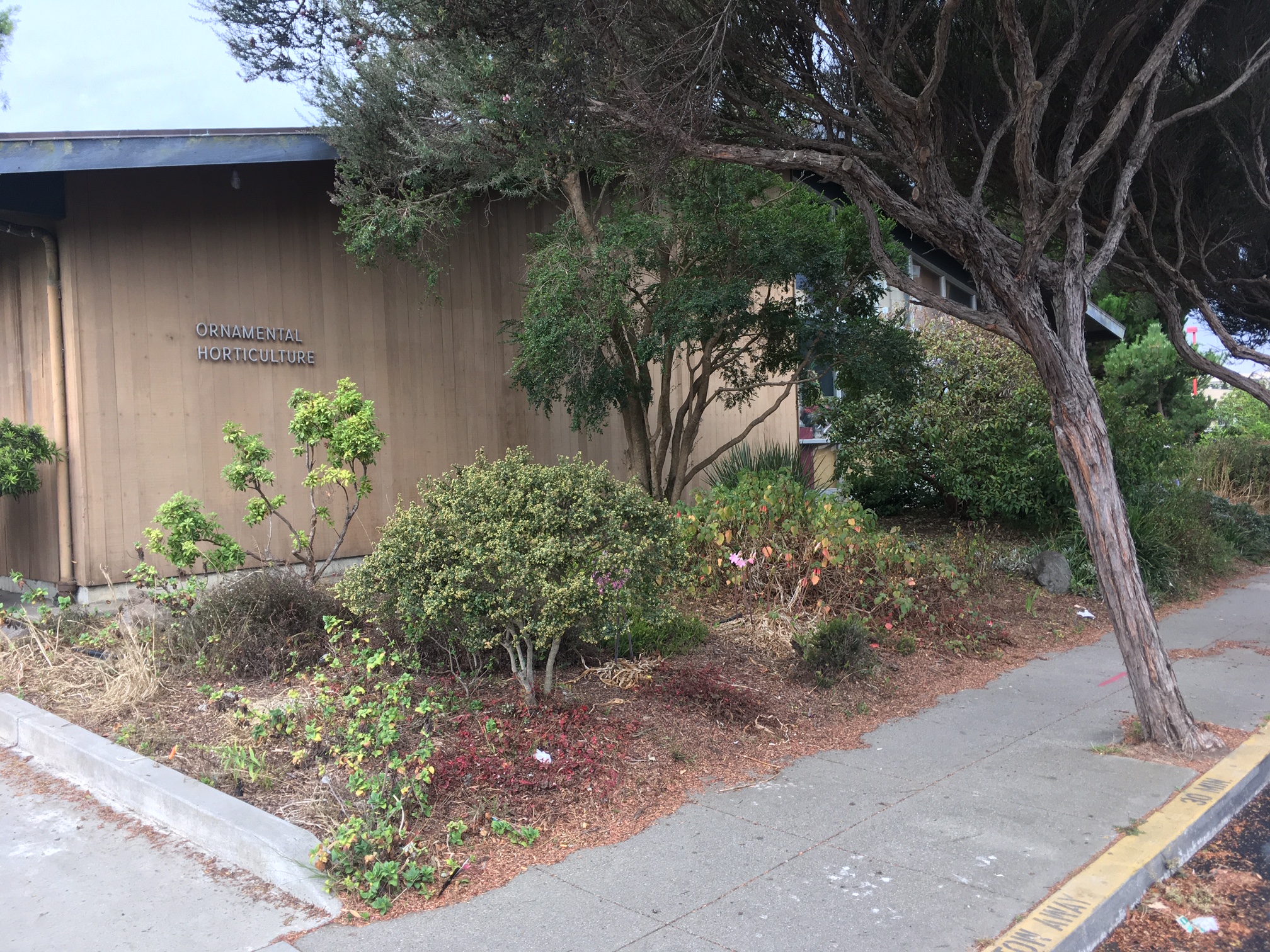
So do a walkabout and find your spot.  It can be your yard, a neighbor’s front yard garden (ask permission), a small mini park.  Make sure that it is not too big.  Not too small.  A rectangular garden or lot is helpful because it is easy.  You can find a two acre, full of trees, up and down the mountain slope lot to do later.  In the beginning, keep it simple and manageable – more or less flat, easily delineated shape.  Sometimes we will just do this little rectangle of a north facing bed in front of our department:

IMG_3992

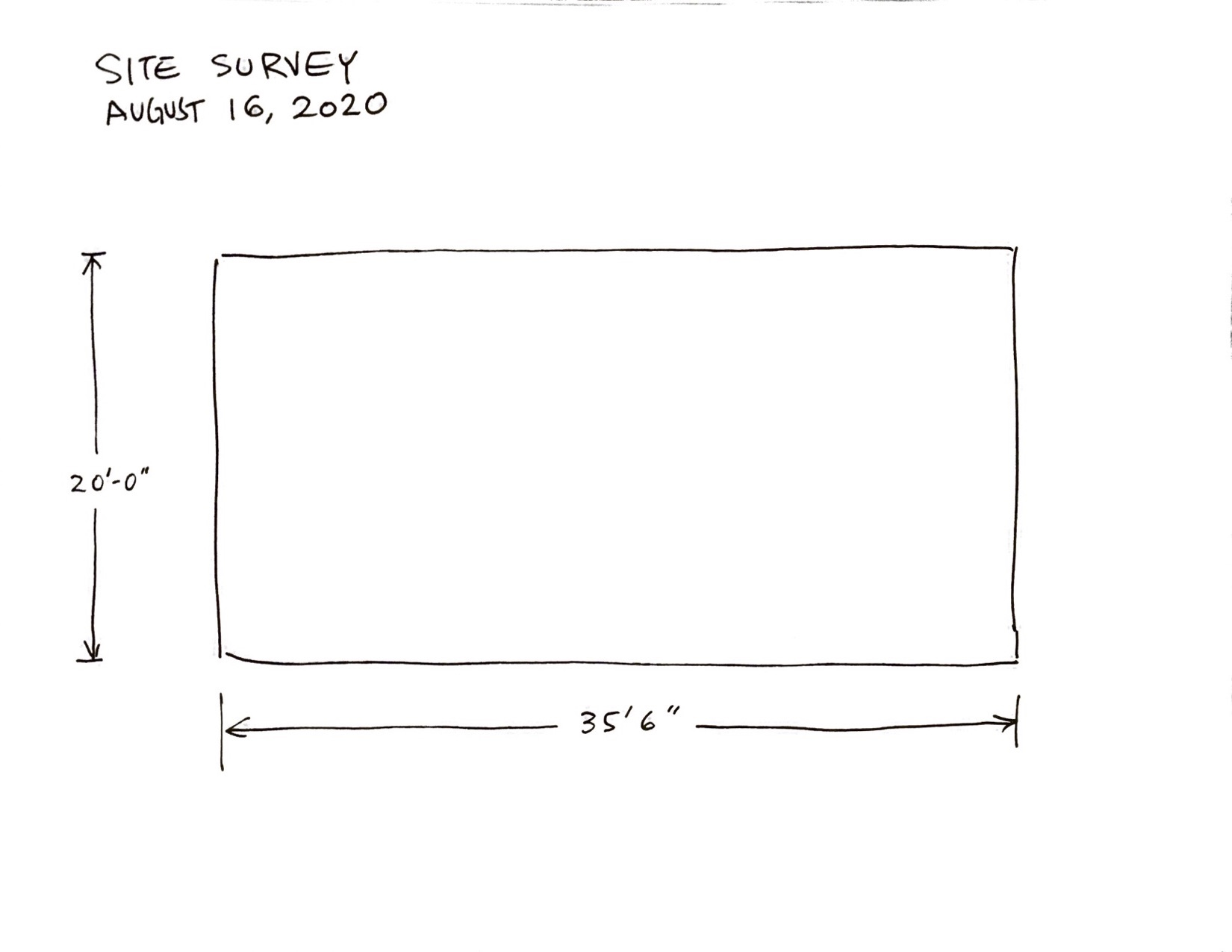
Now take out your tape measure and get the length and the width.  Write that down like so:

a2

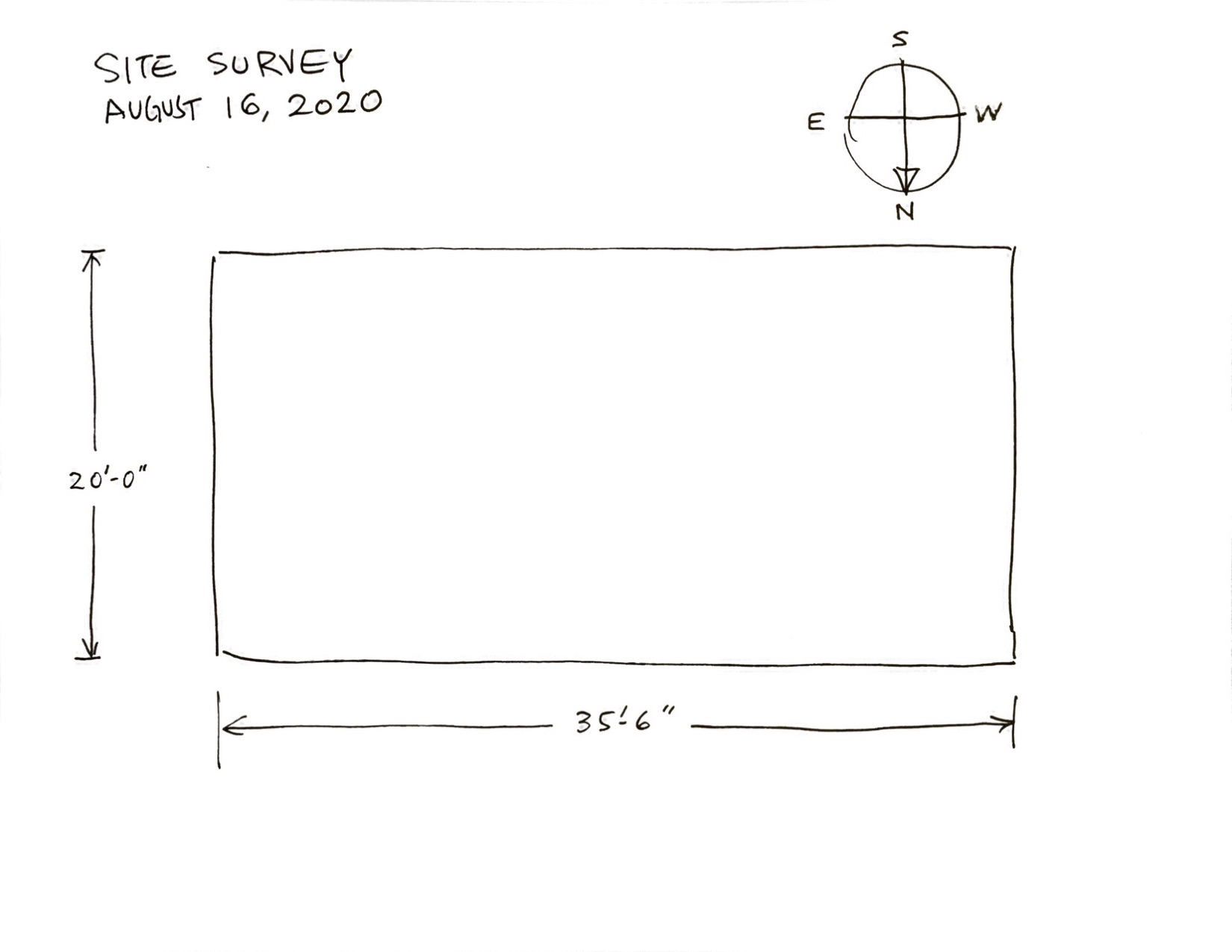
Now take a compass reading.  You may be an old timer that still carries a compass or you can use the one on a smartphone.  A paper map might work too.  Draw a compass rose next to your site indicating the directions.  This is really important for the plants!

A3

Now for the tricky part.  What is the exposure?  Which way does the land or the plants face?  Okay back up.  If you are out in an open field, with nothing but the sun traveling overhead, you have 360 degree exposure, correct?  Well sort of.  In the middle of summer the sun’s path is directly overhead and it ‘ll burn ya pretty good.  But as the season goes towards fall and winter, the sun’s path falls lower and lower in the sky in relation to you, in the open field.  The sun will be shining at you from the south, casting a long shadow.  This is cause of the tilt and wobble of the earth and us being here north of the equator.  The days become shorter, sun sets at 5:30 pm instead of 9 pm.  Stuff doesn’t dry out as much, and so on. 

So on the worksheet for Exposure, turn yourself into a tree rooted in one place, in the plot your are surveying.  Which way are you exposed?  Put your back towards where it is protected (shaded by a fence, a building, etc) and face out.  Now figure out your north south east west, and use your arms and hands to make the arc in the sky for the path of the sun.  Its summer, straight overhead.  Now make that arc go lower and lower.  See how that house over there starts to block your winter sun, see how the sun might come right through the canopy of that deciduous Magnolia cause by then its leaves will have all dropped.  Something like this.  Get into this habit.  Say you are out on a date walking around town.  Just see a spot.  Stop, turn into a tree, and visualize what kind of exposure it gets over the course of a year.  Just like that.

Longitude and latitude is also helpful when deciding plant choices.  Plants from similar latitudes often have similar light requirements.  You can find these coordinates on the maps feature of smartphones.  Imagine the whole globe planet as a grid, that is the longitude and latitude.  

longlat jpg

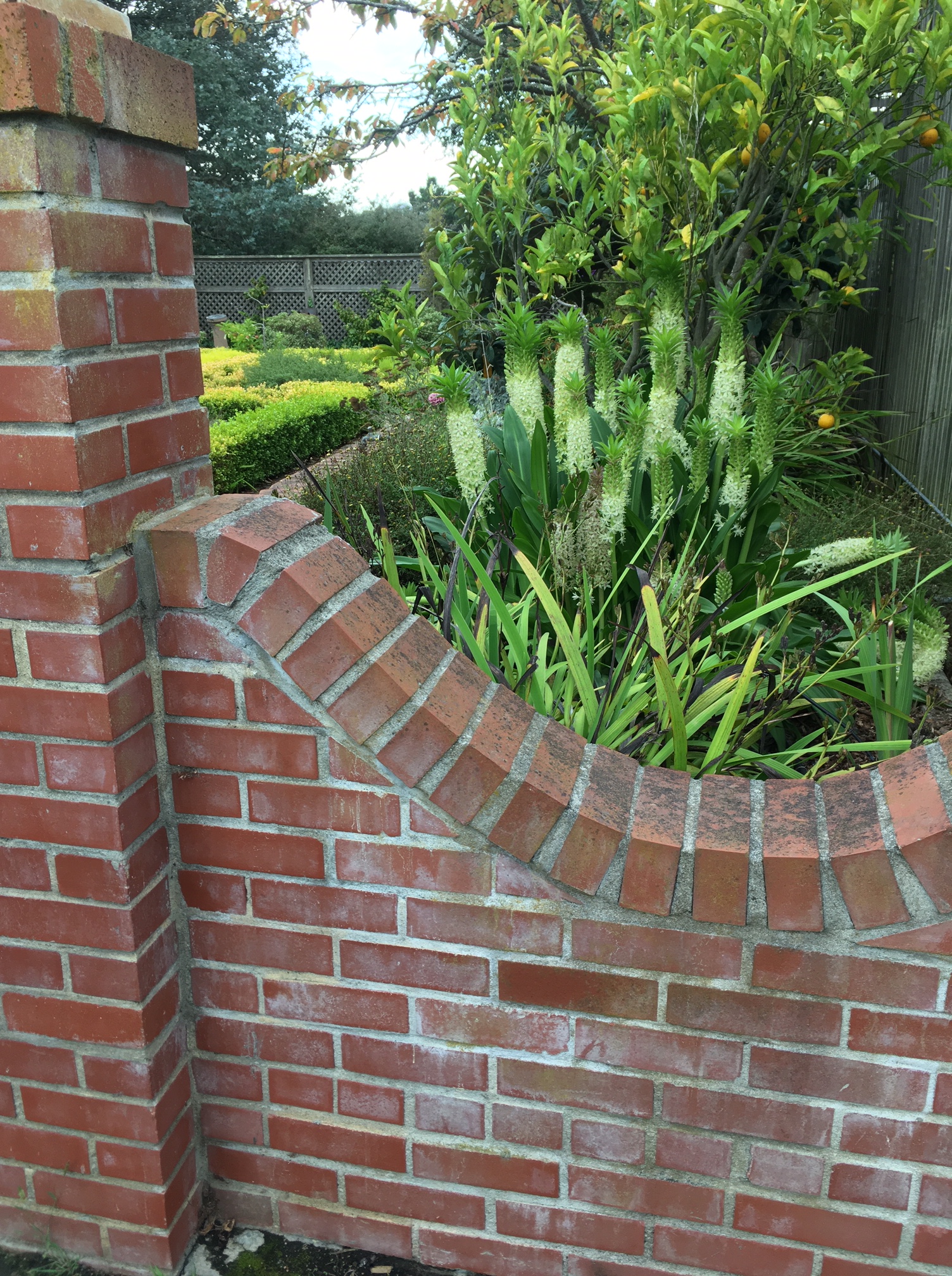
Thermal mass is the ability of a material to absorb and store the heat energy.  We are usually talking about building materials.  A dense material like concrete or earthen walls can take in a lot of sun heat energy during the day, then slowly radiate it out as night falls and temperatures drop.  These materials have high thermal mass.  Wood does not have high thermal mass and so log cabins can get cold really quick, especially if the chinking is loose and the wood stove is not very efficient.  Imagine you lived in a metal house that heated up quick and got cold just as quickly.  Not good. Thermal mass is a very important consideration for plants because that thick brick wall in the garden can create a little microclimate of warmth that is perfect for your lemon tree or tomatoes.  Not only does it serve as a windbreak, it also serves as a nice warm heater.

IMG_3994

When you do the survey of the soil you ought to have a shovel to dig around.  That is how you will know what kind of soils you have – sand or clay, dry or wet, and so on.  When doing these site survey consults, my buddy Gus Broucaret brings a soil probe which is a long tube with a T handle that sucks out a core sample of soil.  He also says to wear glasses and put some chalk in your hair to look distinguished and smart, but I am not sure about that.  But watch where you dig and do not go too deep because you might hit a utility line of some kind (more on that later).  This being Bay Area California, in general, this is the driest time of the year (August September), hasn’t rained since March or April.  So the soil will reflect that.  Oops there was just a thunderstorm of lightning and thunder that came out of who knows where.  So just remember, you can make all the generalizations and predictions you want, but mother nature does what she wants to do, and you don’t know until you get your hands dirty what is really up. 

If you can, do the soil feel texture test, do the soil drainage test, send some soil away to a lab for analysis.  Do you have a layer of clay hardpan at 14” below?  Is there a bunch of plywood and rubble and plastic trash the contractor buried and covered with a thin layer of dirt?  When you put a water hose to the soil does the water just roll off the soil without getting it wet underneath at all (soil is hydrophobic)?  All of these will make a difference in plant selection and placement, in hardscape designs.  But you do not have to learn it all in one sitting, just start to take notice and get your hands in there.

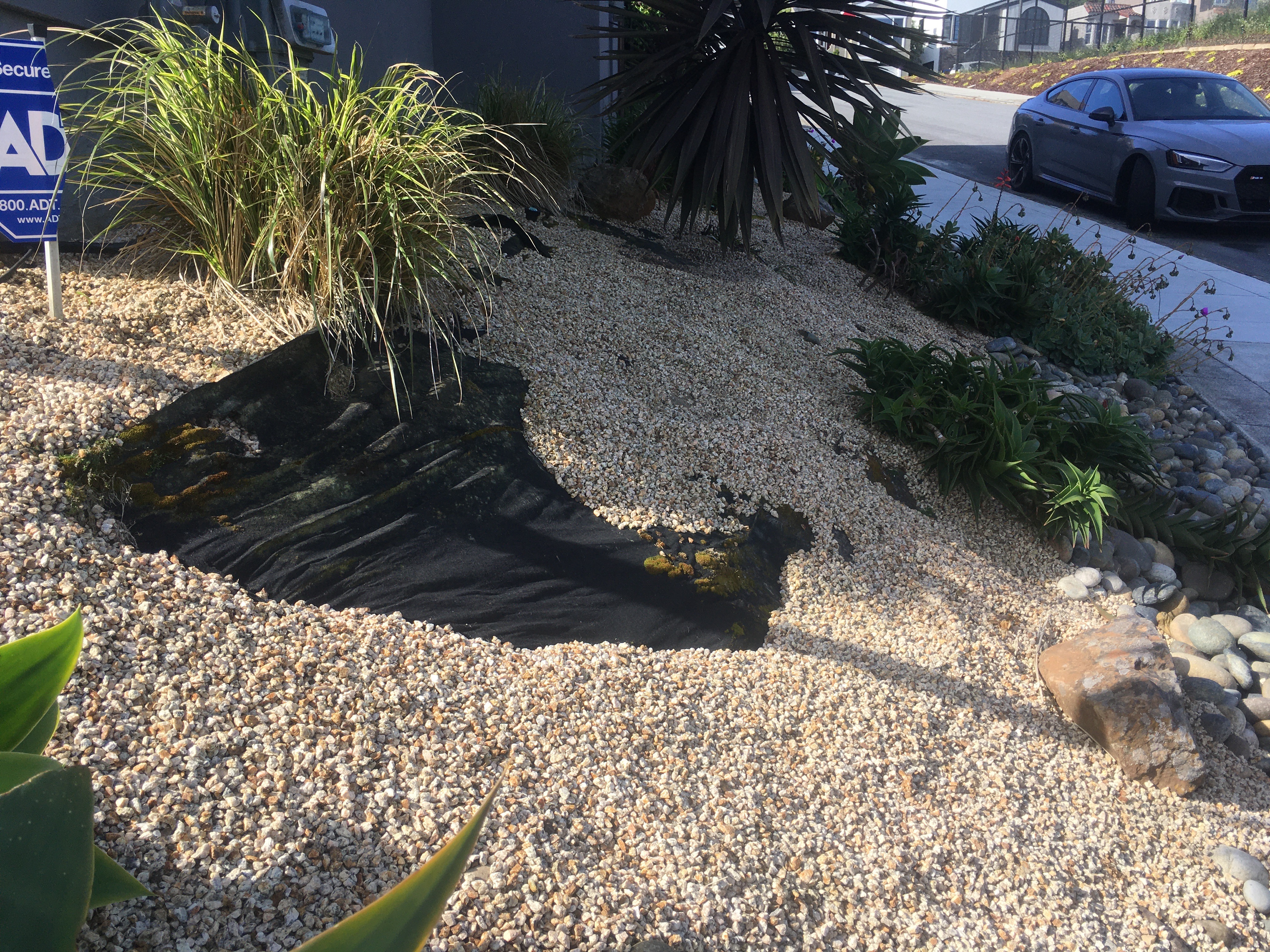
In order to prevent weeds, many places use extensive mulch and install a layer of plastic woven cloth underneath to suppress the weeds (weed cloth).  So if you see wood chips mulch, scrape a little away to see how thick it is, and if the weed cloth is working.  Often, landscapers will put down a one inch or less layer of mulch as a finishing touch to the plantings, then go collect their check.  Then in two or three months, the mulch is blowing away and all you are left with is the black weed cloth emerging in patches.  Or ditto for when mulch is placed on the slippery plastic weed cloth on a slope. It all falls down…  An ideal mulch used to suppress weeds and keep in the soil moisture should be at least 3-4-5 inches deep.

IMG_2596

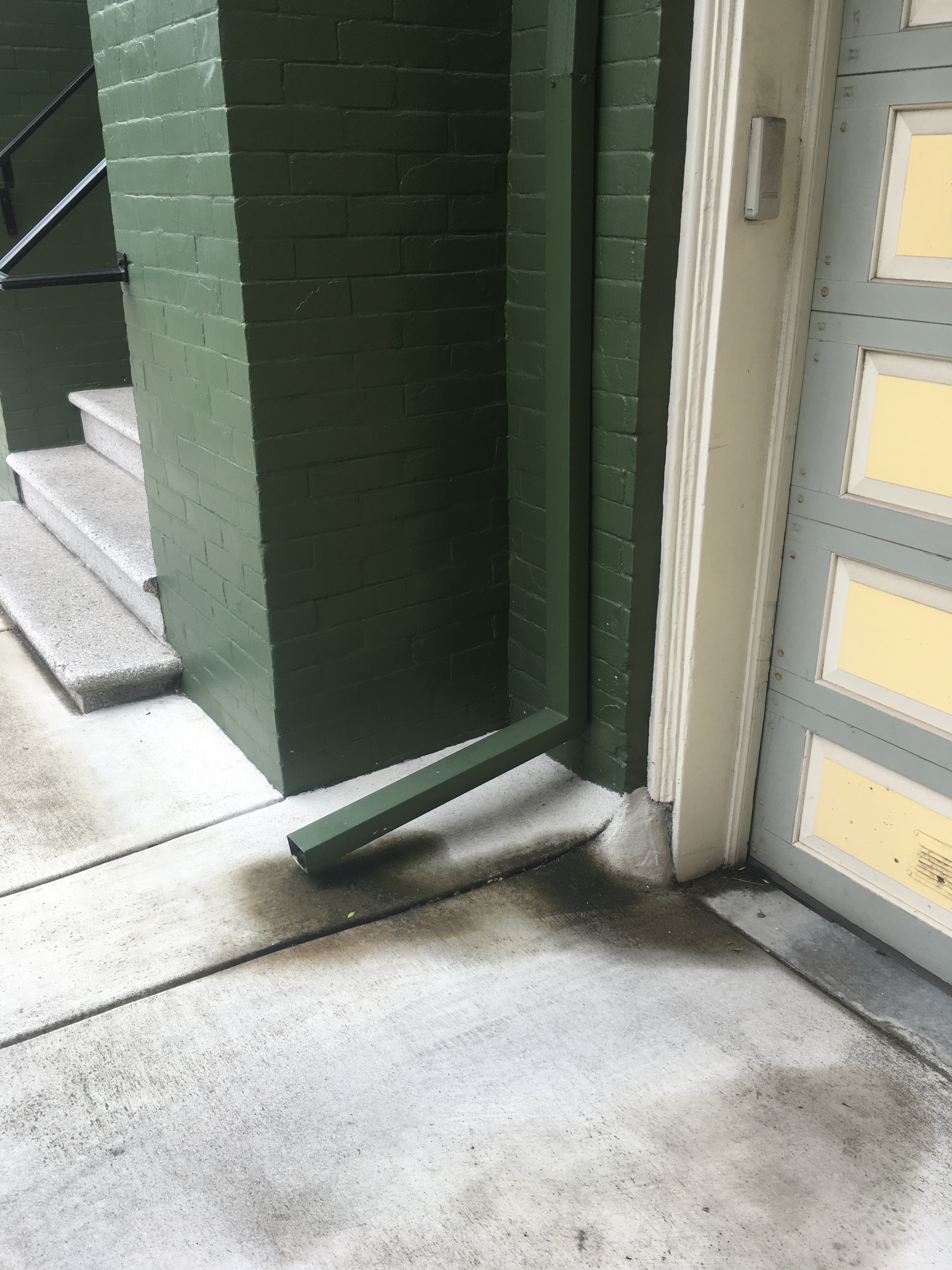
Enough of soil.  Now figure out water and irrigation.  Here in these parts our rains come mostly in the winter months, November December into March April.  That is the time to pay attention to the rainfall.  Best if you can be out in the rain with an umbrella or rain coat when it comes down.  Otherwise, you gotta look for hints and clues and be a detective.  Look for the rain gutters to the house – does the downspout pipe lead to the sewer underground?  Or does it spill out somewhere next to the driveway or the back stoop?  Given the slope and contours of the house and the garden, where does water gather naturally?  Where are the low spots?  Which way is the flow?  You might see stains on the concrete from water sitting, or feel a persistent wetness on one side of the deck.  Is there a grated drain or a culvert that directs the water?  How much of the landscape is permeable?  That is to say, when it rains, is water able to go (infiltrate) into the earth, or does it gather force and volume on a big ol slab of concrete and go somewhere?  Where?!  Where do you think the water goes after it emerges from the downspout here?

IMG_8937

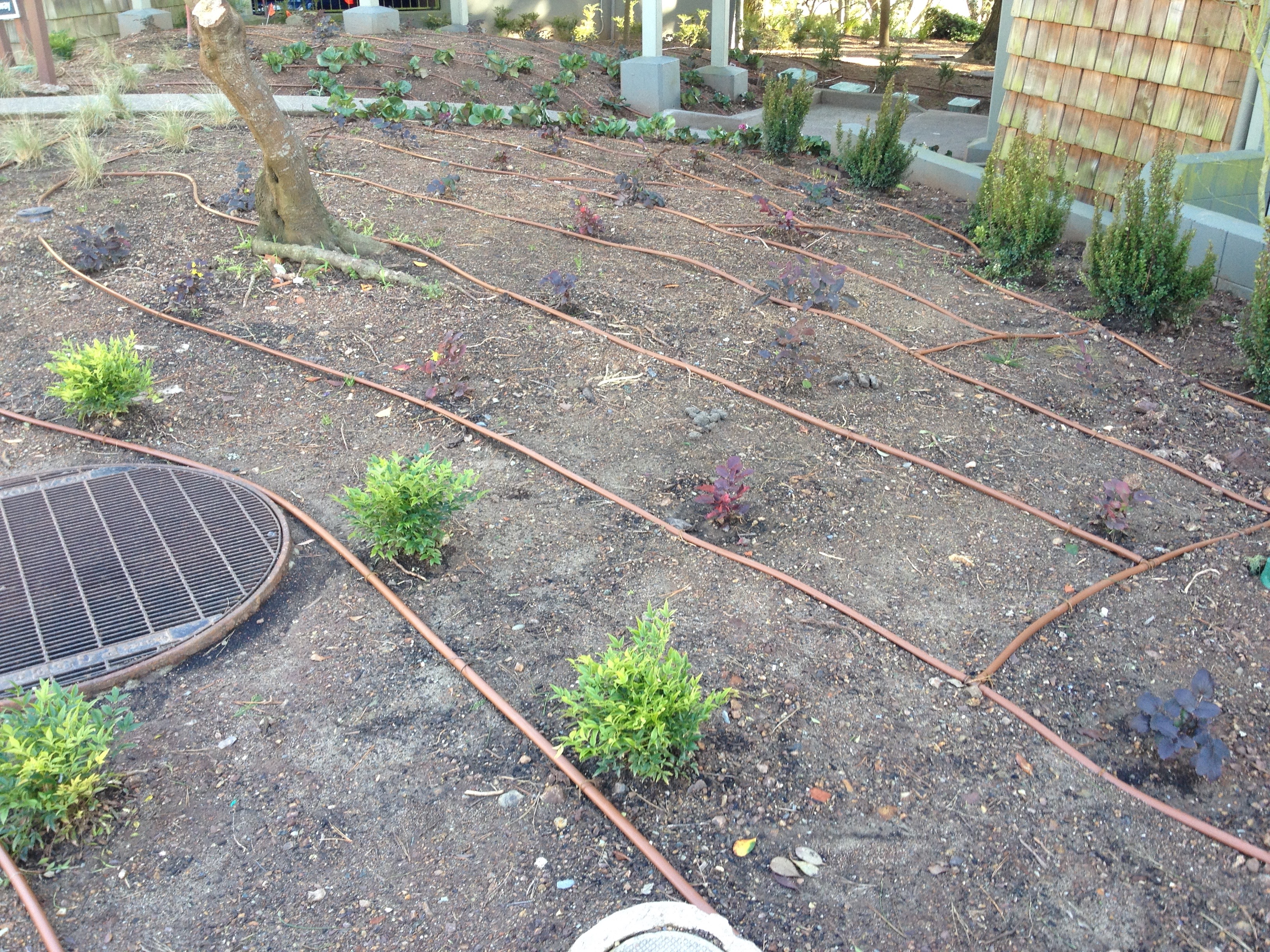
Now go find the hose bib, and any irrigation if present.  That is to say, look for an irrigation clock (maybe indoors inside the garage, under a car port), locate the irrigation valves and or irrigation boxes.  Try to ascertain the path of pipes and hoses that may be underground or slightly buried under mulch or up on top of the soil.  If you know how to work irrigation try the bleeder valve, turn it on at the clock, and so on.  If you do not know irrigation no worries.  Just mark the general location on your survey plan and move on.  Take another class another day.  Heres some irrigation lines before they get all covered with mulch and you can’t see them anymore:

IMG_5388

Lastly talk to the client and neighbors and locals, if they are present and friendly.  They will know if the street was built over an old riverbed full of heavy mud and clay.  They might be able to tell you that there is an underground spring that runs through the middle of the yard at not much more than 2 feet down.  They might also share the detail that two hundred yards of french drains wrap all the way around the foundation but that it is old and water is seeping again into the basement.  So on and so forth.  The plants talk too if you would listen.  There are indicator plants that show where drainages converge and the water table is high.  Any aborigine hunter in Australia knew that that was the key to survival.  Around here when I see the arroyo willow or the red elderberry shrubs, I know that water is not too far below.  Here at the base of this dry hillside is Salix lasiolepis:

IMG_3990

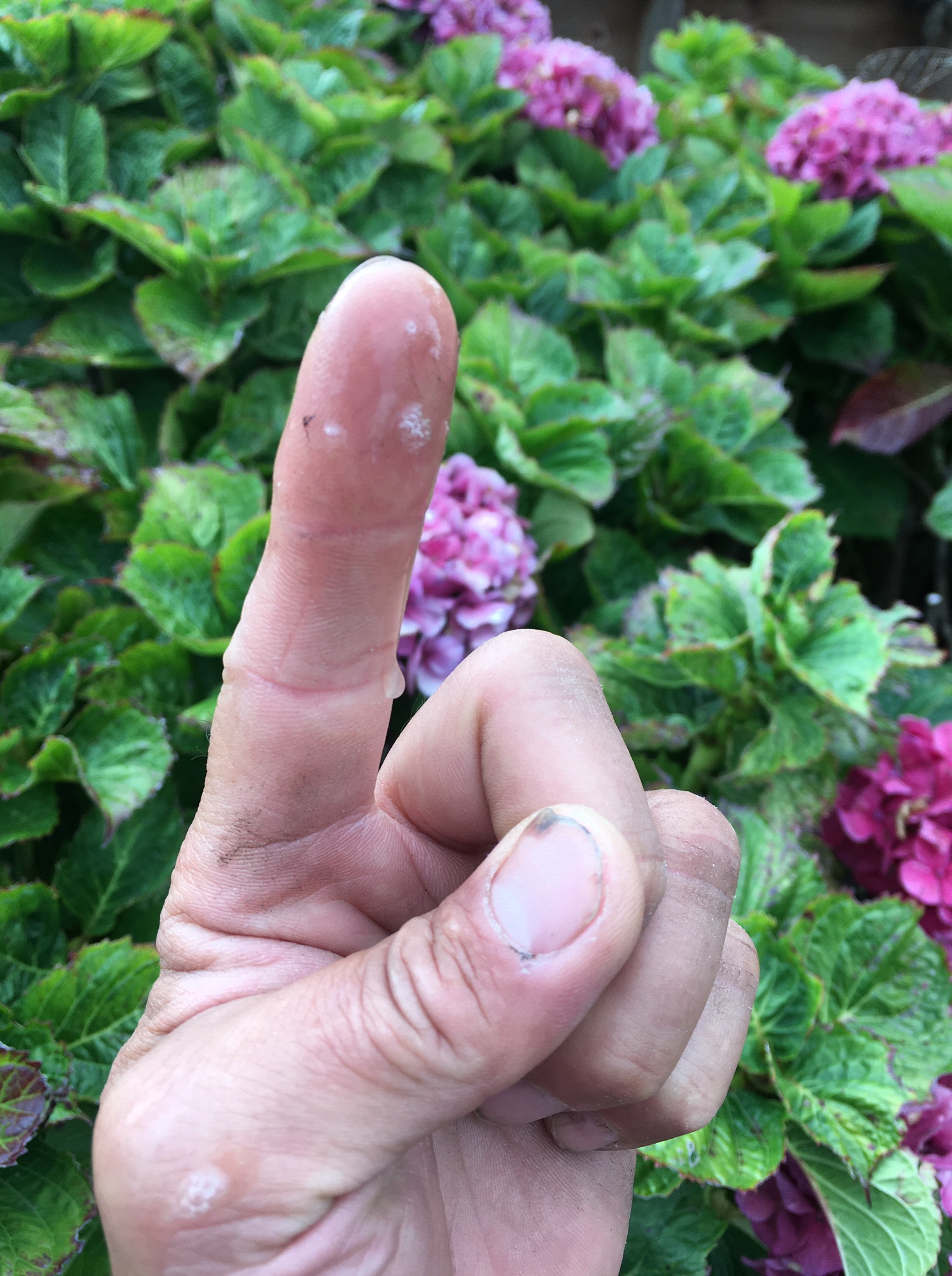
The old time trick was to stick a wet saliva-dipped finger into the air; the finger would cool and dry and you would know what direction the wind was coming from.  This was all important if you were hunting in the field and you did not want an animal to smell your stinky human scent and be off running before you even had a chance at a shot.  This way you could approach from down wind of your quarry, not have your scent blown right to it.  Nowadays they actually sell baby powder in a bottle to puff up in the air and figure out which way the wind is moving. 

IMG_3993

So stay still and document which way the wind is coming from at your survey site.  Again, like the seasons, like the sun, like the time of day, wind is variable.  Likewise, the plants tell the story.  Look for the street tree that has a lean.  The wind will blow the trunk a little sideways.  The canopy and leaves will be predominately on the downwind side.  There may be a little buttress at the base for the tree to anchor and steady itself.  Look for where the fallen leaves gather, that is likely a still spot.  It is one thing to generalize and say okay the wind in San Francisco is onshore and blows west to east, from the ocean inland.  But in any individual yard that direction will vary.  The wind might be traveling through a little windy gap between houses and carve around a corner.  The wind might swirl in circles over a fence through a hedge and putter beside a shed.  Which way do you think the wind is blowing?

IMG_3991

Some plants like a little protection from the wind, some plants don’t mind the wind at all. In places with very still air some plants become susceptible to pests – first the scales and aphids, then the sticky poop and powdery mildew fungus, and of course the ants.  Air flow is an important factor in the design of a garden palette. 

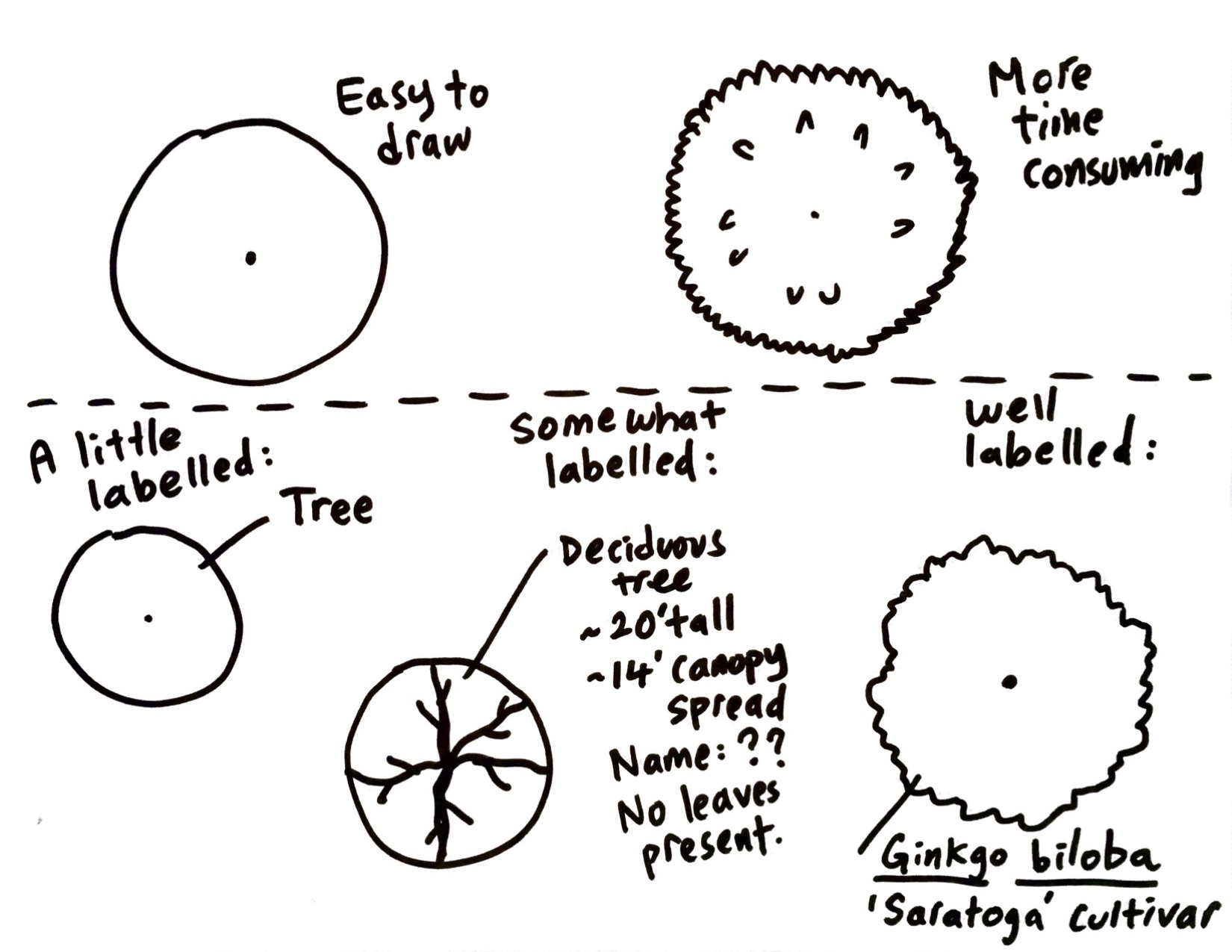
Plants.  Try to identify and mark on your rough little plan the existing plants.  Usually when we are with clients we try to find out which plants they want to keep, and which plants they would like to get rid of.  For this exercise, just mark the main trees or shrubs.  You draw em like this, write down the name if you know it:

plants for site

Do not be concerned at this point if you do not know the names of all the plants.  There is another class for that it is called Plant Identification.  Infinite lifetimes would not be too many lifetimes to try and learn the 300,000 plus plants and how to grow them.   

You can always tell when somebody sprayed the weeds.  Cause one day they are green.  Then they all go yellow and brown.

IMG_4616

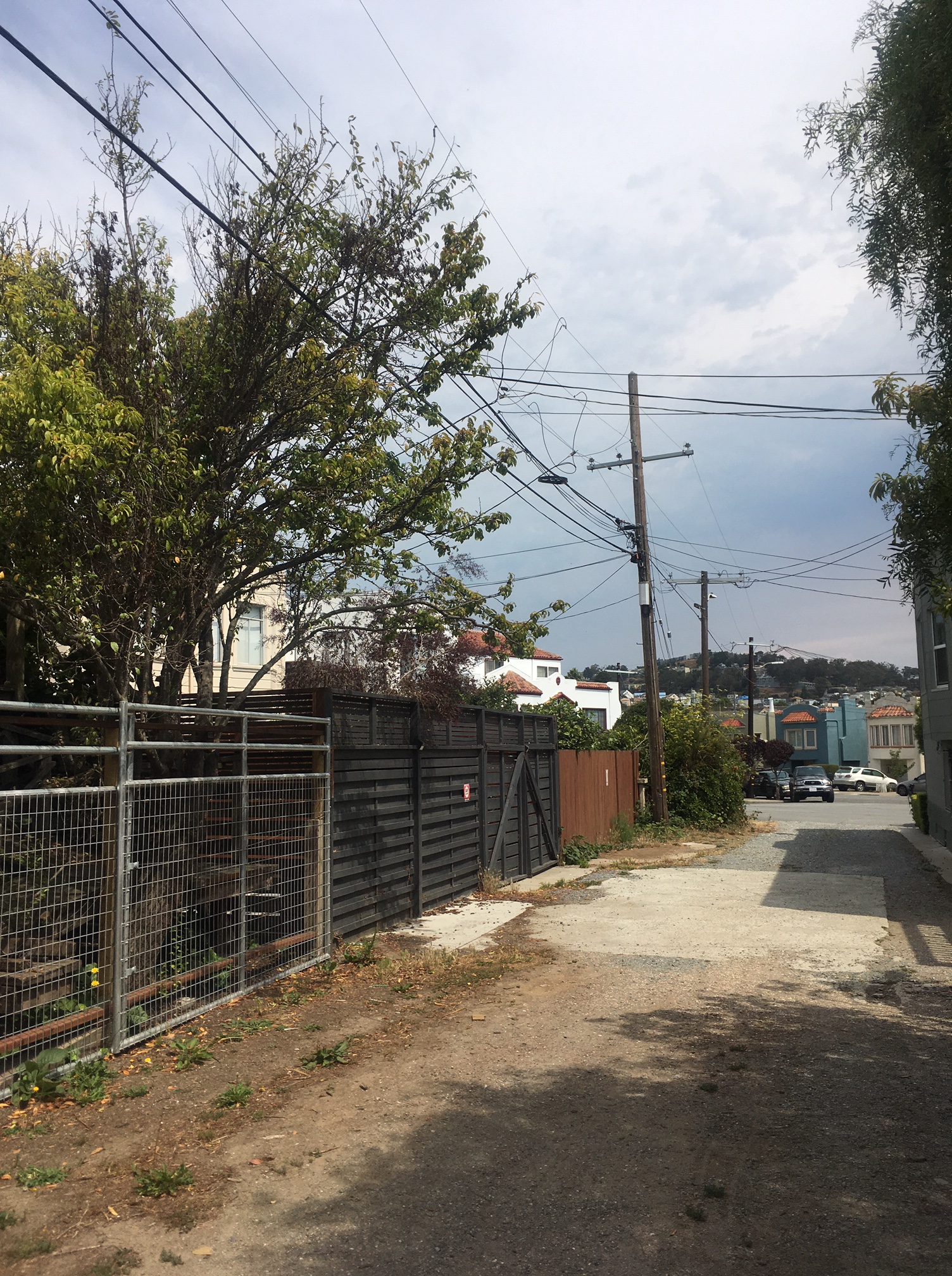
Aside from all this natural phenomenon, the last aspect of the site survey is the presence or absence of human made structures and utilities.  Describe and draw any decks, patios, benches, tables.  Human spaces.  Keep an eye out for electric lines and  right of ways.  In some neighborhoods, the electric power poles are in the backyard along an alleyway, in others the electric cables are underground.  There might be high voltage wires up at the top of a power pole and so no, you do not want to plant a fast growing tree underneath them.  The sewer pipe usually runs to the front of the house by the sidewalk, but because of a slope, or the orientation of the road, it may run through the backyard down the hill.  So no, you do not want to dig there too deep either whether to put in a retaining wall or footings for a gazebo.   Cables passing through the backyards to the house:

IMG_3996

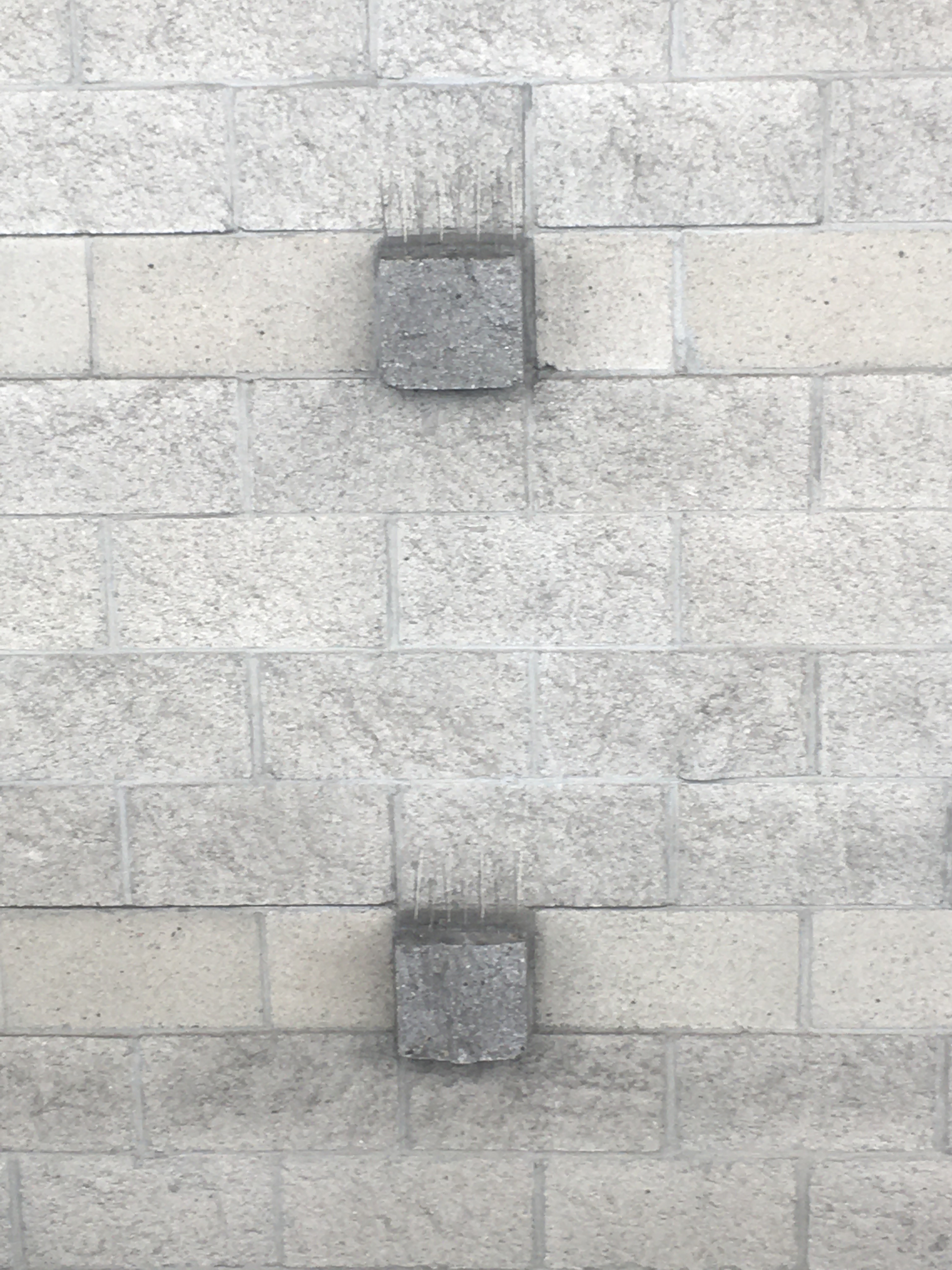
There is a section at the end of your site survey about common landscape pests.  Pigeons, rats, seagulls, raccoons and the like.  They will be interacting with the garden you design.  So best take them into account also.  Notice how this design feature had to have a little followup to keep guano at a minimum:

IMG_1591

Look at the space from all the angles.  As a plant within it.  From the sidewalk as a member of the general public.  From inside the house out the window.  From inside the house on the second floor.  Go low and look up.  Go high and look down.  Gather a myriad of perspectives. 

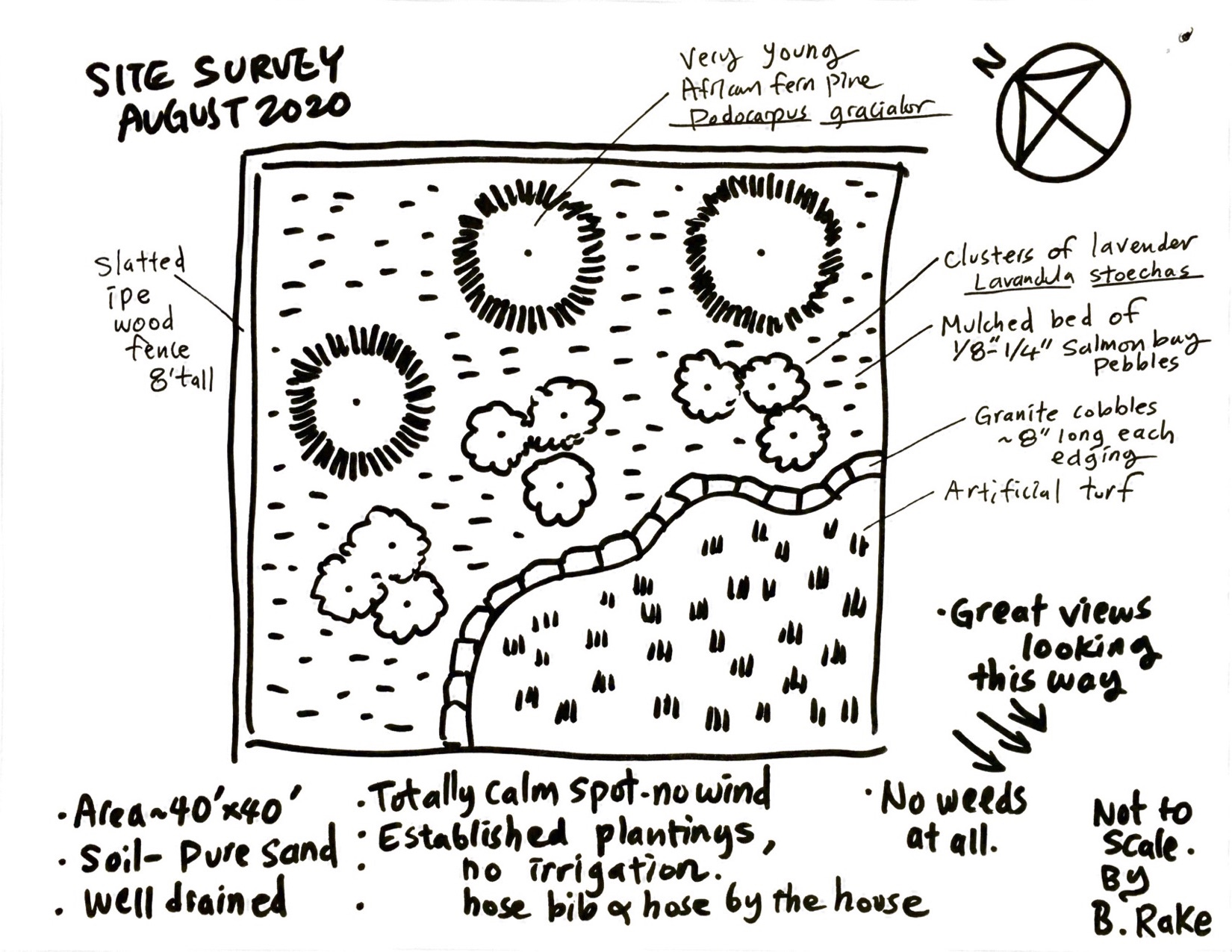
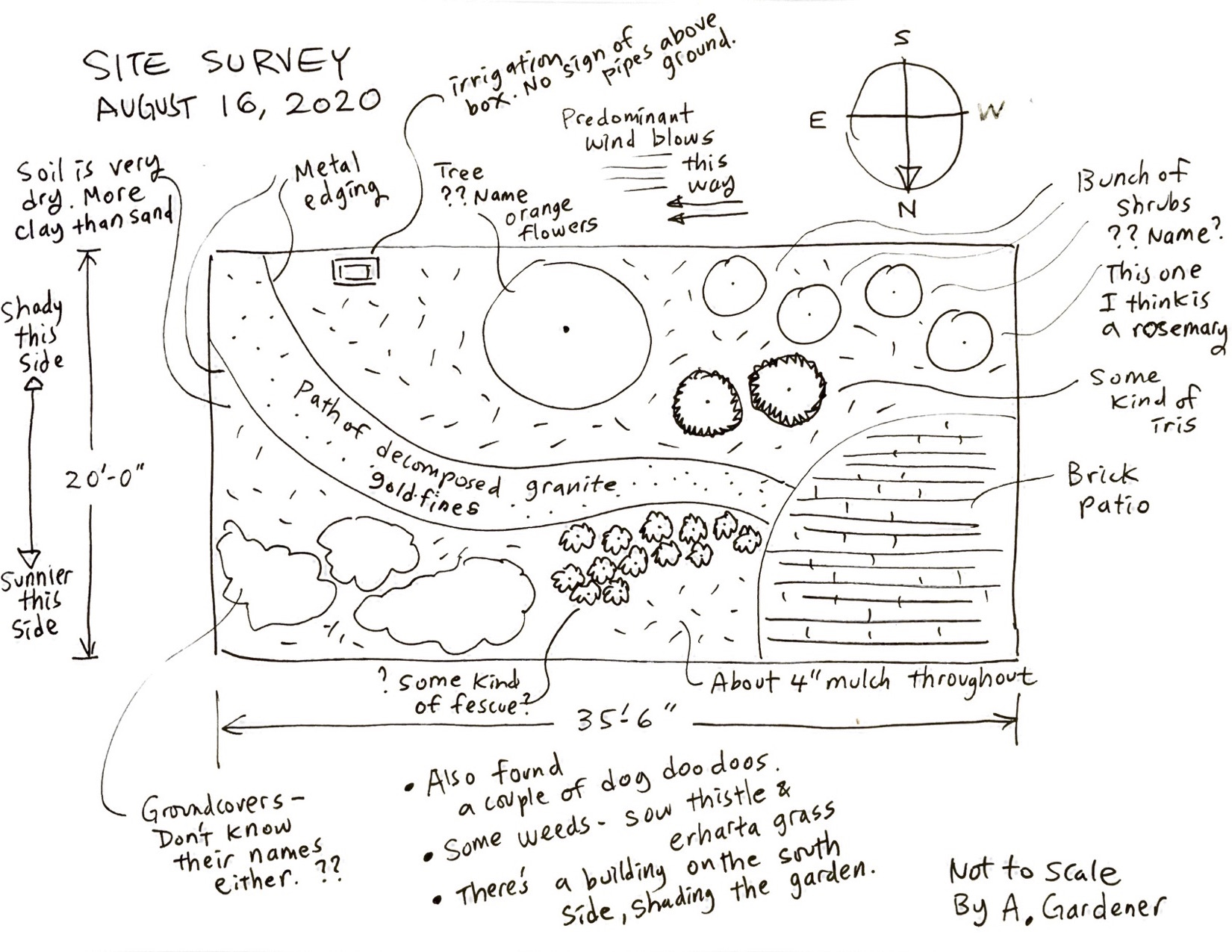
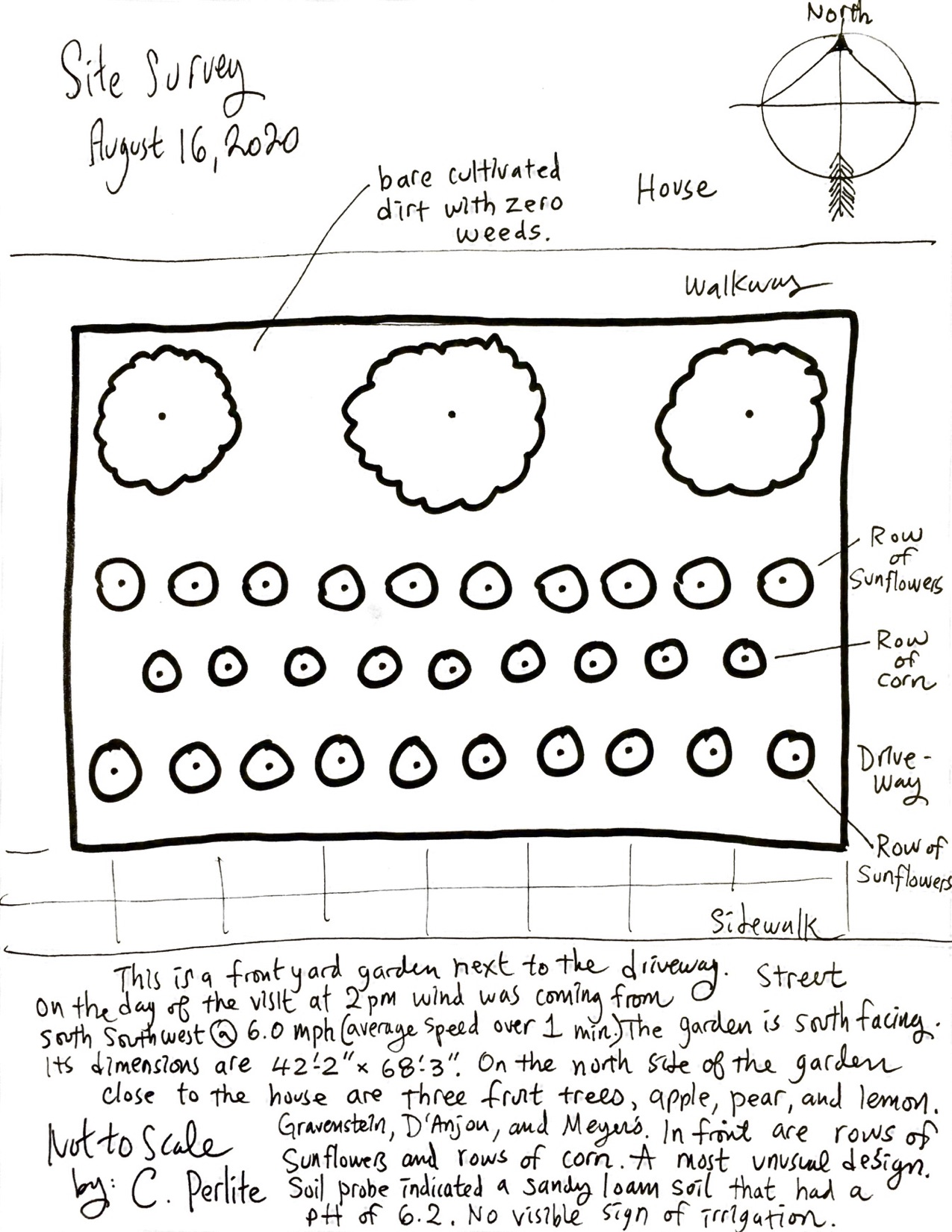
Well that is a lot to digest for a first time designer.  It will all come together with practice and time.  Be aware, observant, and attuned to the world and it gets easier.  People will be like wow you got skills and you will be like just look!   The signs are everywhere!  For now your site survey drawing may look something like this:

b


or this:

A4


or this:

c


Hey!  This is not a presentation drawing.  This is an initial site survey, like when you meet a new friend and jot some information down.  It is a casual exercise.  It can get messy with notes!  If it is well spaced out and somewhat organized that is good.  You may not see everything the first time around.  Go back again.  Take some pictures.  Get to know it.  Takes time…