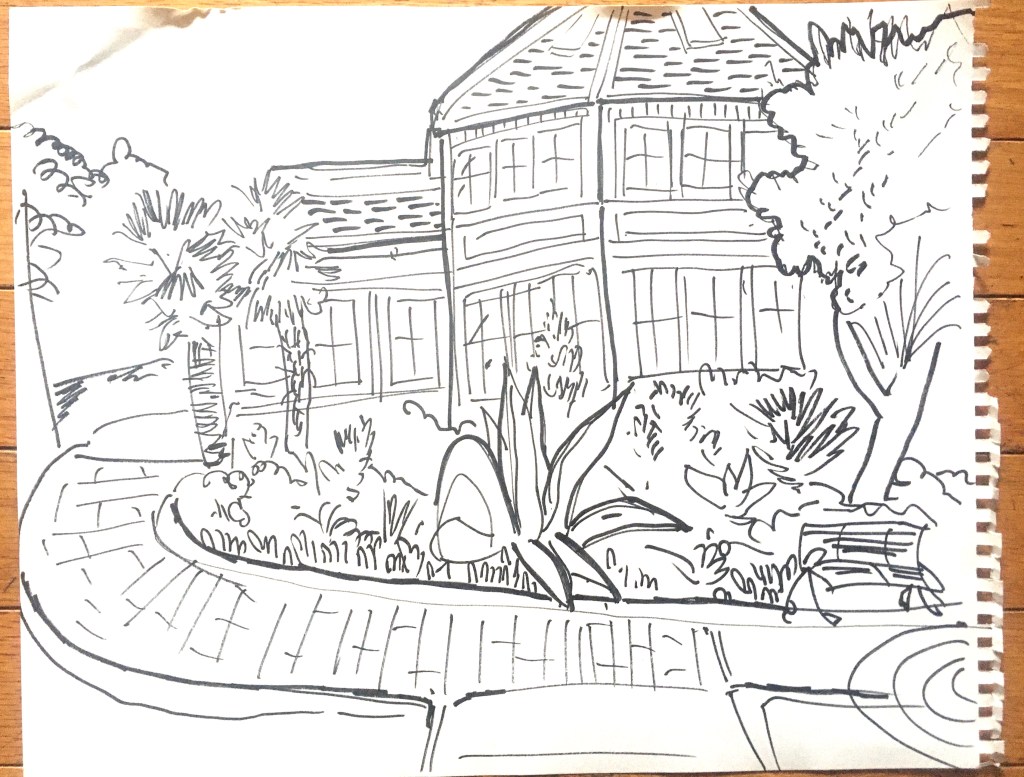
We had a nice draw freehand style draw at the Sunnyside Conservatory
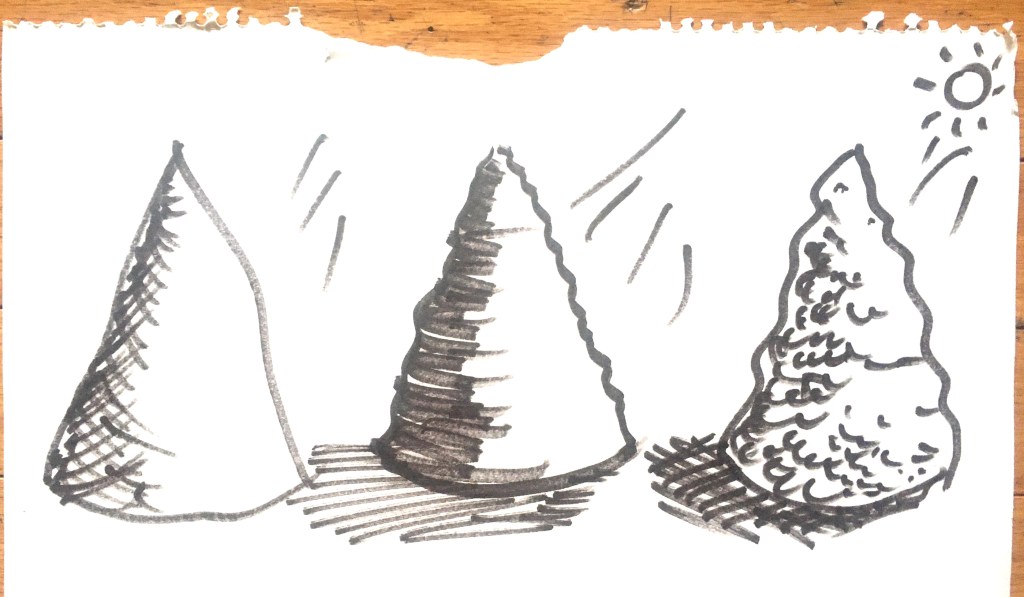
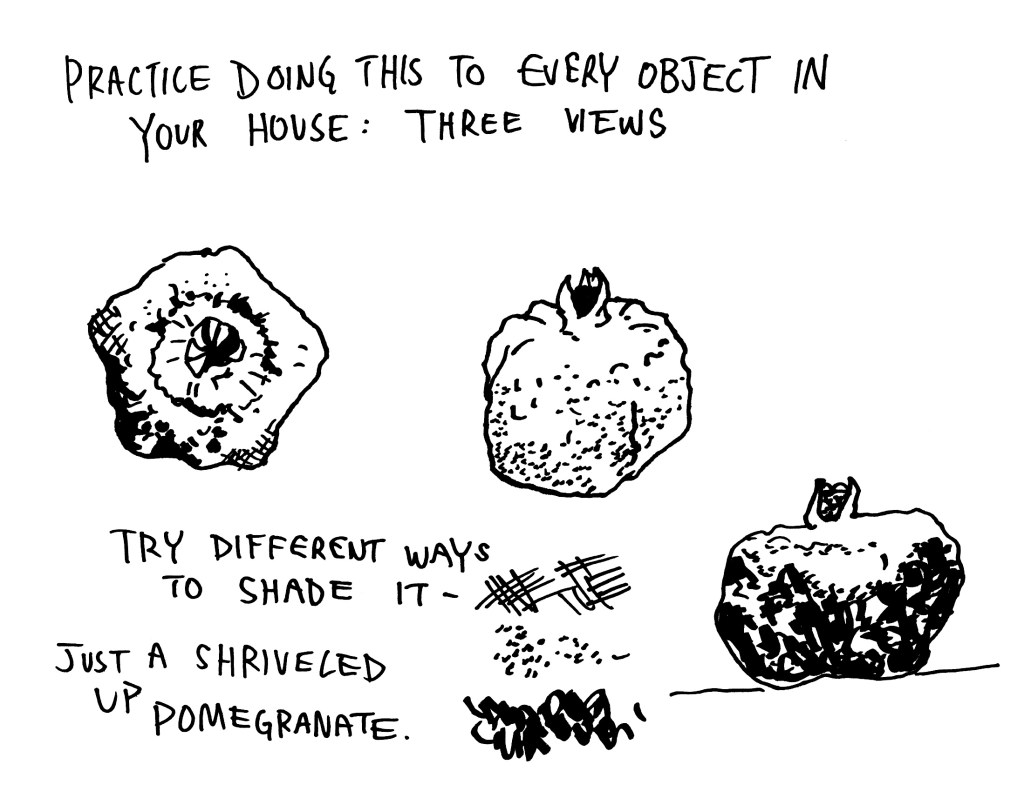
talked about different ways to shade a tree
and how freehand requires a loose throw it all out there approach
in contrast to the more accurate but rigid to-scale type drawings
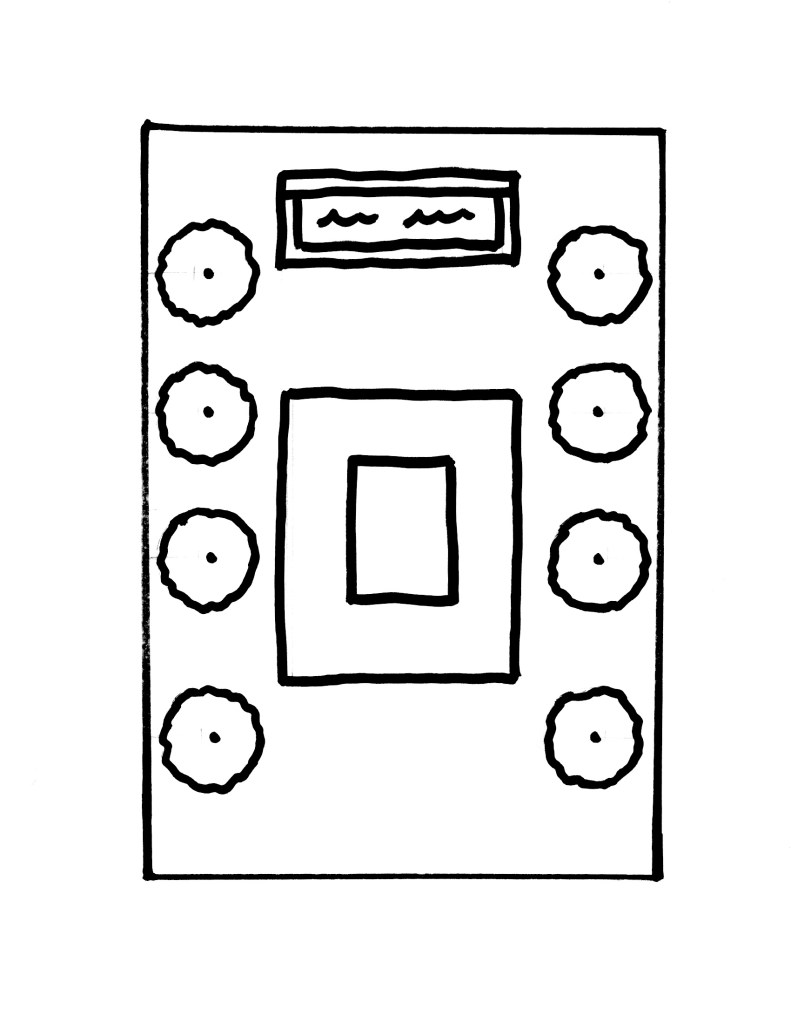
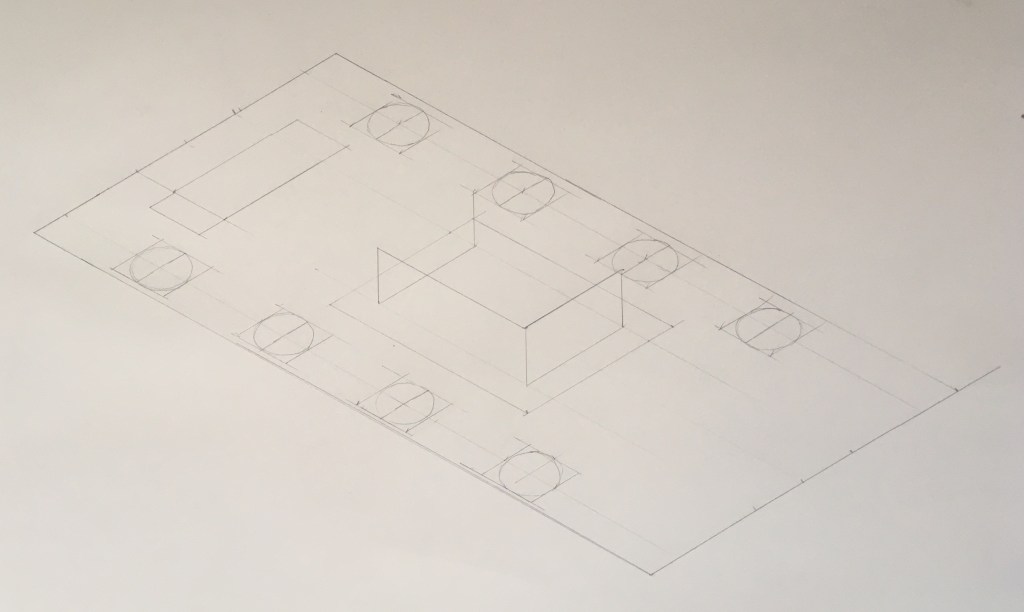
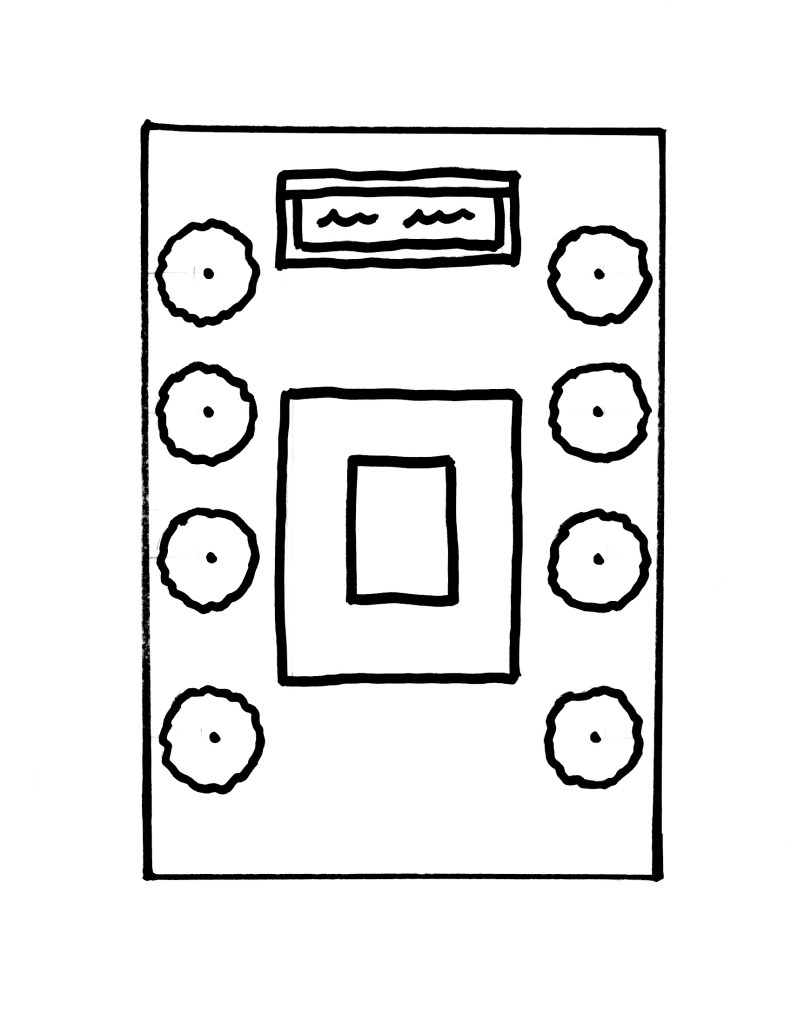
Lets take the basic plan we had from our one point perspective
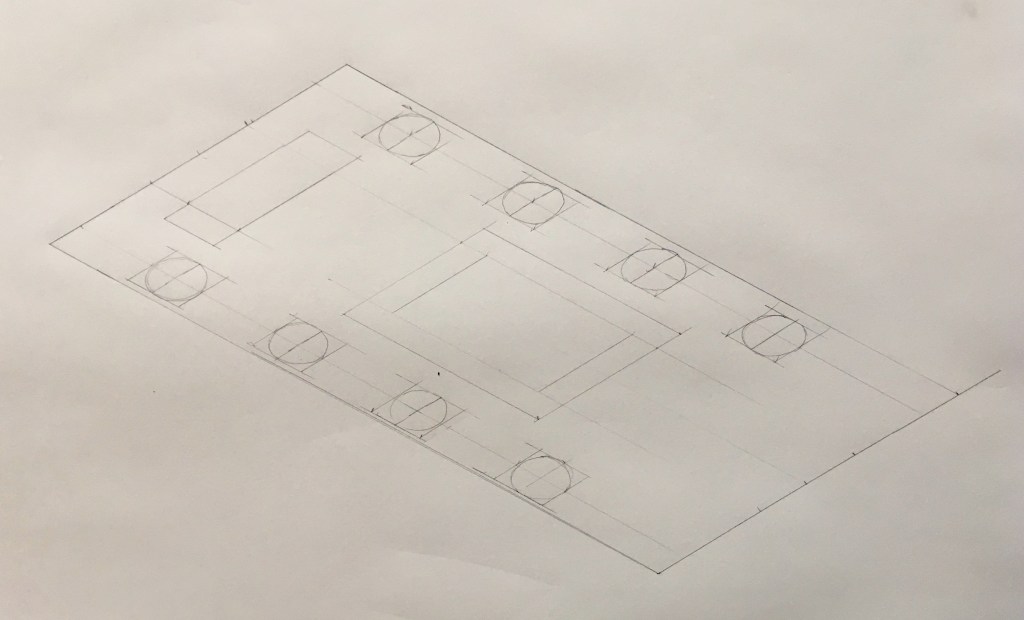
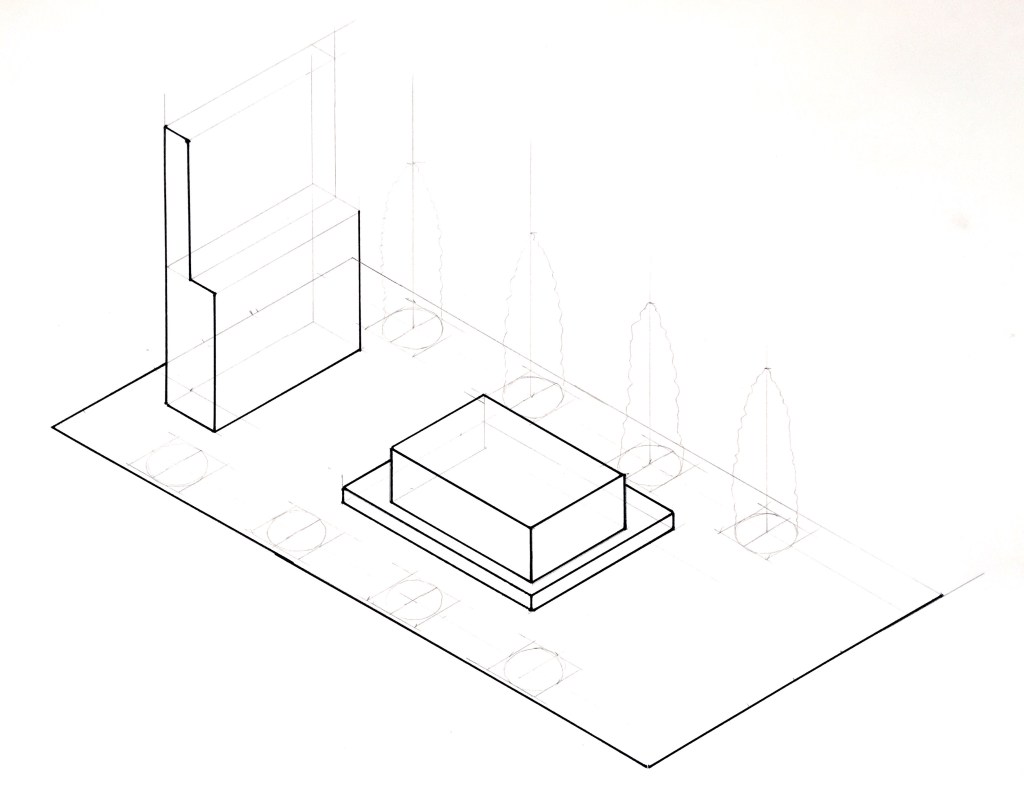
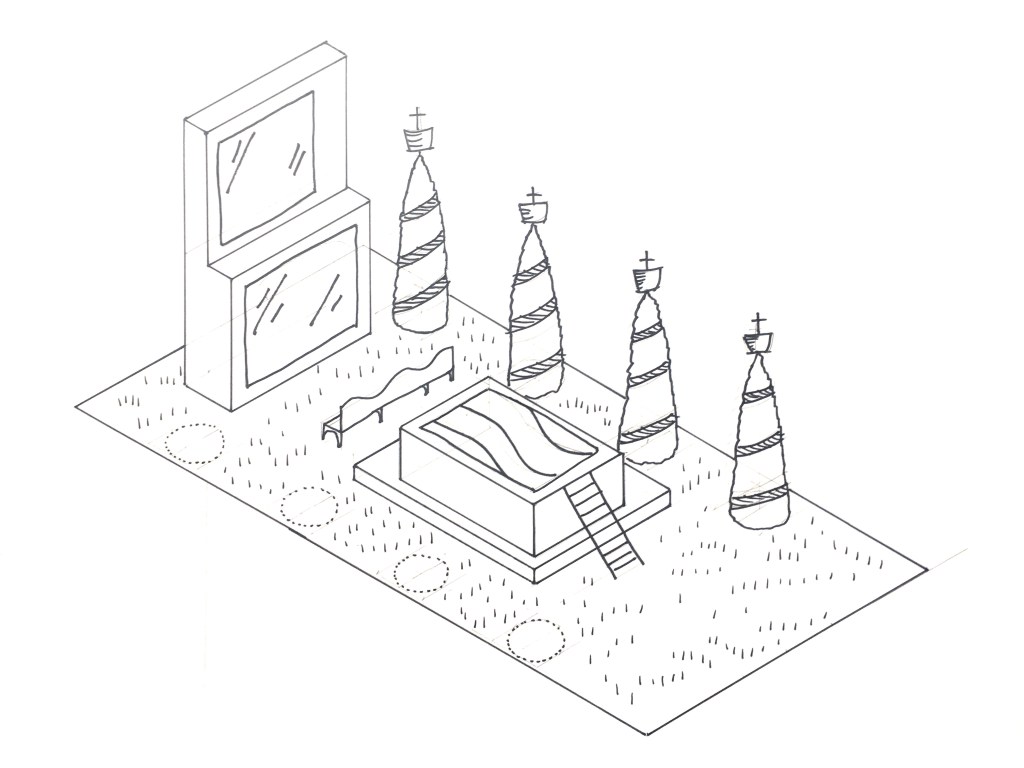
and develop it into an isometric drawing
where that nice 90 degree angle is now 120 degrees
and much of the drawing is done with the help of the 30-60-90 triangle
it is all to scale – so that is pretty easy
but to be fair – it is not really a perspective
in the sense that things far away are small, and things close up are big
still, it does convey the three dimensional imagery,
and helps the viewer to understand what you are visualizing
for the outdoor space
Remember to use the 30 degree angles!!!
And measure correctly! Start with pencil…
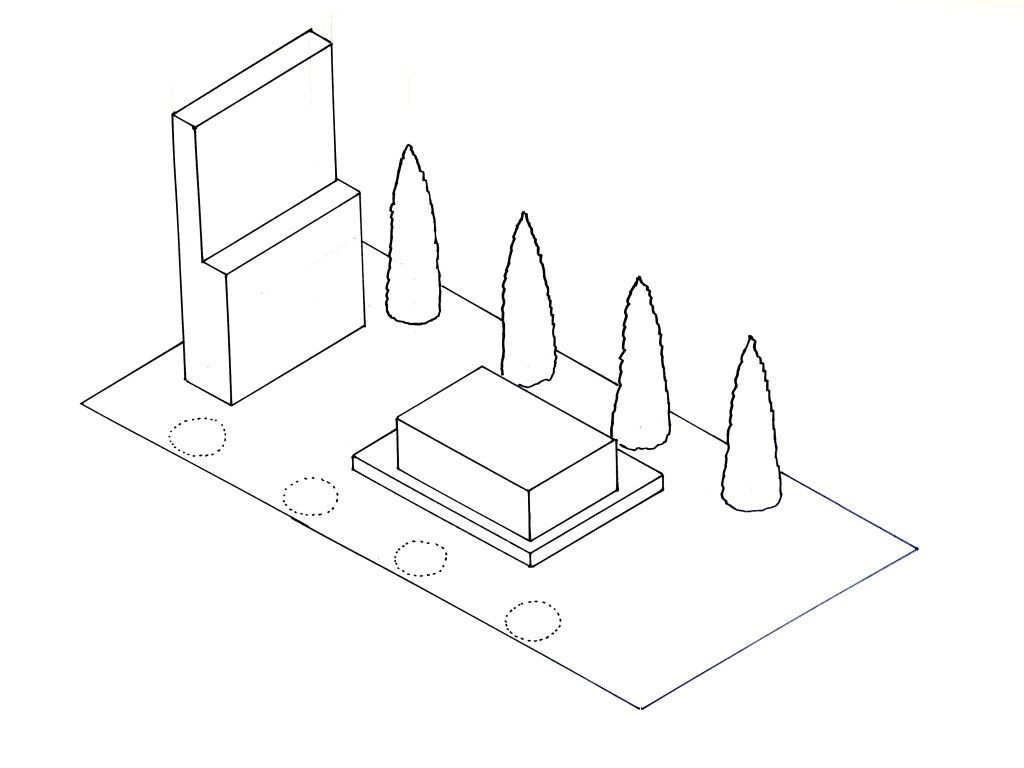
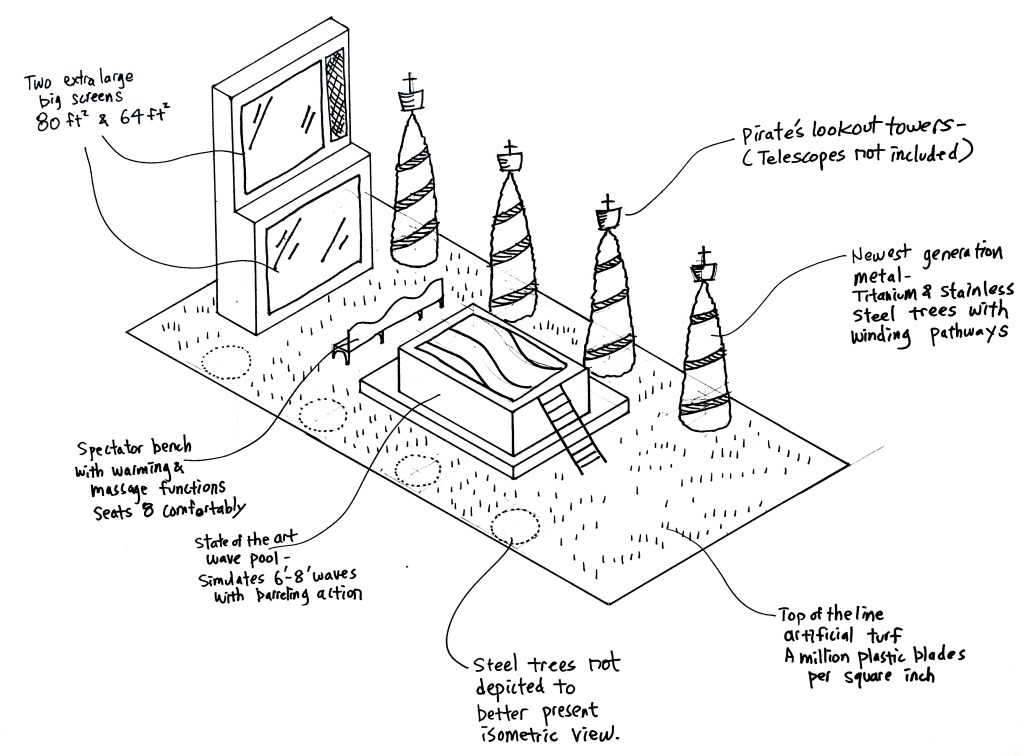
Okay that about does it! So instead of a rectangular patio in the middle, thought it would fun to pop it up into some kinda structure. And the thing in the back of the garden, not sure what that is either?! Practicing the basics of an isometric drawing – YES! Good planning? – Maybe not… But I got my Italian cypress trees ready to screen the neighbors! Lets go to ink.
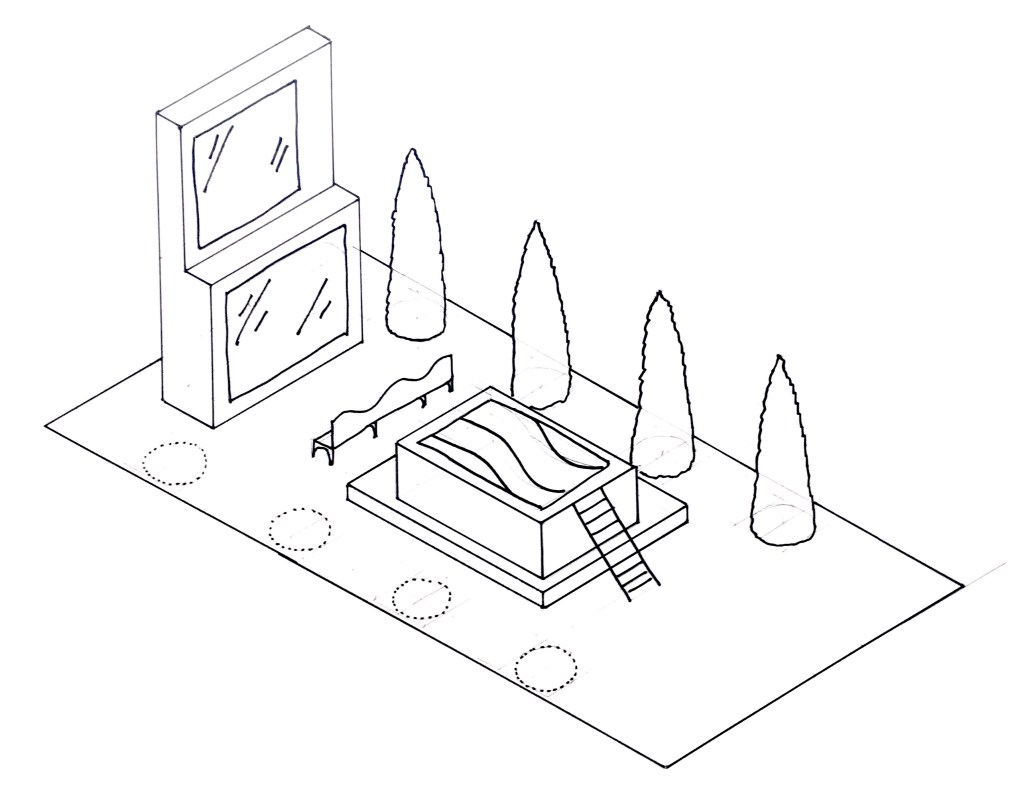
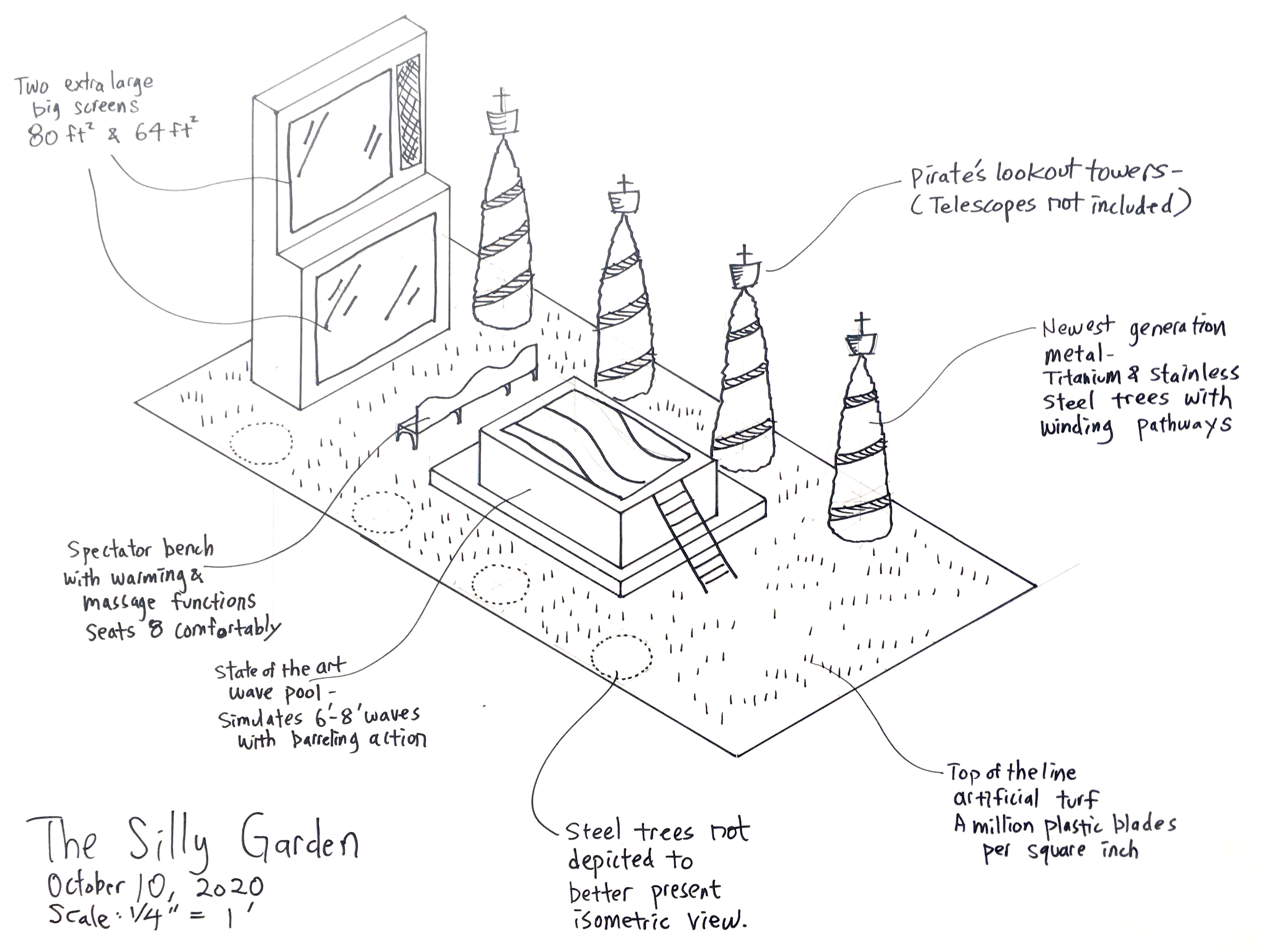
Now wait a second. What are you doing?! What is this strange mess of a garden?!? Stop this nonsense! Go back! Go back!
Are you serious at all!? Who would want to have such a place in their backyard? Well, at least you get the idea – an isometric drawing. Now it is your turn. Let’s go!!!
So frame your picture first. The edge of the paper is the frame. But when you are outside framing, stay focussed. Do not get distracted by the blurriness at the periphery, stay in the frame.
By the way, all drawings here are done in thick black marker or thin black pen for easy visibility and contrast. In your drawings use the black pen for final, and pencil for the guidelines or converging lines so that you can erase them later.
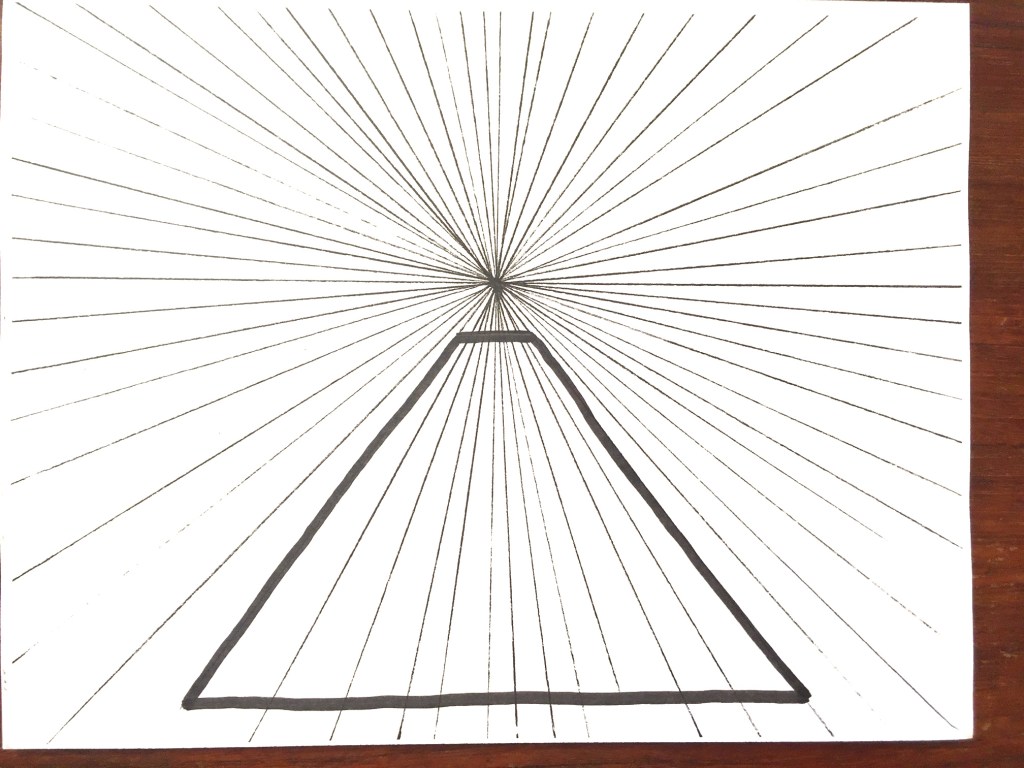
Then you figure that in the distance is the horizon. Somewhere way out there is a flat line. You looking straight at it.
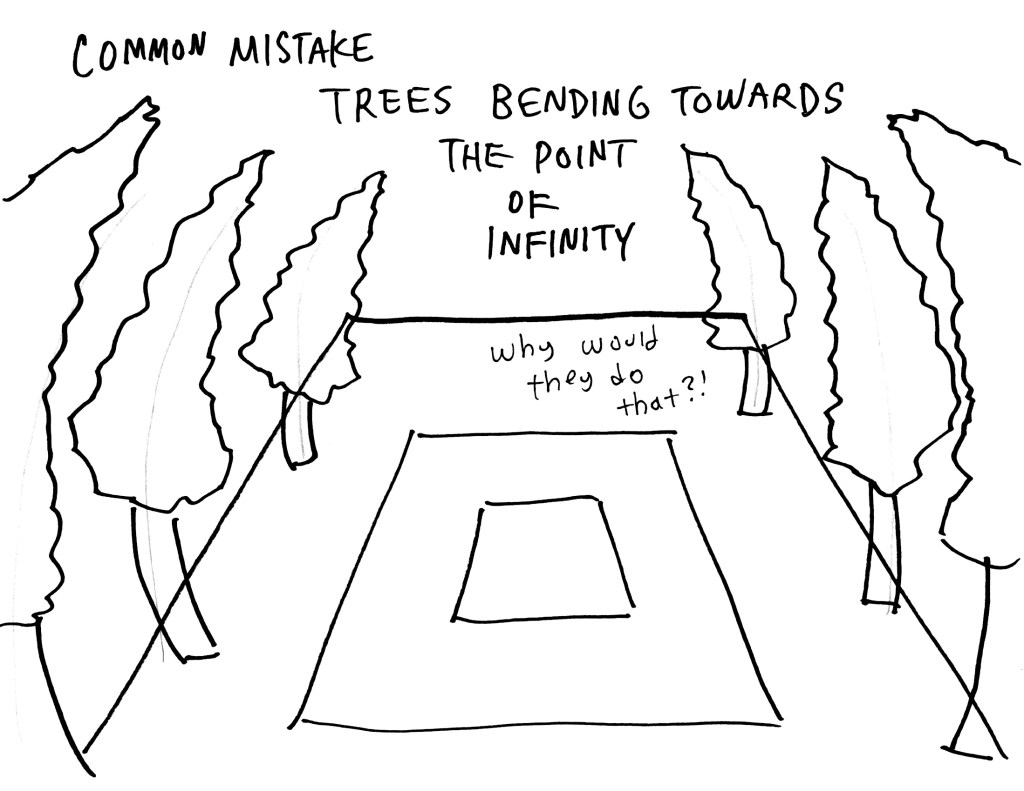
On that horizon, set your sight on one point. The point of infinity so to speak. Stay on that point. It is way out there. All lines are going to converge at the point far far away.
Now draw in all the lines that are converging. You can be exact and draw every line five degrees apart. Or you can be a little sloppy like I was.
Now we are going to draw in our rectangular backyard. You are looking from your house out the back. Depending on how you draw it, the yard is going to be narrow and long, or wide and short, or something in between. You’ll be standing way inside it, or a little outside of the yard.
Let’s move that point of infinity a little higher, a little above the horizon line, and see what happens. Maybe a better angle?
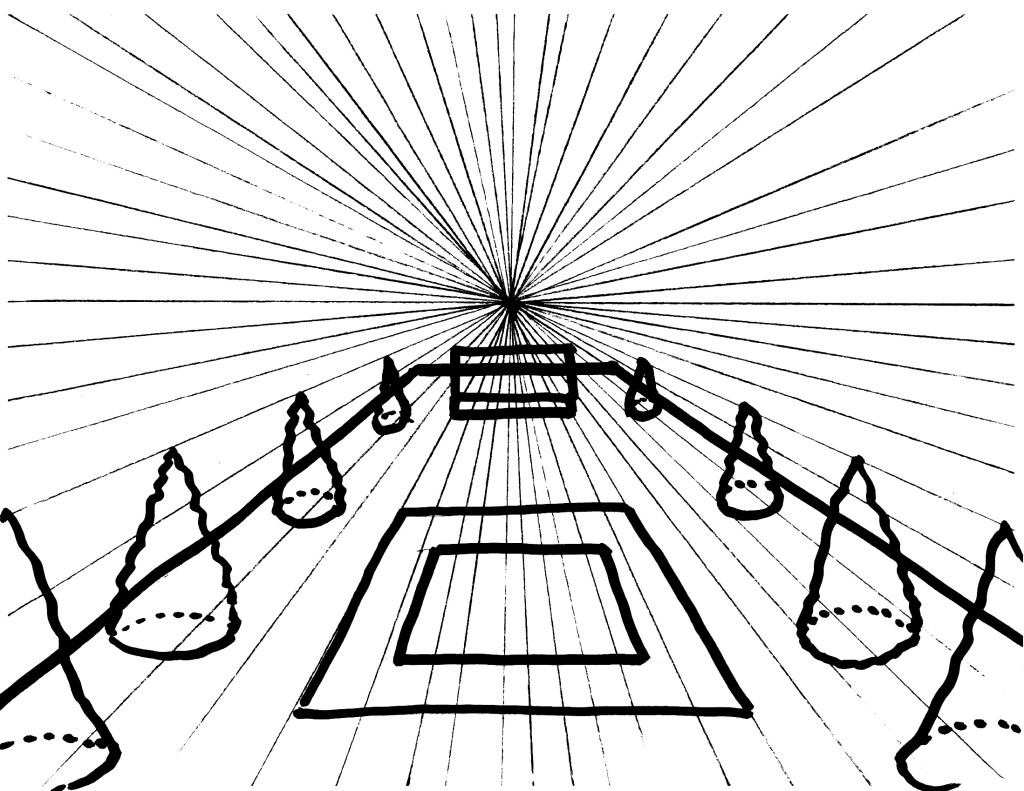
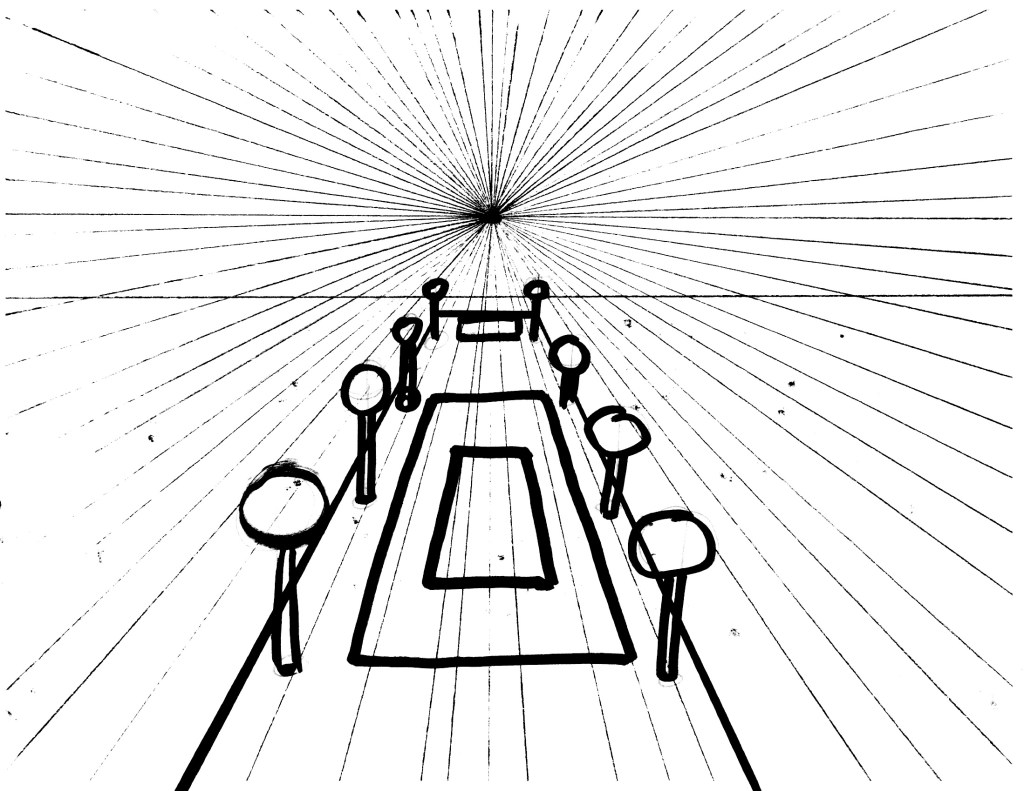
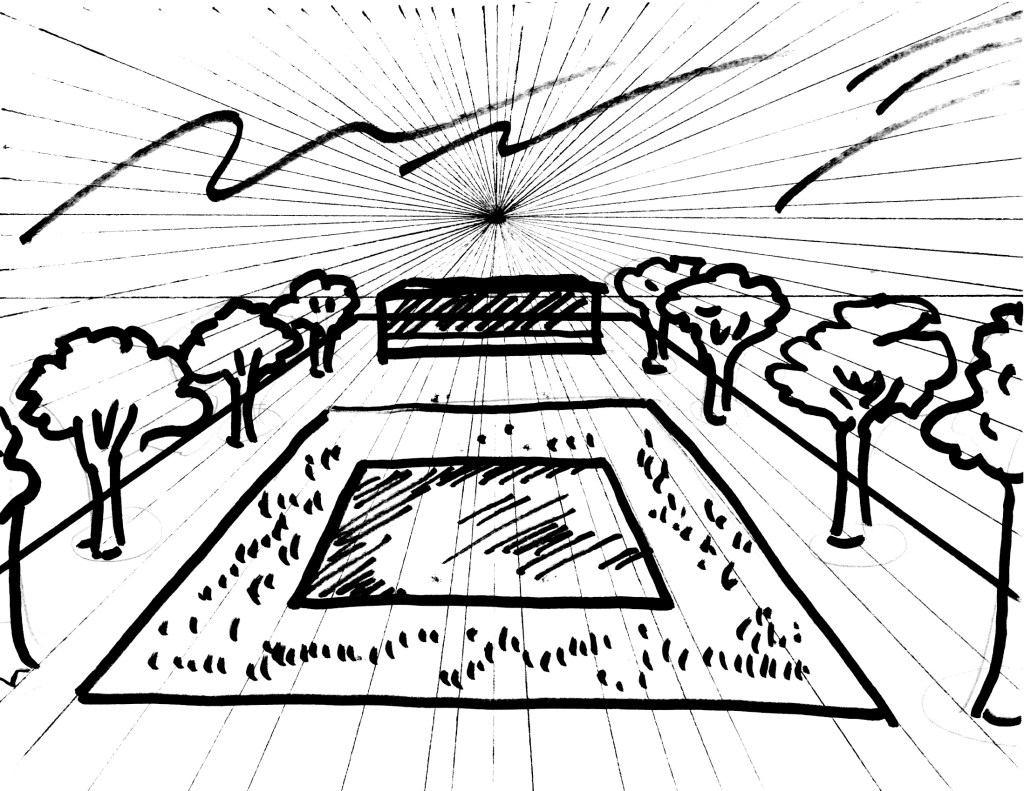
Okay, lets draw a yard full of things using these lines and the point. First time out so lets draw a generic plan that is symmetrical geometric and sorta formal. We will all draw from the same plan view. What is it? I’m not sure. A couple rows of trees. A couple of square things in the middle, and maybe a water wall fountain or a cow watering trough in the back? You have artistic and designer liberty.
Lets give it a few tries. First one a little lopsided and awkward… But arent we all?
That was horrible! Well I did see a little bit of improvement. Some shading. Feeling some comfort. Alright try again! Another set!
What was that!? Palm trees? And what’s that triangular texture in the middle square? I don’t know… little pyramids? Just playing with textures and designs. Take it easy! Sketches only! Now go practice your perspectives, everywhere!
Words and concepts to know, in order of appearance: Invertebrates; ecto and endothermic; ptera; beneficial insects; butterfly host plants; parthenogenesis; integrated pest management; proper pest identification.
This for me is one of the best chapters. The chapter is well written, so I will simply add a few details and stories. We could go on for infinite pages with regards to the study of bugs. A more broad term that covers all of the creatures in this chapter is invertebrates – creatures without backbones. This includes the insects, the arthropods with the hard shell and jointed legs like spiders centipedes and pill bugs, as well as the slimy things like snails and slugs. That would actually be a better title for this chapter – Invertebrates.
In the olden times we were taught cold blooded and warm blooded. The warm blooded was all the good cute noble animals like dogs and people and lions. Whereas the cold blooded was the creepy snakes and salamanders and bugs and stinky fishes. So if a person behaved in a real clandestine non emotional and despicable manner, we would call them ‘cold blooded’. We associate this trait with the ‘lower’ animals called reptilians and crawly things.
The whole idea is that warm blooded creatures can regulate their own body temperature so that it is above the ambient outside temperature; it is 50 degrees outside but your internal temperature is around 98 degrees. Whereas cold blooded creatures are dependent on the sun to heat things up and get them moving. When it is cold they just sit still. They crave the heat. That is why we find the rattlesnake sun bathing on the asphalt roadway, and the blue belly lizard doing pushups on the rocks.
Well nature is of course a bit more complicated than our boxy dichotomies. Tunas and white sharks have heat exchangers that make them warmer than the surrounding water and so they are extra speedy. That is good for chasing down anchovies and salmon and leaping out of the water in pursuit of seals. Bumble bees can also buzz themselves warm on a cold morning so that they can go harvest nectar for their babies, grasshoppers warm up their throats before singing. If you are a snake or a turtle that lives in the tropics, it is likely that you are warm blooded all year round, cause it is hot outside. The more proper terms we use these days for creatures with regards to regulating their metabolism and temperature is ecto and endo thermic, poikilotherm and homeotherm.
There are so many bugs in the world that we will make some generalizations as we discuss their structures and characteristics. Know that there are numerous exceptions as well as millions of bugs we have not yet named and probably know very little about. To start with, the names of the insect orders is indicative of their wings. ptera meaning wing in ancient Greek.
So Coleo ptera (the beetles) means sheath wing. Many have a cool shield of a pair of harder wings on top we call elytra, with the clear membranous flying wings below. If you have ever held a lady bird beetle and watched it open the upper flaps and fly away then you know what I am talking about. Like a car with doors that open up ‘scissor’ or ‘butterfly’ style.
Lepido ptera (butterflies and moths) means scale wing. If you have caught a butterfly and had it leave little pieces of its wing scales on you that is the ticket. Scales that rub and flake off.
Di ptera is the flies. Di is two winged so they have two wings, one pair. But actually they do have four wings, but two are reduced to a funny weird structure that resembles a pair of dumbbells or small clubs called halteres. Used for balance. They fly with amazing agility so that when you are about to swat them they angle away super fast. Well, all those eyes help too.
Hymeno ptera is membrane wing. In this group are the bees and wasps with four wings, all membranous but often with hooks that clip them together for extra flight control. In this group are also ants, which most of the time do not have wings except for when they are breeding, swarming, and dispersing.
Hemi ptera is half wing. For the most part the hemipterans have half a wing looking solid, the other half looking membranous. The backs of them have a distinct criss cross X. If you have bedbugs I am sorry, they are a Hemipteran parasite that feeds with a pierce and suck stylet of a beak of a mouth part. A little confusing is that there is a group tucked within the Hemiptera called the Homoptera. Homo ptera meaning same wing. They used to be their own Order but are now subsumed within the half wings. This is a huge group full of plant feeders that you as a gardener will get to know well as time passes. And not in a good way.
Silver fish and firebrats are the order Thysanura. Thysan ura is tassel tail. For those funny looking appendages that stick out at the tail end. Every I am sitting at the computer writing they always scurry across my paper notes and I get distracted to squash them.
And so on with regards to names and ancient Greek and Latin… A little bit more local color:
Scary looking bugs that you want around the garden: One is the devil’s coach horse beetle you often come across in the compost pile. They are really scary looking and your first reaction will probably be ‘kill it’. But they are ’good’ in that they feed on baby slugs. So let them be. Another one is the larvae of the syrphid fly that loves to eat aphids. Aphids are not your friends in the garden, the larvae of the syrphid fly is your friend. Again, just cause something looks like a sluggy wormy inching-along-thing does not make it ‘bad’. Lastly check out the larvae of the lady bug beetle. Yes we know the ladybugs are good, but its juvenile stages are good as well. But they look nothing like the adult, and some people even call them ugly. All the bugs in the garden that help the gardener with their duties we call beneficials. They are the ones we inadvertently kill if we spray a broad spectrum non selective insecticide.
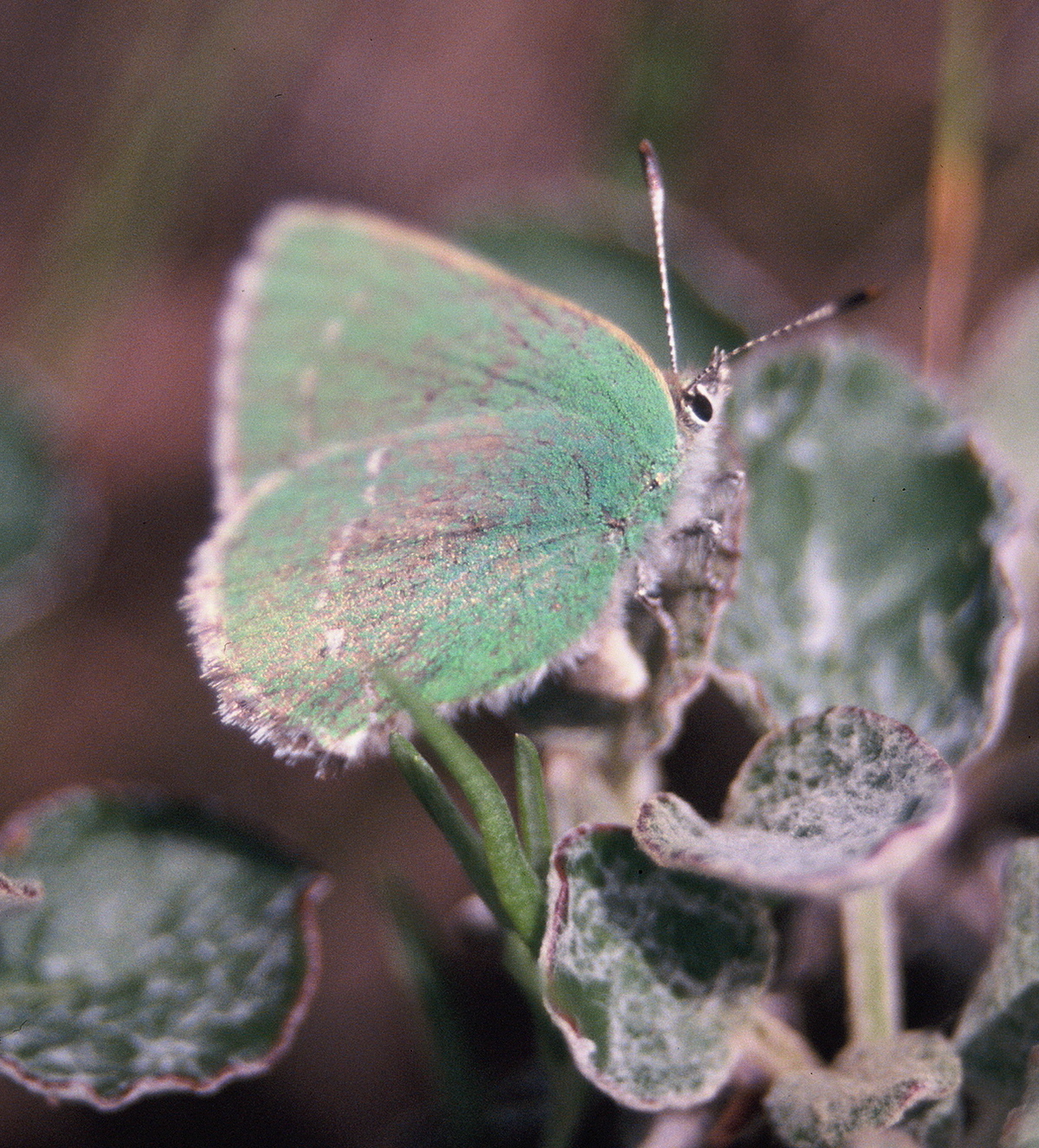
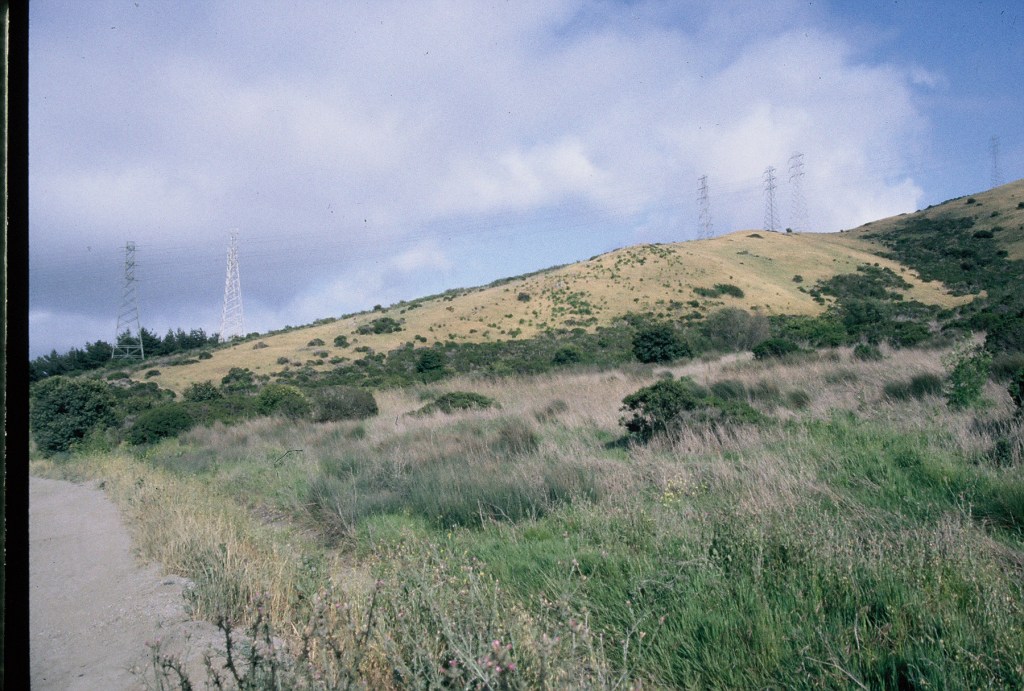
Bugs that saved an entire ecosystem: A little south of San Francisco is a large and wild park called San Bruno Mountain State and County Park. It is pretty nondescript and most of the time it looks like a dried out hunk o rock smack in the way of a bustling and hustling urban metropolis we call the Bay Area. Most people have driven by it thousands of times as they cruise on highway 101 up and down the peninsula without ever wanting to go up there. At one point at the base of the mountain was the dump where all the garbage went. At another point folks who owned it wanted to scalp off the whole top of the mountain to use the rock as fill – to fill in the bay for development and real estate. These days it is protected thanks to the efforts of local peoples like David Schooley and also because of the endangered species like the San Bruno Elfin butterfly and the Mission Blue butterfly who make their home there. Both butterflies have specific host plants the caterpillars feed on in order to complete their life cycle. The Elfin larvae eat stonecrop Sedum, and the Mission Blue larvae eat lupines Lupinus.
If you have never been to this park it is worth a walkabout to the summit or any of its trails. Hopefully on a clear day with no fog so that you can see the surrounding areas from a high ground. It is a neat reminder of how things have looked for the past three five or maybe even ten thousand years. It is the oldest part of the tip of this peninsula that remains relatively unchanged. Not paved, not built on, not dredged, not dug up. Just still plants, rocks, bugs, and some animals. Same as it always ever was. Back in the day fellow from UC Davis Dr Ward recorded about thirty species of ants from the mountain. 30 species! In the city, probably just the one species of ant – the little black ant that comes a wandering in your house, the argentine ant.
Bugs with noteworthy reproductive habits: There are numerous kinds of aphids – little round soft bodied bugs that suck plant juices. As they feed they often act as vectors for plant diseases. They are known for this trait called parthenogenesis whereby they reproduce asexually at an extremely rapid rate. Did you read the stat from the book? 1,560,000,000,000,000,000,000,000 aphids per female for the April to October season. All clones of the mother. Except that the mom makes both male as well as female clones of herself. One heptillion, 560 hexillion. Nuts. Parthenogenesis is also used by some bees, flies, ants…So you either find a mate or go at it alone. Total dominance.
Bug control: Like we have discussed all along. Integrated Pest Management is the key. The first step is always proper identification of the pest, as well as the host plant it is feeding on. Then, you can start to monitor regularly, and consider your options to keep the pests’ population levels under control.
‘We also base wise plant choice on the prevalent diseases in an area and the susceptibility of the plant to that disease. Growth rate and spacing is another consideration. As is diversity and ecology as relates to birds, butterflies, amphibians, reptiles and the like.”
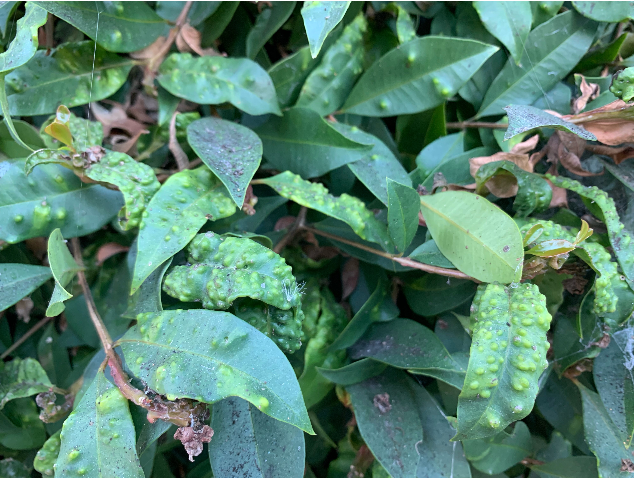
Prevalent disease: Sometime around the 1950’s and 60’s there was an ornamental hedge plant named Eugenia that was planted extensively throughout California. It was a plant in the myrtle family from Australia that had white flowers and pink edible fruits. It took shearing well and grew to be a large shrub to a tree. Real pretty thing. Then a bug named psyllid, aka the jumping plant lice, took a liking to the Eugenia and went around sucking on its plant juices. In the process the Eugenia leaves became malformed and distorted with little bumps and pits. Plus the sugary excrement (frass) of the psyllid on the leaves would bring in the sooty mold fungus. The plant turned into a sick yucky mess. For a while people would use chemicals to treat the plant and kill the bugs, but that got expensive real quick. And some of those toxic chemicals got banned. In the end, many landscapers decided to just chop em down. These days, you can buy psyllid resistant Eugenias, and who knows? They might make a come back in popularity. One more thing – botanists working on this group determined that it actually belonged with the genus Syzygium, so that is where it is now. So old time gardeners will call it Eugenia. Smart up to date kids will call it Syzigium. Same plant though.
Another plant that has gone through a similar trajectory is the Fuchsia plant. Thirty forty years ago they were all the rage. For sure somebody you know had a hanging basket of them. In the 1980’s a mite made its way here and began feeding on the Fuchsias. The leaves became all mangled and distorted and lost their value as an ornamental. Like the Eugenia, chemical and biological control work, but at some point you are like ‘at what cost’? Since then, for the past twenty years or so, we have continued planting fuchsias – the ones that are resistant to the mite, not the old fashioned ones. This has been a concerted effort by breeders who do not want to see the abandonment of such a great plant with fantastic flowers.
The latest plant victim of insect feeding and destruction is the Myoporum laetum tree from New Zealand. Myoporum is a common street tree and sometimes hedge that was adaptable, somewhat drought resistant, and tolerant of town pollution. It served for many years in this capacity. Then about ten years back, it got a bug called thrips. Same sad story of curled stunted and gnarled leaves. A couple of insecticides seem to work okay – the bacterial based Spinosad and the systemic poison known as Imidacloprid. With imidacloprid the dilemma is – how much is that plant worth to you? If using the pesticide causes further harm to local honey bees, is it still worth it?
As a designer you would want to know these things. The nurseries are often helpful with advice about disease resistant plants, as are groups of gardeners who meet and discuss such issues regularly such as the San Francisco Professional Gardeners Association. If you make plant choices and decisions solely based on color and texture and online mags and what they say on the internet then it is likely that you will miss out on local conditions and essential field knowledge.
Growth rate and spacing: Some plants grow fast, others slow. Here, Buddleja butterfly bush is fast, Lavatera is fast, fragrant Daphne and its close relative Dirca are slow. If you place a fast grower next to slow growers, all too soon the speedy one will be towering over the others, casting shade, pushing their roots outa the way, making their life miserable. Ideally you plan for this and give everybody enough room, and make a note to the homeowner to prune regularly.
This here is a row of four or so butterfly bushes at a local park. Back five seven years ago, they looked neat and orderly on a landscape plan. Now, having grown woody and tall quickly, they have ‘taken over’…
The whole thing with spacing is so tricky to nail down. On the one hand you want the garden to grow in relatively quickly, so that your plan manifests itself and the clients are pleased. On the other hand you wish the plants would stop growing at some point and stay in that perfect and mature and precise size and form forever. (When is that, by the way?) Of course the plants do not listen to you as they have their own agendas. So really just do you best on this criteria, and be careful of how many fast growing woody plants you draw in your design.
What are they, what are their plant names? The woody fast growers I got to be careful with? Sigh. I’ll make a list another day. But recognize that nothing is a sure thing in the garden – even if we are talking about the same exact clone of a plant, its growth rate will vary and be dependent on the site’s soil, water, light, wind and air, nutrients, microclimate, etc etc etc. I could give you a list, but better and more specific than a list is you, gardening in your neighborhood, and figuring it out with all of your gardener friends.
Diversity and ecology: Making a garden along these lines is difficult for many people to enjoy visually because it sometimes runs contrary to a garden being clean and neat and not bug ridden. I include this design criteria because some gardens are deliberate ‘butterfly gardens’ or ‘habitat gardens’ or ‘endangered species habitat’. If you go into the designing of native plant restoration sites then it is extra important to know what you are getting into, and what would define success.
In general, I too like the wide open vistas and prefer them over shaded woods. Must be some kind of an ancestral instinct of hunting on the plains and feeling safe. As a gardener, I also appreciate the feeling of weeding a plot of land, or pruning plants so that they are separated distinctly, not all jumbled continuously into one another. When I go to see a fancy private garden like Butchart Gardens in British Columbia, I am impressed that there is one gardener per acre keeping the whole place meticulous and neat, not a weed outa place.
That said, there is another feeling altogether when you are in a mega rich and diverse place, filled with a cornucopia and abundance of life. There is a blurry messiness, right at that edge where people insist on it being clean and sharp.
A diverse place showcases strong, independent and yet connected, life. Strong and independent in that human management is not totally necessary to maintain order. Humans are contributors, but not the main design element that is ‘in charge’. The place and the beings are connected in that they are feeding on one another, but there also exists layers and layers of cooperation and even, dare I say it, harmony. Harmony not in the sense that hunger and death do not exist, but in the sense that they are part of the scene. Stuff turning brown, fruits dropping messy seeds, logs decaying, worms, birds scratching through the weedy ground covers. In a garden aiming for diversity, these are not aspects of the garden to hide and sweep under the rug and ‘make disappear’ and cover up. Such a nature place hums in an altogether different manner. So as a gardener trying to mimic this ‘style’, you have to explore such places and figure out how they tick together.
The old growth amazon jungle is one such wonderland. A few details I remember are the colors of hundreds of butterflies of dozens of species landing on our sweaty backpacks as we lay them down for a rest. Like in those indoor butterfly exhibits times 10,000. It is nuts, like a sky full of flittering glowing wings. All descending for a few drops of sweaty salts and minerals. In designing a garden of complexity, leave some food for the butterflies and the bees and the birds too. Or plant some food for them. Check.
Or the number of trees of varying kinds in the wet humid jungle, that was pretty crazy. That is what they are always talking about with the old growth rainforests right? The sheer number and types of trees – somewhere in the range of three hundred different species of trees per acre. But when you are there walking through the shaded trails, you are tree blind and they all look the same. You dont know a single one of them, so they all look the same. A stick going up. Bunch of sticks. What my friend Mr Kutches calls dog hairs and pecker wood. Just a puzzle of green with all these liana vines stretching to the canopies. So ignorance confers comfort in a way – easy to lump stuff and put it in a corner of your mind. Dismiss it, forget about it. But then you never get to see or to know or to understand. Some kind of profound poverty of the senses if you have in all your life never talked to and befriended the common earthly denizen known as a tree. The lesson: get to know every tree. Check.
Diverse places are rare these days, as a result many or most people have not experienced them or lived with them. If anything probably fear them. We have been actively pushing them away, further and further away from human consciousness. Therefore, I will describe another example of diversity and ecology to try to get you a ticket on the train. Talking about fishin’.
You take your kid fishing to a trout farm. Pay an entry fee. Its a pond filled with trout, all the same species, all more or less the same size. You know you are going to catch something, like 100% sure. You hook up and are super happy. You then weigh the fish and pay for the fish. They even gut it for you. Go home and eat it. Its pretty fun. But not that diverse. Like buying all your plants at a big box store from a nursery that makes billions of cans of the same plants from cuttings. Plants are naturally beautiful so plants are not the problem. Its the sameness of the patterns that is not an element of the ‘wild’ garden.
Next time, you go fishing to one of these human made reservoirs that are stocked with catfish and trout. Again, pay a day use fee, a parking fee, a boat launch fee for that rubber dingy kayak thing. You are floating around the reservoir, the reservoir that has a clean edge with no vegetation, except for a tiny clump of tule reeds on the southern edge. A big bowl of a reservoir that was carved out of the hills without much up down contours and elevation underwater, or in out in out shorelines, just a big round bowl that you can see all the way across. Not much underwater structures for fish to congregate around, few hiding places for schools of little bait fish. The water is trapped, impounded, and hardly moves. Basically the place is a good water source for people, but not much happening if you are a fish trying to raise a family. So you fish and fish and fish, some people are catching em, but not many. They say you gotta come on the day when the hatchery truck comes and be right there. Then for sure you are going to catch a fish. Oh, thats how it is? You are a little frustrated, thinking that you could have spent all that money just buying some filets at the grocery store. There was no feeling of inspired transcendence or unity with nature – just another failed transaction. And got a sunburn besides. Reflecting back on the design of the garden of ‘abundance’, the lesson is to accentuate the jagged outlines and serrate lobed crenate edges and highs and lows, and to gain comfort with that aesthetic – for the sake of all the creatures who would make it their home. If you garden is based on a weed whipped straight edge once every two weeks, or weed free flower beds mulched and sprayed once a month, its gonna be a clean, but quiet garden. The hospital operating room and the military barracks are clean. An old peoples’s home or the library are usually quiet. A diverse garden is really really loud with the sounds of cicadas and frogs and tweety birds and grasshopper strums and mushrooms sneezing spores. A diverse garden is a little bit messy cause theres things living and dying and living and dying and everybody is always eating leftovers.
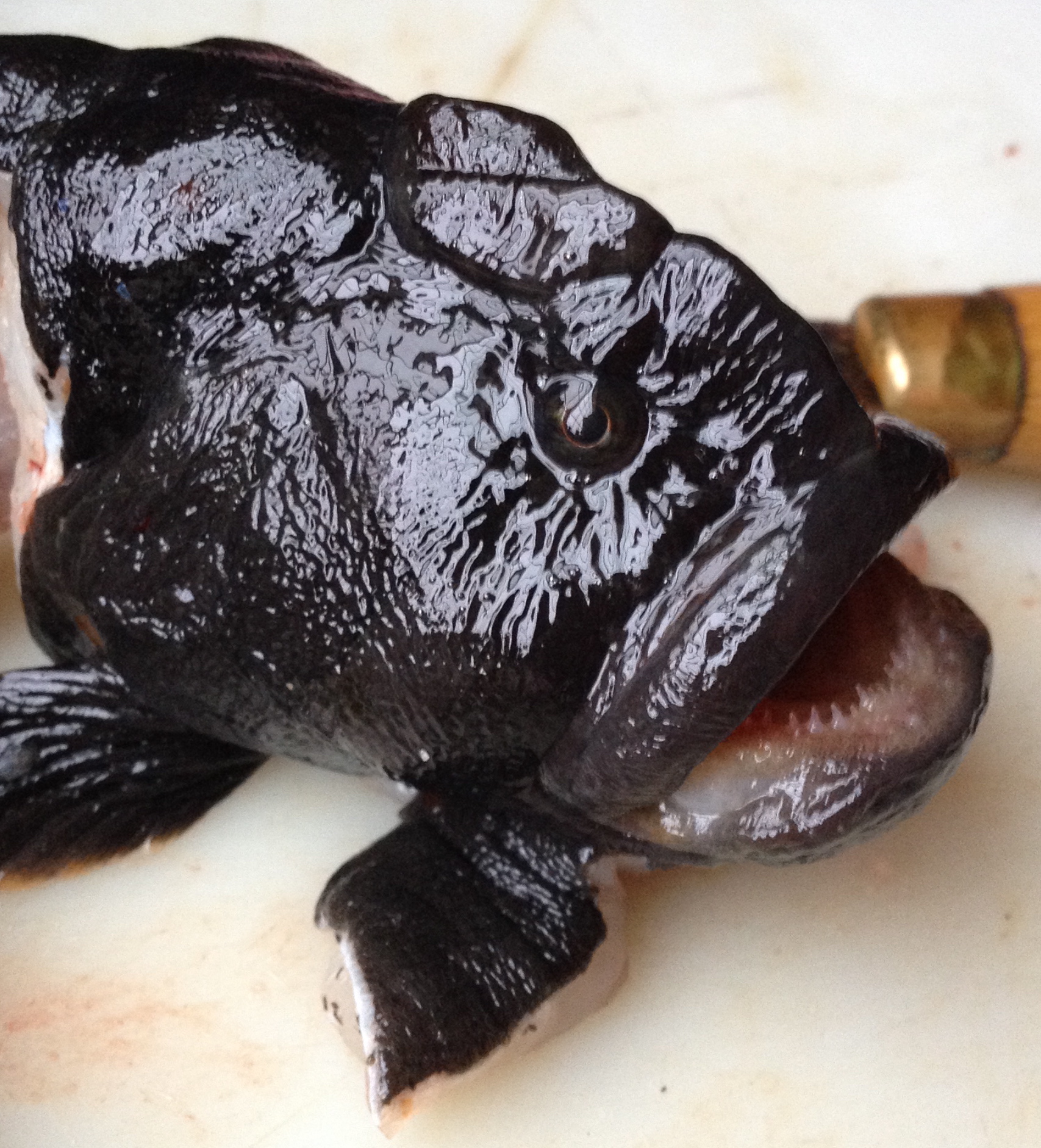
You still want to go fishing. A friend says I will take you and your kid to Three Mile Reef or Hopkins landing or the submarine canyon. You are really scared of the open ocean but you agree to go because you want to experience a place that drops you to your knees. A place that overwhelms you with awe and totally wrecks you out of the dream of ultimate control and dominance. And you want to catch a fish. The friend says be ready at 4 am. With great reluctance and trepidation you agree, and tell your kid to go to sleep early, no more videos and senseless fingering. Tomorrow is the day. Then morning is here and it is still dark when you push off the sandy beach in a boat and make your way out past the two to three foot waves into the depths of the blue sea. Your friend explains. For one, there is a variety of substrates – sand mud rock gravel shale… Two, there is up down shelves and sea mounts and canyons and shoals and bars and caves and trenches and ridges… Three, there are plants named eelgrass and macrocystis kelp and ulva sea lettuce… Then your friend starts going on about currents and temperatures and upwelling and swell and tides and invertebrates and plankton and you are like ‘Can you shut up already? I only care about the fishing!’. No sooner said then done, you are surprised by a whale breaching. Looking down into the water, you see millions of shining silver specks gliding by all headed north. And the rod bends, and its fish on! Your first fish is an alien looking sculpin. But with time, you meet sand dab and sole and halibut and blue rockfish and brown lingcod and spanish mackerel and coho salmon and on and on and on. Stop. What does this have to do with garden design? Well, it is the same thing in the garden, and we as people can play an active role in activating this love of the planet. It starts with the land and the plants and how we cultivate this relationship. Except on land, in the garden, instead of mussels and scallops and monkey face eels and albacore, we are talking about isopods and springtails and creeper birds and allen’s hummingbird and andrenid bees and red legged frogs and gopher snakes and everybody else. And your kid? Jabbering on in the boat, I almost forgot about the kids. They are why we are designing and growing a diverse and ecologically healthy garden. Because the process is fun, is challenging, is exciting and unpredictable. And in the words of the new generation, it is SICK!!!
By leaving logs as path liners and sculptures and erosion control, you will feed saprophytic pill bugs and beetles and turkeys tails and create a habitat for slender salamanders and millipedes. And on and on up the chain of beings.
By having selective groundcovers and self sowing annuals, either ones that you plant, or ones that come in on their own, you will provide food and shelter for creatures of all kinds. Nectar, pollen, seed, foliage, fibers for a nest – its all great stuff. A bunch of mulch all the time looks good for a shopping mall landscape, and that herbicide sure works wonders in the parking lot. But to play in tune with mother nature’s garden, you gotta emphasize the positive, not negative space.
Instead of deadheading and trimming everything, and treating the gardener as a custodian, leave the ripened seed pods and some brown leaves alone. Not only are they ingredients for someones dinner and home, they will enable you to start a seed company or seed exchange. Its that flow and interaction that is gonna make you as a garden designer really pop.
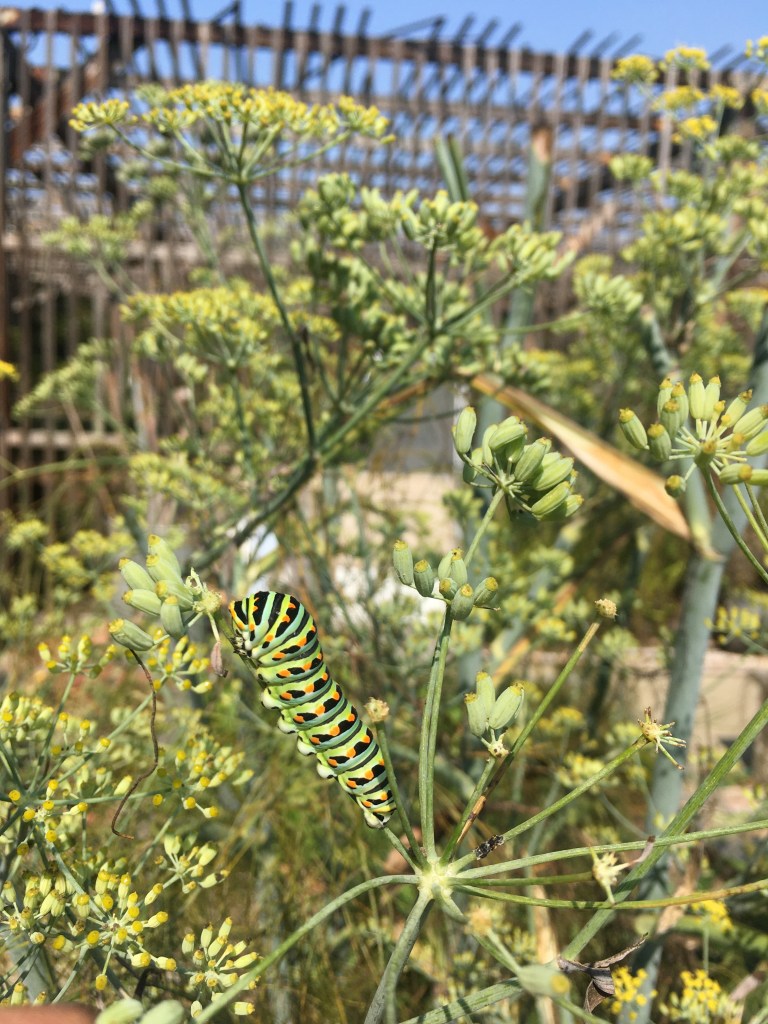
Find out what the host plants for local butterfly caterpillars are, and plant those species along with some nectar plants for the adults. And when the leaves of the host plants are all curled up and tented and full of holes, don’t reach for the bug spray. Let them be. Later, when you see the butterflies in the sky, lighting it up, you might go ‘hey theres my buddy!’. Ditto with encouraging the preferred habitats of damselflies, solitary bees, dragonflies, and so on. And the yellow jacket wasps streaming out of the ground – sorry, take em out.
All in all it is a balance. Some of y’all might think I am advocating for lazy gardeners who neglect their beats and call the weeds habitat. Or that I am anti-power tool anti-pesticide anti-human growth and anti-progress. Or that I am encouraging habitat and wildlife which to you means uncontrolled populations of rats and raccoons and pigeons and coyotes eating pets. No. The design principle here is that we want the kids to know our world as a magical and fantastic place. The garden is a great portal into that world. If you manicure it and sterilize it and try to deny all the joy that is a part of a garden, then the kids are going to miss out altogether. They will be thoroughly disconnected and find themselves in an ugly labyrinth of the mind. You gonna rob em of wonder and force them to live in a sad dull poor lonely miserable world of a garden and that is a no no no. Cannot. Let. That. Happen.
As a maintenance gardener there are some opportunities to do field propagation. If you understand the forces at work then you can keep plants alive and multiply them to make greater abundance. Plus it is a lot of fun.
Transplanting: Maybe the plant grew too big for its space, or it was planted in the shade and not the sun. Or, the new owner of the garden wants a brand new landscape. You are tasked with digging up the plant and either moving it or getting rid of it. You can do it.
Most plants will survive a move. Ideally you want to keep as much of the root as possible, and make sure the roots do not dry out once it is out of the ground. You will want to keep it out of the direct sun for a while ( a few days to a couple of months, depending on the time of the year). Cutting back some leaves (say 30-40-50-60% of the foliage) will keep water loss to a minimum and increase the survival rate.
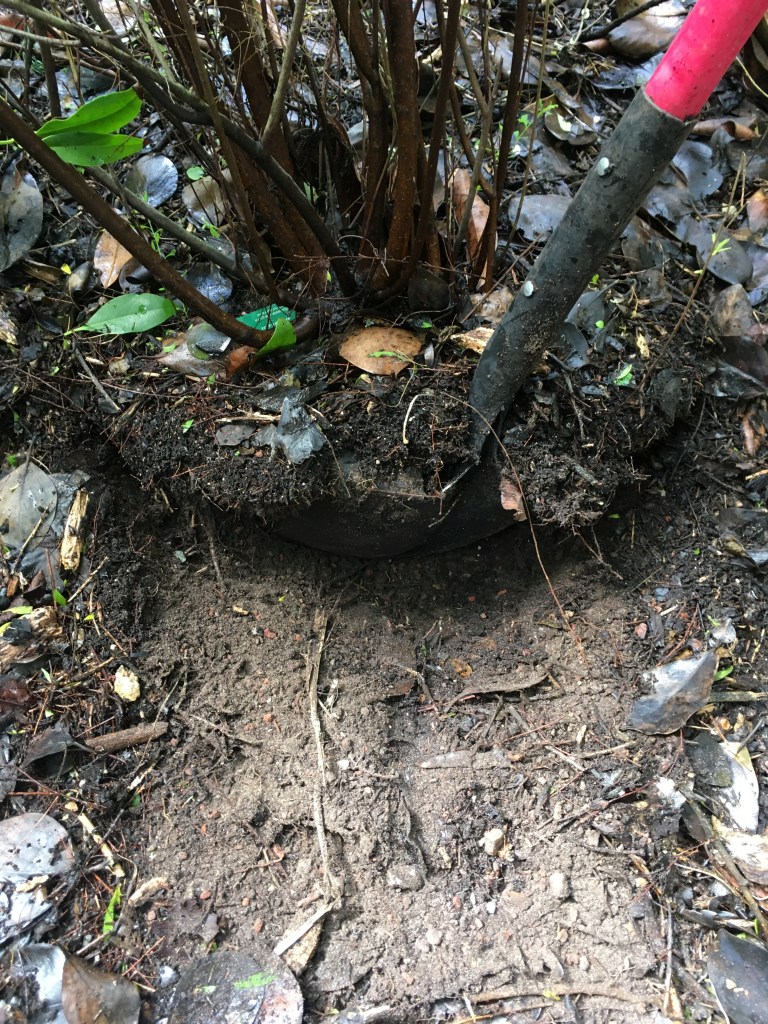
So use your round point shovel or spade and dig around the plant. The bigger the plant the wider you go. Go straight down, not slanted in, if possible. Get as much as the root as you can. All the way around. Go deep. At some point, rock it back and forth, pull it up and out. If it is still attached somewhere, cut that roots with your spade, with an old saw you don’t mind putting in the dirt, with an ax, or with a reciprocating saw. While you are digging and moving it, wear that eye protection. It is easy to approach in close and have a stray and itinerant little stick of the plant poke your eye out.
Put the plant in a tarp or big bucket to move it. Try not to get dirt everywhere. If the dirt is really too heavy then shake and bat some of it off. If you can plant it in the ground somewhere right away then do it! Unless that spot is in the hot hot sun with drying wind and hydrophobic soil. In that case you really should have waited until the rainy season to do the transplanting.
If you are not planting it, heel it in. This is laying the plant down with the roots in some wet soil in a shady semi shady spot. “I’m too busy to get to it right now, but the plant is okay for a bit like that, and I’ll deal with it as soon as I can.”
Then you can sell that magnolia tree or camellia bush to another client for 50 80 100 dollars. Eventually you are thinking about owning a small nursery…
Dividing: Many grasses or plants with grassy looking forms are candidates for easy propagation. The plants I am thinking of have names like Juncus, Hemerocallis, Festuca, Dietes, Aristea, Nerine. Dig them up. split em in sections using that old hand saw again. Plant them. Beware of too small sections that cant handle the process, that dry up and die. Be careful with some of the african rushes in the restios group because in the process of division they dont take it too well. They may die back further and take two three months to return to a semblance of normality rather than just keep trucking along.
Sowing and planting annuals: If you have a yard with bare dirt or open sands that is not mulched and weed clothed and filled with weeds then you may have a spring time flower show with annuals. Lightly cultivate with a hard rake (not a flex rake) in November or so, just after the first rain. Buy your pound or two of seed beforehand so you are ready to go. My favorites are Clarkia farewell to spring, Eschscholzia California poppy, Phacelia, lupines, and sunflowers Helianthus. Over sow to make sure the stuff pops come spring time. Sow and spread the seeds evenly as you press them into the soil with your shoes. Or cover lightly with available soils. If you are lucky, the plants like the spot, and drop their seeds. Pretty soon your hillside is all naturalized with wildflowers that persist year after year. The only things is… hope for rain. Pray for rain. Otherwise that 100 dollars you spent on seed is a bust. Well worth a try at least.
Making cuttings: Some of these tricks I learned on my own, others I picked up about twenty years ago watching my teacher General King Sip, park supervisor Andy Stone, and any number of kind and knowledgeable plant people who were happy to share.
Many succulents are easy to grow. Just take a piece and stick em in the ground. Especially true for aeoniums, crassulas, delosperma, and aloes. Ideally after cutting them, you would let them callus, sit around for a day, then plant them. But if you are sticking them into pure sand, and hold off the irrigation for a bit, that is the same idea. You just don’t want that rot to creep into the open cut of the stem.
One time they were rerouting the path in the garden and an angel’s trumpet tree brugmansia was in the way. And we did not want to lose the specimen and just junk it. So Andy cut some sticks of it and stuck em in the ground. Took off some leaves of it too, to cut down on the transpiration. This is on a north facing shaded and wet hillside that is pure sand. Sure enough, the cuttings took. Up higher, in a tiny bit more sun, beautiful ol lady Ora Walker had her bed of rose cuttings. Sounds like some fancy thing but it was just three short little wood boards with a the back of it a chain link fence. Filled with sand and little labels to indicate what plant was what. She would make five inch cuttings and stick them in the sands of Golden Gate Park. No leaves just sticks like a pencil. Sometime in the fall winter. Give them three four months, come back, pot em up! Super easy and fun too. Sand is pretty good as a cutting medium because it has large pores that are easy for roots to grow through and it drains well. That means rot is less likely.
Many plants may not be succulent succulents, but they have a woodyish stem that is juicy and chock full of nodes. Nodes which have the ability to send out roots quickly. If you happen to be hedging or cutting back Begonia fuchsioides, Impatiens sodenii, or Strobilanthes penstemonoides, then save those pieces. Take them home, put them in a vase with water. They will root easily sitting in water. Then you can plant them back out in another garden, and maybe even charge the client for the plants. If you do enough of this kind of thing, then you may be tempted to open a nursery…
I was transplanting some rhododendrons, Salvias, and Spiraeas the other day. Although they were irrigated often, the soil right below was dry dry dry bone dry. Right below meaning about 3 inches down. This is the kind of place where more compost and wetting agents would be helpful, as well as trying out different irrigation regimes and nozzles.























 Mission Azul